UBTech sells 1,079 full-size humanoids in 2025 as robot revenue rises 22-fold to RMB820.6 million
UBTech Robotics said in its 2025 annual results that revenue from full-size humanoid robots rose 2,203.7% to RMB820.6 million on 1,079 units, lifting group revenue 53.3% to RMB2.0 billion. The net loss narrowed to RMB789.8 million, while three share placings raised RMB5.78 billion to fund capacity for more than 6,000 robots a year.
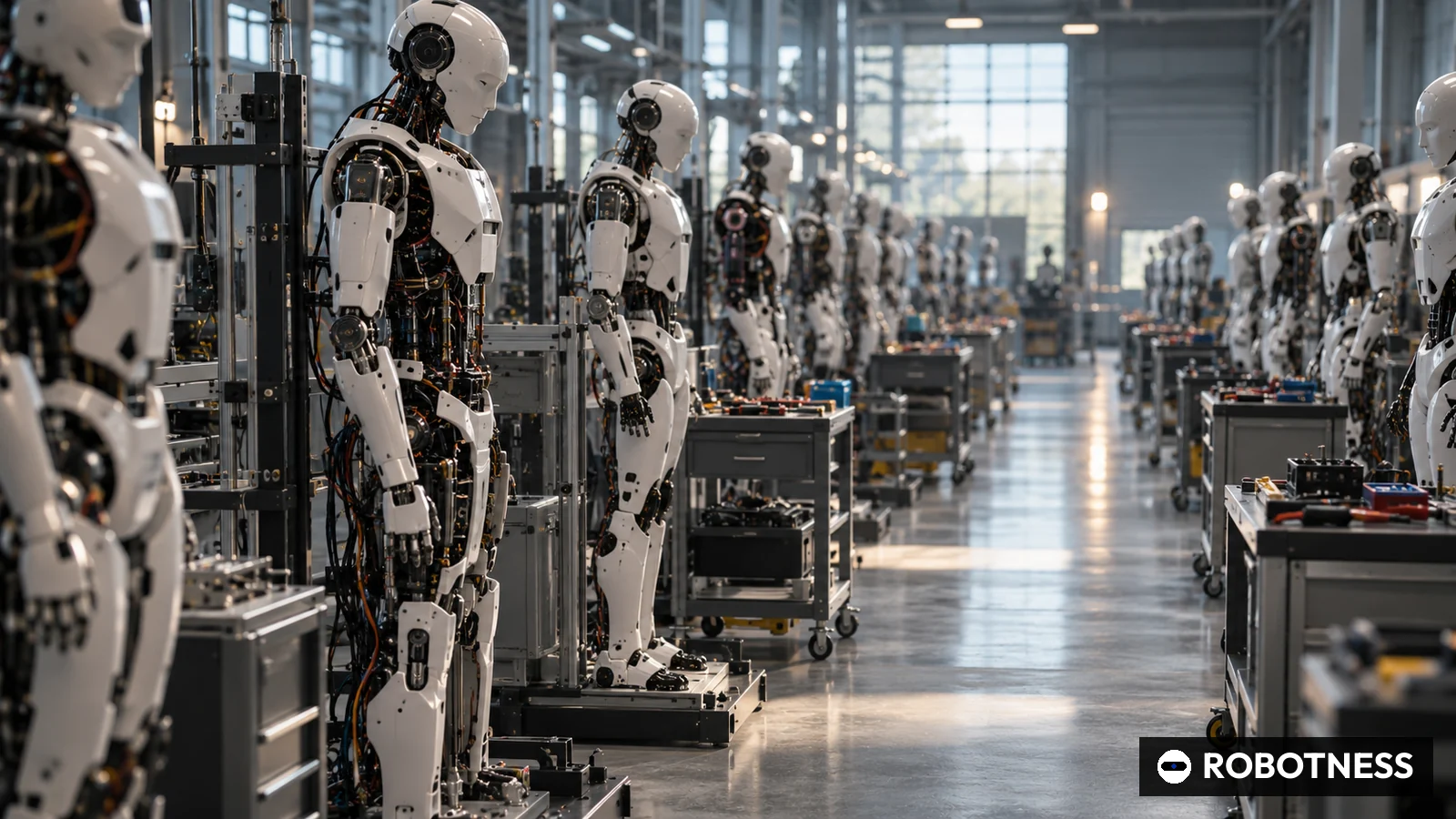
In 2024 UBTech Robotics booked RMB35.6 million from full-size humanoid robots. In 2025 the same line brought in RMB820.6 million from 1,079 machines, the Shenzhen company said in annual results filed with the Hong Kong stock exchange on 31 March 2026, and walking, two-armed robots overtook logistics robots and consumer hardware to become its largest revenue segment.
The filing matters beyond one company because full-year unit sales and revenue for humanoids, stated under exchange disclosure rules, are rare. Most of UBTech's rivals in China and the United States are private and report demonstrations, pilot sites and funding rounds rather than shipments. The 2025 accounts show what a year of real deliveries looks like, and also how much it cost to get there.
Revenue rose by half while the loss shrank by a third
Group revenue rose 53.3% to RMB2,001.0 million from RMB1,305.4 million, the company said. Gross margin widened by 9 percentage points to 37.7%, and gross profit roughly doubled to RMB753.8 million. The net loss narrowed to RMB789.8 million from RMB1,159.9 million, and the adjusted, non-IFRS loss fell to RMB690.5 million from RMB914.6 million. Basic loss per share was RMB1.55, against RMB2.67 a year earlier. The board recommended no dividend.
- Group revenue (RMB m)
- 2001
- 1305.4
- 53.3
- Full-size humanoid revenue (RMB m)
- 820.6
- 35.6
- 2,203.7
- Full-size humanoid units sold
- 1079
- No data
- 35,866.7
- Gross margin (%)
- 37.7
- 28.7
- No data
- Gross profit (RMB m)
- 753.8
- 374
- 101.6
- Net loss (RMB m)
- 789.8
- 1159.9
- -31.9
- Adjusted net loss, non-IFRS (RMB m)
- 690.5
- 914.6
- -24.5
- R&D expense (RMB m)
- 507.5
- 478.1
- 6.1
- Cash and cash equivalents, year-end (RMB m)
- 4887.9
- 1191
- No data
Source: UBTech annual results announcement filed with HKEX on 31 March 2026. Figures disclosed, not estimated. Change = 2025 / 2024 minus 1, except the unit change, which is the company's own figure. Units sold in 2024 were not stated as a number in the announcement.
As of Oct 1, 2026
Full-size humanoids produced 41.0% of group revenue, by ROBOTNESS calculation (RMB820.6 million divided by RMB2,001.0 million). Dividing that revenue by the 1,079 units sold gives an average of about RMB760,000 per robot, a figure that blends Walker S2 sales with other full-size models and any services booked in the segment. The smaller lines moved less. Non-embodied humanoids, UBTech's term for its compact, non-industrial humanoid products, sold 12,759 units for RMB48.0 million, up 15.3%. Other intelligent robots fell 16.9% to RMB628.7 million, which the company put down to project timing, and other hardware rose 6.4% to RMB499.2 million.
Walker S2 moved from field trials to a production line
UBTech said Walker S2 entered mass production and delivery during 2025, which it described as the shift from field trials to commercial use. The robot has a bionic torso with 52 degrees of freedom, carries loads of up to 15 kilograms and can swap its own battery in three minutes, allowing 24-hour operation, according to the filing. By the end of the year the company had annualised capacity for more than 6,000 full-size humanoids. It named automotive manufacturing, smart manufacturing and logistics as the main fields of deployment. The announcement named no customers and gave no figure for orders on hand.
Founded in 2012 and listed in Hong Kong in December 2023, UBTech had 2,550 full-time staff at the end of 2025, all but five of them in mainland China, and held 2,985 granted patents, 508 of them overseas. Research and development spending rose 6.1% to RMB507.5 million, which fell to 25.4% of revenue from 36.6%. The growth was paid for with equity. UBTech placed new H shares three times in 2025, at HK$90.00 in February, HK$82.00 in July and HK$98.80 in December, raising RMB5,779.9 million in total. Cash and cash equivalents stood at RMB4,887.9 million at year-end against RMB1,191.0 million a year earlier, while operating activities used RMB784.1 million. The balance sheet also carried RMB117.0 million in deposits for the purchase of shares in Zhejiang Fenglong Electric, the Shenzhen-listed company UBTech went on to control.
The battery swap is the commercial argument
A humanoid that stops to recharge for hours occupies a line position it cannot fill. UBTech's design lets Walker S2 walk to a station, exchange its own pack and return, so one robot can in principle cover consecutive shifts. Fifty-two degrees of freedom means 52 independently driven joints across legs, waist, arms and hands, each needing its own electric actuator, reducer and sensor. The joint count drives both what the robot can do and what it costs to build, which is why the revenue per unit matters as much as the unit count.
Rivals raise more and disclose less
- UBTech Robotics
- CN
- 2012
- Placing of new H shares
- No data
- 2777.4
- No data
- 2025-11-25
- Figure AI
- US
- No data
- Series C
- 1000
- No data
- 39
- 2025-09-16
- Skild AI
- US
- 2023
- Series C
- 1400
- No data
- 14
- 2026-01-14
- Apptronik
- US
- 2016
- Series A extension
- 520
- No data
- No data
- 2026-02-11
- LimX Dynamics
- CN
- No data
- Pre-IPO
- 200
- No data
- No data
- 2026-07-14
- Agility Robotics
- US
- 2015
- Series B
- 150
- No data
- No data
- 2022-04-22
ROBOTNESS database rows verified on primary pages, as of 1 October 2026. Figures disclosed, not estimated; null = not disclosed. UBTech raised RMB5,779.9 m across three placings in 2025 (RMB807.9 m, RMB2,194.6 m and RMB2,777.4 m), per its annual results.
As of Oct 1, 2026
Among Chinese peers, Unitree Robotics listed on Shanghai's STAR Market in August 2026, and AgiBot said in April 2026 that its 2025 revenue had passed RMB1 billion, ROBOTNESS reported at the time. LimX Dynamics raised US$200 million in a Series B in February 2026. In the United States, Figure AI raised US$1 billion at a US$39 billion post-money valuation in September 2025 and Apptronik closed a US$520 million Series A extension in February 2026. None of the private rivals publishes segment revenue on UBTech's basis, which makes its filing the closest thing the sector has to a public benchmark for price and volume.
What the filing leaves open
Three gaps stand out. The announcement gives no order backlog, so 2026 revenue cannot be read from it. The 1,079 units sold equal 18.0% of the year-end capacity of 6,000, a gap the company will need to close to make the new lines pay. Selling, administrative and R&D expenses together reached RMB1,314.1 million, against gross profit of RMB753.8 million, so the business still depends on the equity market. At the 2025 rate of operating cash outflow, year-end cash covers about six years and three months, a cushion that holds only if burn does not rise with volume.
ROBOTNESS analysis
UBTech's 2025 accounts show that Chinese humanoids can now be sold in four-digit volumes at a price that lifts group margins, but the business model is still a capital-markets model in which share placings fund the gap between gross profit and operating costs.
The evidence is in the mix. Full-size humanoids went from 2.7% of revenue in 2024 to 41.0% in 2025, and group gross margin rose 9 points in the same year, which suggests the new line carries a margin at least as good as the old ones. Yet the three placings raised 7.3 times the year's net loss, and the cash added on the balance sheet came almost entirely from them.
The strongest counter-argument is that 2025 is a launch year. Capacity was built ahead of demand, and fixed costs spread over 1,079 units will look very different spread over several thousand. On that reading the operating gap is a timing issue, not a structural one.
Bull case. Unit sales keep compounding, revenue per robot holds near RMB760,000 and operating losses close as the 6,000-unit capacity fills. UBTech then becomes the first humanoid maker to fund its own growth, with the Fenglong stake giving it manufacturing depth its private rivals lack.
Bear case. Volume rises but price falls, as private rivals with deeper funding and state-linked customers compete for the same factory pilots. Margins compress, placings continue at lower prices, and the 2025 numbers turn out to be a peak rather than a base.
Three signals to watch:
- UBTech's 2026 annual results, due under Hong Kong listing rules by 31 March 2027, for units, revenue per robot and the operating cash flow line.
- Any new H-share placing before then, and its price against the HK$98.80 set in December 2025.
- Zhejiang Fenglong Electric's periodic reports on the Shenzhen exchange, which will show whether UBTech moves humanoid assembly or parts into the acquired company.
- Annual results for 2025, HKEX, 31 March 2026
- RMB789.8 million (2024: RMB1,159.9 million)
- 37.7% (2024: 28.7%)
- RMB2,001.0 million, up 53.3%
- More than 6,000 full-size humanoids a year
- RMB5,779.9 million from three H-share placings
- 1,079 units
- RMB4,887.9 million at 31 December 2025
- RMB820.6 million, up 2,203.7%
Why it matters
UBTech's 2025 accounts are the first full-year set of humanoid numbers from a listed company that is large enough to compare against private-market valuations. Investors pricing Figure AI at US$39 billion or Skild AI at US$14 billion have had no public reference for what a humanoid actually sells for in volume. UBTech's segment gives one: 1,079 units for RMB820.6 million, about RMB760,000 each on average.
The second reason is the margin signal. Group gross margin rose 9 points in the year the humanoid line went from 2.7% to 41.0% of revenue. Unless the older segments improved sharply, which the filing does not suggest, the humanoid line carries a gross margin near or above the group's 37.7%. That contradicts the common assumption that early humanoid sales are loss leaders sold below cost to win pilots.
Rival analysis
In China the comparison set is Unitree, AgiBot, Galbot, LimX Dynamics and EngineAI. Unitree listed on the STAR Market in August 2026 and now reports under mainland rules, which will give a second public data set. AgiBot said its 2025 revenue passed RMB1 billion, more than UBTech's humanoid line, but as a private company it does not split revenue between full-size and smaller robots on the same basis. LimX and EngineAI each raised US$200 million in 2026, money that buys factory pilots in the same automotive plants UBTech targets.
In the United States, Figure, Apptronik and Agility have the deepest automaker relationships, but none reports unit revenue. UBTech's edge is that it already has a disclosed production record and a listed currency to raise money with; its weakness is that every number it reports is visible to customers negotiating price, while rivals keep theirs private.
Valuation context
UBTech's three 2025 placings priced at HK$90.00, HK$82.00 and HK$98.80. The December price was 9.8% above February's, which means investors paid more after seeing the Walker S2 ramp, but not dramatically more. Against that, private US peers raised at valuations that imply far higher multiples of revenue, since most have little or none.
The cleaner comparison is capital per unit. UBTech raised RMB5,779.9 million in 2025 and sold 1,079 full-size humanoids. The ratio is not a valuation, but it shows how much fresh equity the sector still consumes for each robot that reaches a customer. A falling ratio in 2026 would be the clearest sign that the business is maturing.
Supply-chain implications
Each Walker S2 has 52 driven joints, so if every one of the 1,079 units sold were a Walker S2, the year would have consumed 56,108 joint drive sets, each with a motor, reducer, encoder and driver. The filing does not name suppliers or split costs by component, so exposure by country cannot be read from it; more than 90% of the group's non-current assets sit in mainland China, the company said. The deposits paid toward Shenzhen-listed Zhejiang Fenglong Electric point to a manufacturing base UBTech controls rather than buys from.
The autonomous battery swap adds a second supply chain, for standardised packs and charging stations, which must be installed at each customer site. That raises the cost of entry for a new customer but also makes switching to a rival's robot more expensive once stations are in place.
Signals to watch
The 2026 interim report, filed in August 2026, showed 921 full-size humanoids sold in the first half, ROBOTNESS reported, or 85% of the 2025 full-year total in six months. The next test is the 2026 annual results, due by 31 March 2027, which will show whether revenue per unit held up as volume grew.
Watch also for any new H-share placing and its price, disclosures of named automotive customers, and Fenglong's quarterly reports on the Shenzhen exchange for evidence that humanoid production or parts are moving into the acquired company.
Analyst view
Thesis: UBTech has proved it can sell humanoids at scale and at a healthy gross margin, but it has not yet proved it can run the business without new equity. Confidence: medium. The revenue, unit and margin figures come straight from an exchange filing, which supports the first half of the thesis. The second half rests on operating costs that could fall faster than we assume if volume keeps doubling, and on a 2026 order book the filing does not disclose.
What would change our view: two consecutive half-years with positive operating cash flow, or a disclosed backlog large enough to fill the 6,000-unit capacity. Either would move the company from a capital-markets story to an industrial one.
Questions you should be asking
What share of full-size humanoid revenue in 2025 came from Walker S2 rather than earlier models or service contracts?
How many units are covered by signed orders for 2026, and how many customers account for them?
What is the gross margin of the full-size humanoid segment on its own, and how does it change with volume?
Which parts of the Walker S2 bill of materials will Zhejiang Fenglong Electric make, and on what timetable?