Who supplies humanoid robot joints? Japan's Harmonic Drive and Nabtesco, China's Leaderdrive and Germany's Schaeffler lead, while Tesla and Figure build their own
The joints of today's humanoid robots come from a short list of gear and actuator makers: Harmonic Drive Systems and Nabtesco in Japan, Leaderdrive, Tuopu and Sanhua in China, and Schaeffler in Germany, while Tesla, Figure and Unitree design key parts themselves. Filings show orders reaching the Japanese incumbents first, yet Tesla's stated Fremont capacity alone implies 25 million to 30 million joint actuators a year, about 22 times the 1.15 million precision reducers Nabtesco can make annually.
The joints of a humanoid robot are supplied today by a small group of precision-gear and motion companies, led by Harmonic Drive Systems and Nabtesco in Japan, Leaderdrive in China and Schaeffler in Germany, with the Chinese manufacturers Tuopu Group and Sanhua Intelligent Controls moving into complete actuators. The robot makers with the largest stated volumes, Tesla and Figure AI, design their actuators in-house, which leaves the merchant suppliers a market that is smaller and more contested than humanoid shipment figures suggest.
The stakes come down to arithmetic. Schaeffler says an average humanoid needs 25 to 30 actuators for joints such as shoulders, knees and hips. IDC counted nearly 25,000 humanoids shipped worldwide in the first half of 2026, which implies roughly 625,000 to 750,000 joint actuators, by a ROBOTNESS calculation. Tesla says its first Optimus line in Fremont is designed for 1 million robots a year. At the same ratio that is 25 million to 30 million actuators a year, about 22 times the 1.15 million precision reduction gears Nabtesco says its three plants can turn out annually. The sections below set out who makes each part of the joint, what their filings show, and where the bottleneck is likely to form.
A humanoid joint is three parts, and each has its own champions
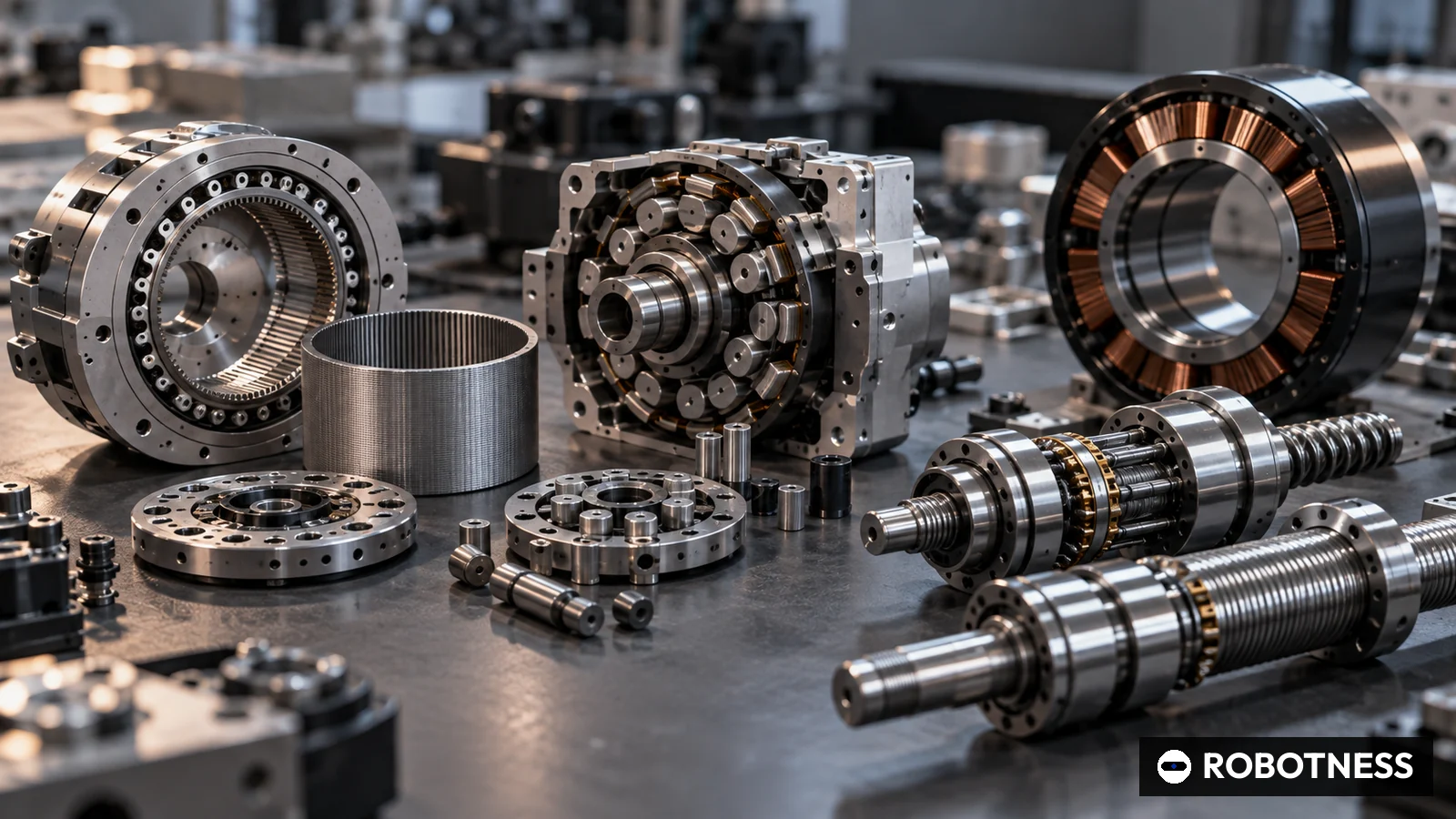
An electric joint combines a motor, a gear that trades speed for torque, and the sensors and electronics that close the control loop. Rotary joints in shoulders, elbows and wrists usually rely on a strain-wave gear, widely called a harmonic drive after the company that commercialised it, or on a planetary gearbox. A strain-wave gear flexes a thin toothed ring inside a rigid one, giving a high reduction ratio with almost no backlash in a small, light package; planetary gears are sturdier and cheaper but bulkier for the same ratio. Linear joints in knees, ankles and hips often use planetary roller screws, in which many threaded rollers share the load as a motor's rotation is turned into a push. Frameless torque motors, a rotor and stator sold without a housing so the robot maker can build them into the joint, supply the force. Schaeffler's planetary gear actuator, shown at CES in January 2026, packs a two-stage planetary gearbox, motor, encoder and controller into one unit rated at 60 to 250 newton-metres, the company said. The more of that stack a supplier owns, the more of the joint's value it captures, which raises the question of who is booking humanoid business today.
The Japanese incumbents are booking the first orders
Harmonic Drive Systems reported sales of 59.56 billion yen for the year to March 2026, up 7.0%, and orders of 61.61 billion yen, up 16.2%, according to its exchange filing. The company said it had won orders from customers moving robots that use AI technology into mass production. Momentum then accelerated: in April to June 2026 sales rose 23.6% to 16.68 billion yen and orders jumped 55.7% to 24.13 billion yen, leaving a backlog of 29.46 billion yen, up 45.6%. That is a book-to-bill ratio of 1.45, by our calculation. On Aug. 7 the company lifted its full-year forecast to 74.5 billion yen in sales and 8.5 billion yen in operating profit, from 68.0 billion yen and 6.2 billion yen set in May. Its quarterly filing credits surgical-robot orders in North America and semiconductor equipment tied to generative AI for the growth, not humanoids, a reminder that the humanoid share of its book is not disclosed.
Nabtesco, whose precision reduction gears have so far gone mainly into industrial robots, sold 45.1 billion yen of precision reduction gears in the first half of 2026, and its component segment took 48.0 billion yen of orders, up 23%, according to its August results briefing. Full-year component sales of 79.33 billion yen in 2025 rose 17.3% as industrial-robot inventories normalised, the company said. Nabtesco puts its reducer capacity at 1.15 million units a year across Tsu (890,000), Hamamatsu (170,000) and Changzhou in China (90,000), and began delivering a smaller "RV mini" in the second half of 2026 to capture what it calls physical AI demand. Japan's incumbents therefore have the order books, but the faster growth rates are in China.
- Harmonic Drive Systems
- JP
- Apr-Jun 2026
- JPY
- 16,681
- 23.6
- Orders from customers moving AI robots to mass production (FY to March 2026 filing)
- Nabtesco (precision reduction gears)
- JP
- Jan-Jun 2026
- JPY
- 45,100
- No data
- RV mini deliveries from H2 2026 for physical AI
- Leaderdrive
- CN
- Jan-Jun 2026
- CNY
- 348.55
- 38.64
- Embodied-AI robot business grew substantially; amount not disclosed
- Tuopu Group (robot actuators only)
- CN
- Jan-Jun 2026
- CNY
- 14.05
- 83.43
- Linear and rotary actuators, hand motors in small-batch delivery
- Sanhua Intelligent Controls (group)
- CN
- FY2025
- CNY
- 31,012
- 10.97
- Bionic-robot actuators a strategic business; revenue not disclosed
- Timken (Industrial Motion segment)
- US
- Apr-Jun 2026
- USD
- 453.9
- 14.6
- Owns Cone Drive and Rollon; robot sales not broken out
Figures as reported in company filings and results materials; no currency conversion and no estimates. Nabtesco revenue is the precision reduction gear line from its H1 2026 briefing (no YoY given for that line). Tuopu row is robot-actuator revenue only. Sanhua and Timken rows are group or segment totals because robot sales are not disclosed. null = not disclosed.
As of Oct 1, 2026
China's suppliers are growing faster from a smaller base
Leaderdrive, the Suzhou harmonic-reducer maker listed on Shanghai's STAR Market, reported 2025 revenue of 570.71 million yuan, up 47.31%, and net profit of 124.37 million yuan, up 121.42%, according to its annual report summary, which describes the company as a core supplier to several leading embodied-AI robot makers and lists planetary roller screws and planetary joint modules among its products. First-half 2026 revenue rose 38.64% to 348.55 million yuan and net profit 31.25% to 70.11 million yuan, its sponsor CITIC Securities reported in a filing that also notes substantial growth in the embodied-AI robot business. Research spending climbed 50.26% to 9.93% of revenue, with projects that include miniature planetary roller screws for dexterous joints.
Ningbo-based Tuopu Group booked 14.05 million yuan of robot-actuator revenue in the first half of 2026, up 83.43%, according to its interim report. That is about 0.1% of group revenue of 14.2 billion yuan. The company says its linear and rotary actuators and dexterous-hand motors are in small-batch delivery and that the first phase of a robot-components base, part of a planned 5 billion yuan investment, is essentially complete. Sanhua Intelligent Controls, which is applying its thermal-management know-how to robots and reported 2025 revenue of 31.01 billion yuan, calls electromechanical actuators for bionic robots a strategic emerging business and plans to expand their overseas production, but its annual report gives no revenue for the line. Neither company names a robot customer. Unitree, the largest humanoid shipper, says in its STAR Market prospectus that it has built a self-developed and self-produced system that covers core components, and that about 20% of its raw-material purchases were imported goods bought through domestic agents.
Europe's play is the integrated actuator, sold with a customer attached
Schaeffler has built its humanoid position through deals that tie actuator supply to robot purchases for its own factories. In November 2025 it agreed to supply Neura Robotics with a significant share of its actuator needs and plans a mid-four-digit number of humanoids in its plants by 2035. In April 2026 Hexagon said Schaeffler would deploy at least 1,000 AEON humanoids by 2032 and supply actuators to AEON. In May 2026 London-based Humanoid named Schaeffler its preferred supplier under a five-year agreement covering more than half of its joint-actuator demand through 2031, a seven-digit number of units, while Schaeffler takes a four-digit wheeled fleet by 2032, starting with box handling at Herzogenaurach from December 2026. Timken, the US industrial group that owns the harmonic-gear brand Cone Drive and the linear-motion firm Rollon, grew its Industrial Motion segment 14.6% to 453.9 million dollars in the second quarter but does not break out robot sales.
- Schaeffler
- Humanoid (UK)
- 1,000,000
- Joint actuators, at least (seven-digit; over 50% of Humanoid's demand)
- 2031
- 2026-05-13
- Schaeffler
- Hexagon AEON
- 1,000
- AEON humanoids in Schaeffler plants, at least; Schaeffler supplies actuators
- 2032
- 2026-04-22
- Schaeffler
- Neura Robotics
- No data
- Mid-four-digit humanoids in Schaeffler plants; Schaeffler supplies actuators
- 2035
- 2025-11-04
- Nabtesco
- Tsu, Hamamatsu, Changzhou
- 1,150,000
- Precision reduction gears per year (capacity)
- No data
- 2026-08-05
- Tesla
- Fremont Optimus line
- 1,000,000
- Robots per year (design capacity; in-house design)
- No data
- 2026-04-22
- Tesla
- Gigafactory Texas line
- 10,000,000
- Robots per year (long-term design capacity)
- No data
- 2026-04-22
- Figure AI
- BotQ first line
- 12,000
- Robots per year (initial; actuators designed in-house)
- No data
- 2025-10-09
Volumes as stated in primary announcements. 'Seven-digit' is entered at its floor of 1,000,000; 'mid-four-digit' has no exact figure and is null. Nabtesco capacity is the sum of Tsu 890k, Hamamatsu 170k and Changzhou 90k units. Tesla dates are from its Q1 2026 update.
As of Oct 1, 2026
The biggest buyers are building their own
Figure AI says the actuators, batteries, sensors and electronics of its Figure 03 were designed completely in-house, and that the first line at its BotQ plant can make up to 12,000 robots a year. Tesla said in April that its Fremont Optimus line is designed for 1 million robots a year and that a later Texas line is designed for long-term capacity of 10 million; by July it reported the Model S and X lines decommissioned and first-generation Optimus lines being installed, with production expected later this year. Tesla has not named actuator suppliers in its shareholder updates. In Japan, Yaskawa Electric's Dash 35 plan of May 2026 commits to motors and actuators optimised for AI robotics, adding a motion-control incumbent to the in-house camp. If the largest programmes keep the joint in-house, merchant suppliers will compete for the long tail of robot makers, which is where the implied volumes below matter.
- Humanoids shipped worldwide, H1 2026 (IDC)
- 25,000
- 625,000
- 750,000
- 0.54
- Figure BotQ first line, per year
- 12,000
- 300,000
- 360,000
- 0.26
- Tesla Fremont design capacity, per year
- 1,000,000
- 25,000,000
- 30,000,000
- 21.74
- Tesla Texas long-term design capacity, per year
- 10,000,000
- 250,000,000
- 300,000,000
- 217.39
Method: robots x 25 and x 30, the average actuator count per humanoid given by Schaeffler (Dec. 16, 2025). Multiple = actuators at 25 per robot / 1,150,000 (Nabtesco's stated annual precision reduction gear capacity). Illustrates scale only: not every joint actuator uses a Nabtesco-type reducer, and design capacity is not output.
As of Oct 1, 2026
ROBOTNESS analysis
The humanoid joint will be won by whoever can make tens of millions of actuators at automotive cost, which favours China's volume manufacturers and Schaeffler's integrated units in volume even as Japan's precision incumbents collect the early, higher-margin orders.
The evidence points both ways at once. Harmonic Drive Systems' first-quarter orders rose 55.7% and its forecast went up by 9.6% on sales and 37.1% on operating profit in three months, while Leaderdrive is growing revenue near 40% a year with net margins around 20%. Yet the only volume commitments a supplier has put a number on, Schaeffler's seven-digit actuator deal with Humanoid and its plant deployments with Hexagon and Neura, come from a company that sells a complete actuator rather than a gear, and Tuopu and Sanhua are building the same kind of module at industrial scale.
The strongest counter-argument is that precision does not commoditise easily. In our judgement strain-wave and cycloidal gears depend on metallurgy and tooth-profile know-how that is slow to copy, and humanoids that fail in the field cost their makers more than an expensive gear. If buyers pay for reliability, the incumbents keep pricing power even at higher volumes.
Bull case: humanoid volumes follow the curve IDC is measuring, Tesla and Figure cannot make every part themselves, and merchant suppliers with capacity in place, Nabtesco's 1.15 million units and Leaderdrive's growing lines, sell out. Margins expand as fixed costs spread, as Harmonic Drive's forecast already implies.
Bear case: the large programmes stay vertically integrated, Chinese module makers win the rest on price, and the Japanese incumbents remain industrial-robot and semiconductor suppliers with a humanoid sideline. Tuopu's robot revenue, at 0.1% of sales, shows how far announced capacity can run ahead of paying demand.
Signals to watch:
- December 2026: Humanoid's wheeled robots start box handling at Schaeffler's Herzogenaurach plant, the first test of the actuator-for-robots exchange.
- By end-2026: Tesla's first Optimus production in Fremont, and whether any supplier discloses Optimus actuator content.
- February 2027: Nabtesco's full-year results, the first with "RV mini" deliveries, show whether physical AI demand appears in component orders.
What would change our view is a named, multi-year humanoid contract for a Japanese gear maker at a disclosed volume. Until one appears, the incumbents are selling to the boom without yet being priced into its scale.
- Figure (Figure 03), Tesla (Optimus, suppliers undisclosed), Unitree (core components)
- Designed for 1 million robots a year, implying 25 m to 30 m actuators
- Revenue 348.55 m yuan (+38.64%), net profit 70.11 m yuan (+31.25%)
- 25 to 30 on average (Schaeffler)
- Over 50% of Humanoid's joint-actuator demand through 2031, seven-digit units
- 1.15 million units a year; RV mini deliveries from H2 2026
- Nearly 25,000 worldwide, Chinese vendors over 95% (IDC)
- Raised Aug. 7 to 74.5 bn yen sales, 8.5 bn yen operating profit
- 14.05 m yuan (+83.43%), about 0.1% of group revenue
- Sales 16.68 bn yen (+23.6%), orders 24.13 bn yen (+55.7%)
Why it matters
Actuators are where a humanoid's money goes. Schaeffler says on its humanoid robotics page that actuators make up about half of a humanoid's bill of materials by value, and its own count of 25 to 30 actuators per robot means every unit of humanoid demand multiplies into a much larger component market. Whoever controls the joint controls most of the robot's cost curve.
That makes supplier choice a strategic decision rather than a purchasing one. Figure and Tesla have taken the joint in-house, Unitree describes a self-produced core-component system, and the European newcomers Humanoid and Neura have instead tied themselves to Schaeffler. The split will decide which listed companies carry humanoid upside and which only carry the narrative.
Rival analysis
Harmonic Drive Systems and Leaderdrive compete head-on in strain-wave gears. HDS is larger and more profitable in absolute terms but just recovered from a year in which operating profit was 6 million yen; Leaderdrive earned net margins of 21.8% in 2025 and 20.1% in the first half of 2026 on far smaller revenue, and spends nearly 10% of revenue on research aimed at embodied-AI joints. Nabtesco sits in a different niche, cycloidal RV reducers, and is the only one of the three to publish a unit capacity figure.
Schaeffler, Tuopu and Sanhua compete one level up, as makers of complete actuators. Schaeffler is the only one with named humanoid customers and a disclosed volume. Tuopu reports actual robot revenue, 14.05 million yuan in the half, while Sanhua reports none. Timken owns relevant brands in Cone Drive and Rollon but has not presented humanoids as a reported business, so for now it is an option rather than a competitor.
Valuation context
We do not compare market values here because none were verified for this piece. Disclosed profitability is the better yardstick. HDS earned an operating margin of 4.3% in the year to March 2026 (2,567 / 59,557 million yen) and guides to 11.4% this year (8,500 / 74,500). Nabtesco's component segment earned 6.8% in 2025 (5,420 / 79,325 million yen) and 10.6% in the first half of 2026. Leaderdrive's net margin of about 20% is the highest of the group.
The gap matters because humanoid volumes, if they arrive, will press prices down. Leaderdrive's margin structure suggests a Chinese strain-wave maker can price aggressively and still earn more than the Japanese incumbents. The Japanese companies' operating leverage is real, as HDS's forecast shows, but it rests on industrial-robot, surgical and semiconductor demand that has nothing to do with humanoids.
Supply-chain implications
By component and country the map is concentrated. Strain-wave gears: Japan (Harmonic Drive Systems) and China (Leaderdrive), with Timken's Cone Drive in the US. Cycloidal RV reducers: Japan (Nabtesco), with 90,000 units of its 1.15 million capacity in Changzhou, China. Integrated rotary and linear actuators: Germany (Schaeffler) and China (Tuopu, Sanhua). Planetary roller screws for linear joints appear in Leaderdrive's and Tuopu's disclosures and in Schaeffler's linear-transmission range.
The exposure for Western humanoid makers is that the fastest-growing merchant suppliers are Chinese, while the largest disclosed humanoid fleet commitments are European. Unitree's prospectus shows the flow in the other direction: about 20% of its raw-material purchases were imported goods bought through domestic agents, so even China's leading shipper is not fully insulated from foreign components.
Signals to watch
HDS reported its first half last year on Nov. 12, 2025; the matching report this November will show whether orders keep growing above 50% and whether management attributes any of it to humanoids. Nabtesco's full-year results in February 2027 will be the first to include RV mini deliveries. Leaderdrive's annual report next spring will show whether embodied-AI revenue is broken out.
On the demand side, Humanoid's robots begin box handling at Schaeffler's Herzogenaurach plant from December 2026, Tesla expects first Optimus production in Fremont later in 2026, and Tuopu's full-year report will show whether robot-actuator revenue moves beyond small batches.
Analyst view
Thesis: the joint market will be decided by cost at scale, and the companies best placed for that are Schaeffler and China's volume manufacturers, while HDS and Nabtesco win early orders without yet proving humanoid volume. Confidence: medium. The order data for HDS and the growth at Leaderdrive are verified and strong, but no supplier yet discloses humanoid revenue, and the largest robot makers keep their actuator sourcing private.
What would raise our confidence: a disclosed humanoid revenue line at Leaderdrive or HDS, Tuopu robot revenue reaching a meaningful share of sales, or Tesla naming suppliers. What would lower it: Tesla and Figure staying fully in-house at volume, which would leave merchant suppliers with a fragmented market of smaller robot makers.
Questions you should be asking
For Harmonic Drive Systems: what share of the 24.13 billion yen of first-quarter orders came from humanoid or AI-robot customers, and how many such customers have moved to mass production? For Nabtesco: what torque range and price point does RV mini target, and is any of the 1.15 million unit capacity reserved for it?
For Leaderdrive and Tuopu: how much of revenue comes from the top embodied-AI customer, and at what volume does the planetary roller screw line break even? For Schaeffler: are the actuators supplied to Humanoid and Hexagon the same 60 to 250 newton-metre planetary units shown at CES, and where will they be built?