Runway turns its video models into robot control with Praxis-1, an open-weight world action model
Runway announced Praxis-1 on 30 September 2026, an open-weight world action model that converts its large-scale video pretraining into control for real robots. Early tests run with Noble Machines, Standard Bots and Ultra on bimanual, six-axis arm and mobile-base hardware, and public weights are promised in the coming months.
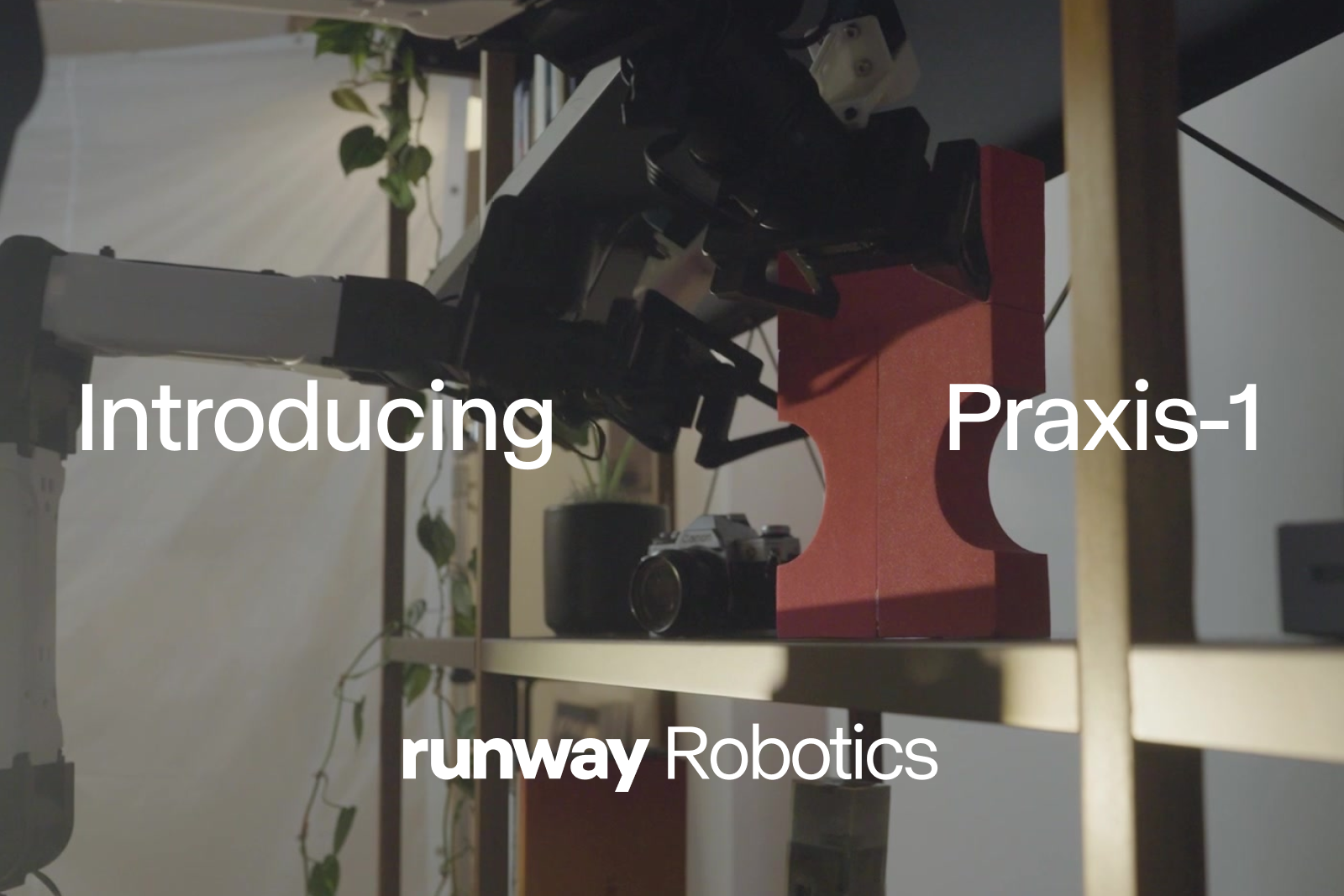
Runway, the New York company best known for generative video, announced Praxis-1 on 30 September 2026, describing it as an open-weight world action model that turns the company's video pretraining into control for real robots. The model is in early testing with three hardware partners, and Runway said it will publish the weights in the coming months.
The central claim rests on two numbers. In Runway's experiments, a policy pretrained only on web video reached a final placement error of 16.1 cm, against 16.0 cm for a policy pretrained on teleoperated robot video, measured across 93 evaluation pairs, according to the research post. Runway also said that simulating robot policies inside its world model predicts real-world results with a correlation of 0.95. Pretraining volumes in the scaling chart run from about 10 to about 1,000 hours of video, and Runway reports that policy performance improves as third-person video is scaled.
The partners cover three different body types. Noble Machines is testing bimanual manipulation, Standard Bots its RO1 six-axis arm and Ultra a mobile base, each running the model on its own hardware. Runway said the testing is designed to check both efficacy and safety across embodiments and environments before a public release. In one demonstration the same policy moved from a studio setting with controlled light and a fixed rig to a domestic kitchen counter in mixed light without retraining, the company said. Runway did not disclose the parameter count, architecture details, licence terms or a release date.
Praxis-1 extends a strategy Runway set out in December 2025, when it introduced GWM-1, a general world model built on its Gen-4.5 video model. GWM-1 came in three variants, one of them GWM Robotics, which was offered through a Python SDK for synthetic data generation and for evaluating robot policies in simulation without physical hardware. Praxis-1 moves from simulating robots to driving them.
The launch puts a video-generation company into a field crowded with better-funded robotics specialists. Physical Intelligence has released open weights for its earlier π0 models, NVIDIA publishes its GR00T humanoid models openly, and Google DeepMind ships Gemini Robotics models to selected partners. Skild AI raised $1.4 billion at a $14 billion valuation in January 2026 to build a general robot brain, and Figure AI trains its own Helix model in-house after raising $1 billion at $39 billion in its Series C, according to the companies.
The technical bet is that the physics a robot needs can be learned largely from ordinary video rather than from expensive teleoperation. Teleoperated data, where a human drives a robot to record demonstrations, remains the main fuel for robot foundation models, and collecting it is slow and costly. If web video does almost as well, as Runway's 16.1 cm versus 16.0 cm comparison suggests for its test task, the data bottleneck that has shaped the industry would loosen. A world action model combines a model that predicts how a scene will evolve with a policy that chooses actions, so the same system can both imagine outcomes and act.
For robot makers without their own model teams, open weights matter more than benchmarks. Standard Bots and other arm makers can fine-tune an open model on their own hardware and data without paying per-call fees or sending data to a model vendor. That widens the supply of capable robot software beyond the few companies that can afford to train foundation models from scratch.
The disclosed evidence is narrow. The video-versus-teleoperation result comes from a single placement metric with errors of 10 to 20 cm, far from the millimetre accuracy many industrial tasks require. Runway itself lists four failure categories it is targeting: rigid or repeated objects, cluttered scenes, transparent materials and deformable items. Without a parameter count, licence or third-party benchmark, it is not yet possible to compare Praxis-1 directly with π0 or GR00T.
The next milestones are the open-weight release, promised for the coming months, and the first results from Noble Machines, Standard Bots and Ultra. The licence terms will decide whether manufacturers can use the model commercially.
- Final placement error, web-video pretraining from scratch
- 16.1
- cm
- Final placement error, teleoperated robot-video pretraining from scratch
- 16
- cm
- Evaluation pairs behind the comparison
- 93
- pairs
- Correlation of world-model policy evaluation with real-world results
- 0.95
- r
- Smallest pretraining volume in scaling chart
- 10
- hours
- Largest pretraining volume in scaling chart
- 1000
- hours
- Hardware partners in early testing
- 3
- companies
Figures from Runway's Praxis-1 research post of 30 September 2026; error bars ±1 SEM over 93 evaluation pairs. Parameter count not disclosed.
As of Oct 1, 2026
- Skild AI
- US
- Series C
- 1,400,000,000
- 14,000,000,000
- 2026-01-14
- Figure AI
- US
- Series C
- 1,000,000,000
- 39,000,000,000
- 2025-09-16
- Walden Robotics
- US
- Seed
- 300,000,000
- 1,100,000,000
- 2026-07-15
- Physical Intelligence
- US
- Series B
- No data
- No data
- 2025-11-20
- Runway
- US
- No data
- No data
- No data
- No data
Company and investor announcements as recorded in the ROBOTNESS database; null where not disclosed or not verified on a primary page. Runway's funding not included because it was not confirmed on a Runway page.
As of Oct 1, 2026
ROBOTNESS analysis
Praxis-1 is a credible attempt to make internet video the main training source for robot control, but Runway has so far shown a promising scaling signal rather than production-grade performance.
The evidence for the thesis is the near parity between web video and teleoperated robot video on Runway's placement task, together with the 0.95 correlation between simulated and real policy results. Both point to a cheaper path for data and evaluation, the two costliest parts of robot learning.
The strongest counter-argument is that placement within roughly 16 cm is a coarse task, and that fine manipulation depends on contact forces and tactile feedback that video does not capture. Robotics specialists with large teleoperation fleets may keep a lasting advantage on dexterous work.
Bull case: open weights land with a permissive licence, partners report useful skills on three embodiments, and Praxis-1 becomes a default starting point for arm and mobile robot makers that lack model teams. Runway turns its video data and compute into a second business line in physical AI.
Bear case: the release slips or arrives with a restrictive licence, results stay limited to coarse pick-and-place, and better-funded rivals with real robot data outperform it on the tasks customers pay for. Praxis-1 then remains a research showcase.
Signals to watch:
- Q4 2026 to Q1 2027: publication of the Praxis-1 weights and licence terms.
- Q1 2027: first task results or deployments disclosed by Noble Machines, Standard Bots or Ultra.
- 2027: independent benchmark comparisons of Praxis-1 with π0 and GR00T models on shared tasks.
- Praxis-1, open-weight world action model
- Runway (New York)
- 30 September 2026
- GWM-1 general world model with GWM Robotics variant, December 2025
- Promised in the coming months, licence not disclosed
- Noble Machines (bimanual), Standard Bots (RO1 six-axis arm), Ultra (mobile base)
- 0.95 correlation between world-model and real-world policy results
- 16.1 cm vs 16.0 cm final placement error, 93 evaluation pairs
Why it matters
Praxis-1 is the clearest attempt yet by a generative video company to sell robot control rather than robot simulation. If Runway's finding that web video nearly matches teleoperated data holds up beyond its test task, the cost of training robot policies could fall sharply, because teleoperation is the slowest and most expensive input in the current robot learning stack.
The open-weight promise also matters. Most robot makers outside a handful of well-funded labs have no model team. An open model tested on three different body types would give them a starting point they can fine-tune on their own hardware.
Rival analysis
Runway enters against Physical Intelligence, whose earlier π0 models are available with open weights, NVIDIA's openly published GR00T humanoid models, and Google DeepMind's Gemini Robotics family. Skild AI and Figure AI build their own models with far larger budgets, having raised $1.4 billion and $1 billion respectively in their latest disclosed rounds.
Runway's edge is its video data and its experience training large video models; its gap is real robot data and deployment experience. The three partners are smaller hardware firms, which suggests Runway is targeting companies that need a model rather than those already building one.
Valuation context
Runway's own valuation is not cited here because ROBOTNESS could not confirm it on a primary Runway page. For context, robot model developers raised capital in 2025 and 2026 at valuations of $14 billion (Skild AI) and $39 billion (Figure AI), and Walden Robotics launched at $1.1 billion, according to company announcements.
If Praxis-1 gains adoption, it gives Runway a route into the physical AI market without building hardware, and investors may start to value its world models partly on robotics revenue. That outcome depends on commercial terms that have not been published.
Supply-chain implications
A model trained mainly on video shifts value away from teleoperation data collection, a growing service business, toward compute and video data. It also lowers the barrier for hardware makers: arm and mobile-base companies such as Standard Bots and Ultra could differentiate on cost and reliability while sourcing intelligence from an open model.
For component suppliers the effect is indirect. Cheaper software would make more robot deployments viable, raising demand for actuators, cameras and edge compute, especially in the cost-sensitive segments where open models are most attractive.
Signals to watch
The first signal is the open-weight release and its licence, promised for the coming months. A permissive commercial licence would make Praxis-1 a realistic option for manufacturers; a research-only licence would limit it to experimentation.
The second is partner evidence. Task results, success rates or deployments disclosed by Noble Machines, Standard Bots or Ultra in early 2027 will show whether the model performs on paid work. Independent benchmarks against π0 and GR00T on shared tasks would settle how it compares.
Analyst view
Thesis: Praxis-1 is a serious technical contribution with a plausible data advantage, but it has not yet shown the precision or reliability needed for commercial manipulation. Confidence: medium.
The 0.95 sim-to-real correlation and the near-equal web versus teleop result are meaningful, and Runway has a track record of shipping world models. Confidence is held at medium because the evidence comes from a single placement metric with errors around 16 cm, the parameter count and licence are undisclosed, and there are no third-party results yet.
Questions you should be asking
What licence will the open weights carry, and will commercial use be allowed without a separate agreement? How large is the model and what compute does it need for inference on a robot?
Does the web video advantage persist for contact-rich tasks such as insertion or cloth handling, where force feedback matters? Will Runway charge for its GWM Robotics simulation and evaluation tools as a paid layer on top of the free model?