Amazon buys Fauna Robotics, maker of the 107 cm Sprout humanoid, less than two months after the robot's launch
Fauna Robotics said on 24 March 2026 that it had joined Amazon and would operate as an Amazon company, keeping its Sprout humanoid on sale and its customers supported; no terms were disclosed. The deal gives the operator of more than 1 million warehouse robots a small, safety-first humanoid used by Disney, Boston Dynamics, NYU and UC San Diego, and a team drawn from Google DeepMind and CTRL-labs.
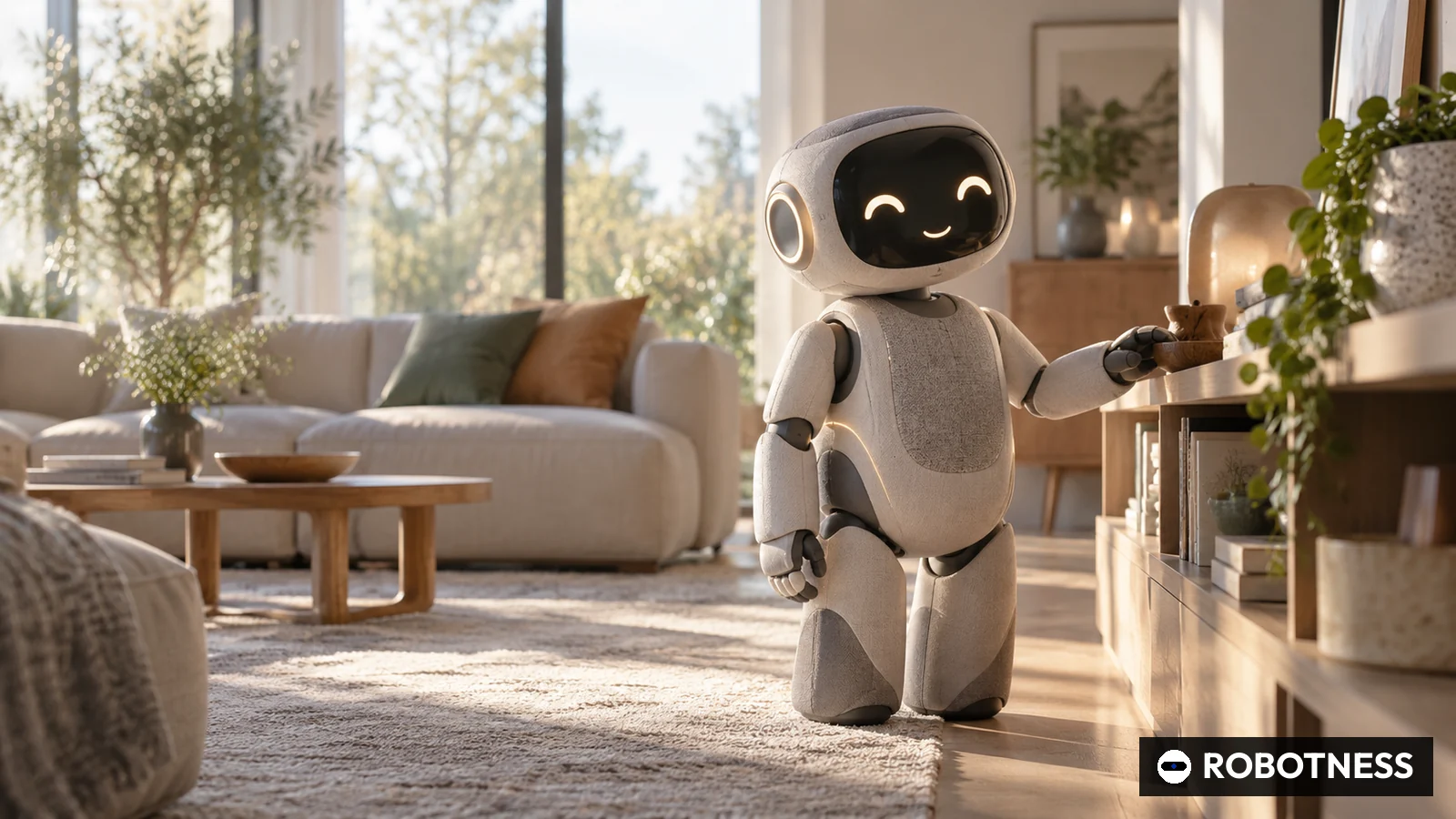
Fauna Robotics sold its first humanoid for less than two months as an independent company. The New York start-up said on 24 March 2026 that it had joined Amazon and would operate as "Fauna Robotics, an Amazon company", 56 days after it unveiled Sprout, a 107-centimetre, 22.7-kilogram robot built to work next to people rather than behind factory fencing.
Measured against the quarter's funding rounds the deal looks small, and neither company has put a price on it. Its significance lies in direction. Amazon operates more than 1 million robots, nearly all of them designed to move goods through warehouses. Fauna builds a very different machine, and the useful question is why the largest operator of logistics robots wanted it.
Fauna's announcement is short on terms and long on continuity
In a post signed by co-founder and chief executive Rob Cochran, Fauna said it would keep selling the Sprout Creator Edition to new customers, that support for existing customers would not change, and that it was hiring. The post gives no purchase price, headcount or reporting line inside Amazon, and ROBOTNESS found no Amazon release carrying those details. Fauna said it was founded in New York City in February 2024, which makes this an exit about 25 months after launch.
Sprout's specifications come from Fauna's launch release of 27 January 2026. The robot has 29 degrees of freedom, a count that includes motorised eyebrows, and a swappable battery rated for 3 to 3.5 hours. It computes on an NVIDIA Jetson AGX Orin module with 64 GB of memory, sees through a ZED 2i stereo camera, listens through a four-microphone array and uses four time-of-flight sensors to stop short of obstacles. Fauna named Disney, Boston Dynamics, UC San Diego and NYU as early customers and said Sprout is built and supported in the United States. Those buyers are a studio, a robot maker and two universities, which says a good deal about what the robot is for.
Sprout was engineered to be allowed near people
Most of Fauna's design decisions concern permission to share space. The company said Sprout has no sharp edges or pinch points, carries little kinetic energy because it is short with a low centre of gravity, and runs compliant motor control with torque limits set in software. That trades payload and reach for the ability to walk among children, visitors or patients without guarding. In his launch post Cochran wrote that more than 80% of the workforce is in services rather than manufacturing and that Fauna wanted robots in homes, schools, offices and community spaces.
The software follows the same logic. Sprout ships with pre-trained policies for walking, kneeling, crawling, sitting, jumping and dancing, with built-in mapping and localisation and whole-body teleoperation through integrated grippers. Developers plug their own models into a modular stack. In practice that makes Sprout a data-collection and research platform. A lab can teleoperate it to record demonstrations and then train manipulation or interaction models on top of locomotion that already works.
The founding team points the same way. Cochran previously worked at CTRL-labs, the neural-interface company. Chief technology officer Josh Merel was a research scientist at Google DeepMind, and hardware head Anthony Moschella was a vice-president at Peloton. Fauna said its staff also includes veterans of Meta, Google DeepMind and Amazon itself. That blend of robot learning, consumer hardware and human-interface work is hard to hire in one go, a point that matters for how the deal should be read.
Amazon has tried humanoids before, as warehouse tools
Amazon's robotics record is long and industrial. The company said on 1 July 2025 that it had deployed its 1 millionth robot across more than 300 facilities and introduced DeepFleet, a foundation model built with SageMaker that coordinates fleet traffic and, by Amazon's account, cut robot travel time by 10%. In October 2023 it began testing Agility Robotics' bipedal Digit for tote recycling at a research site near Seattle and said it had invested in Agility through its Industrial Innovation Fund. Sprout fits none of those jobs. At 22.7 kilograms it was never meant to haul totes.
Rivals raised billions for bigger machines
Elsewhere the quarter's capital flowed to larger robots and larger models. Skild AI raised $1.4 billion at a valuation of $14 billion on 14 January. Apptronik closed a $520 million Series A-X on 11 February, taking its Series A past $935 million. Sunday, maker of the Memo household robot, raised a $165 million Series B at a $1.15 billion valuation led by Coatue on 12 March and said a beta would roll out in the autumn. 1X, which offers its NEO home humanoid for $20,000 or $499 a month, released a world model on 12 January that it said lets NEO learn from internet-scale video. Fauna is also the second humanoid developer absorbed by a listed company this quarter, after Mobileye agreed in January to pay $900 million for Mentee Robotics.
- Fauna Robotics
- US
- Acquired by Amazon
- 2026-03-24
- No data
- No data
- No data
- Mentee Robotics
- IL
- Acquired by Mobileye
- 2026-01-06
- 900
- No data
- No data
- Sunday
- US
- Series B
- 2026-03-12
- 165
- 1.15
- 14.3
- Skild AI
- US
- Series C
- 2026-01-14
- 1400
- 14
- 10
- Figure AI
- US
- Series C
- 2025-09-16
- 1000
- 39
- 2.6
- Apptronik
- US
- Series A-X
- 2026-02-11
- 520
- No data
- No data
- 1X Technologies
- US
- Series B
- 2024-01-13
- 100
- No data
- No data
Figures as disclosed on company and acquirer primary pages and in verified ROBOTNESS records; none estimated. Amount as % of valuation = amount / disclosed valuation x 100. Fauna and Amazon disclosed no price. Mentee figure is Mobileye's announced purchase price.
As of Oct 1, 2026
For robot makers everywhere, the message is that the largest technology platforms are assembling their own physical AI stacks. Google DeepMind builds Gemini Robotics models, NVIDIA sells the Jetson computers that sit inside Sprout, and Amazon now owns a humanoid design outright. Independent developers that hoped to sell people-facing robots through Amazon's channels now face an in-house rival.
An acqui-hire would look exactly like this
The open questions are basic. Amazon has not said which organisation Fauna reports to, whether Sprout will remain a product beyond current commitments, or how much it paid. Fauna's assurance that nothing changes "today" describes the present only. A 107-centimetre frame also limits reach and payload for household chores compared with adult-sized humanoids. The first hard evidence may come with Amazon's quarterly filing for the three months to 31 March 2026.
ROBOTNESS analysis
Amazon has bought a people-facing humanoid platform with a developer base attached, which points its humanoid work at homes, schools and public spaces rather than at its own warehouses.
The evidence sits in the spec sheet and the customer list. Everything about Sprout, from its height and mass to its torque-limited joints and expressive face, is tuned for proximity to people, and its first buyers are an entertainment group and research labs rather than logistics operators. Fauna's commitment to keep selling the Creator Edition to outside developers suggests Amazon values that community and the interaction data it produces, which a warehouse fleet cannot generate. Capital markets show how costly the alternative is. By our calculation in the table, Sunday's Series B equalled 14.3% of its disclosed valuation and Skild AI's round 10.0%, so buying an early team is a cheaper entry than funding a lab that competes for the same engineers.
The strongest counter-argument is that this is an acqui-hire. Amazon gains roboticists from Google DeepMind and CTRL-labs for its own AI and robotics groups, and Sprout survives only as long as existing contracts require. Nothing on Fauna's page rules that out, and the absence of an Amazon announcement fits a small talent deal.
- 2023-10-18
- Digit humanoid (Agility Robotics) tested for tote recycling near Seattle
- No data
- 2025-07-01
- 1 millionth robot deployed; DeepFleet fleet model launched
- 1,000,000
- 2026-03-24
- Fauna Robotics joins Amazon; Sprout stays on sale
- No data
From Amazon's own announcements (18 Oct 2023, 1 Jul 2025) and Fauna's 24 Mar 2026 post. Amazon said the 1 millionth robot operated across more than 300 facilities and that DeepFleet cut fleet travel time by 10%.
As of Oct 1, 2026
In the bull case, Amazon keeps Sprout on sale, builds a developer ecosystem around it and uses the fleet to learn how people and robots share homes and public spaces. Within two years that data and team would give Amazon a credible consumer robot without the multibillion-dollar burn of the independent humanoid labs.
In the bear case, Sprout is quietly withdrawn once current customers are served and the team is folded into warehouse and model projects. The purchase then registers as an acqui-hire and says little about consumer humanoids beyond Amazon's appetite for talent.
Signals to watch:
- By early May 2026: Amazon's Form 10-Q for the quarter to 31 March 2026, and whether the Fauna purchase appears in it at all.
- Autumn 2026: Sunday's Memo beta reaches homes, the first real benchmark for a people-facing robot that Amazon now competes with.
- Through 2026: whether Fauna keeps selling Sprout Creator Edition to outside developers, and whether 1X delivers NEO to its priority buyers as promised.
- Fauna Robotics joined Amazon, operates as “Fauna Robotics, an Amazon company”
- Not disclosed
- NVIDIA Jetson AGX Orin, 64 GB
- February 2024, New York City
- Sprout humanoid, unveiled 27 January 2026
- 24 March 2026 (Fauna post by CEO Rob Cochran)
- More than 1 million robots across 300+ facilities (July 2025)
- 107 cm, 22.7 kg, 29 DOF, 3 to 3.5 h swappable battery
- Disney, Boston Dynamics, UC San Diego, NYU
Why it matters
Amazon is the largest buyer and builder of logistics robots in the world by its own count, with more than 1 million units across more than 300 sites as of July 2025. Its disclosed humanoid work before this deal, the 2023 Digit trial and its investment in Agility Robotics, served fulfilment. Fauna is a humanoid company Amazon now owns outright, and it is a company whose stated market is homes, schools, offices and community spaces. That makes the deal a statement about where Amazon expects humanoids to earn money, whatever its size.
The timing also matters. In the same quarter, independent humanoid and robot-model companies raised billions at valuations that assume they will become platforms. A platform company buying a two-year-old team for an undisclosed sum is a reminder that the largest technology groups can enter late and cheaply, and that start-ups without a clear path to scale may find their exit is a buyer rather than an IPO.
Rival analysis
Sunday is the closest commercial analogue. It is building Memo for household chores, raised $165 million at a $1.15 billion valuation on 12 March 2026 led by Coatue with Bain Capital Ventures, Fidelity, Tiger Global, Benchmark and Conviction, and said it had tripled engineering, quadrupled research and quintupled data operations staff. Its published work centres on a Skill Capture Glove and on ACT-1, which Sunday described in November 2025 as a robot foundation model trained on zero robot data. Fauna instead offers whole-body teleoperation of a humanoid in rooms where people are present. Under Amazon, Fauna gains capital but gives up the independence a start-up such as Sunday keeps when it signs partners.
1X is the most direct humanoid rival for the home. NEO is priced at $20,000 for early access or $499 a month, with priority deliveries promised in 2026, and on 12 January 2026 1X released a world model that it said lets NEO learn tasks from internet-scale video. Sprout is smaller and positioned for developers rather than households, so the two do not yet meet head on. Figure, Apptronik and Agility build adult-scale machines aimed at factories and logistics, where Sprout cannot compete on payload.
Among acquirers, Mobileye's agreement to pay $900 million for Mentee Robotics in January 2026 is the comparable deal of the quarter. Mobileye put a number on its deal. Amazon disclosed nothing and bought a small, people-facing humanoid. The contrast suggests two different theses about where humanoids create value first.
Valuation context
No price is disclosed, so any valuation for Fauna would be an estimate and ROBOTNESS does not publish one. What the verified data does show is the cost of the alternatives. Sunday's $165 million round equalled 14.3% of its disclosed $1.15 billion valuation. Skild AI's $1.4 billion equalled 10.0% of $14 billion, and Figure's $1 billion Series C in September 2025 equalled 2.6% of $39 billion. Formula: round amount divided by disclosed valuation.
Those ratios mean that a strategic investor who wants a seat in the humanoid race through minority stakes buys a small fraction of a company at a high price. A full acquisition of an early team avoids that, at the cost of buying a product with a narrow market. If Amazon's 10-Q for the March quarter treats the deal as immaterial, it will confirm the purchase was small relative to Amazon's acquisition budget.
Supply-chain implications
Fauna has disclosed only a handful of Sprout's parts. Compute is an NVIDIA Jetson AGX Orin with 64 GB, and Fauna said Sprout is produced and supported in the United States. Perception uses a ZED 2i stereo camera, four time-of-flight sensors, a four-microphone array and an IMU. Fauna did not disclose its actuator, reducer or battery cell suppliers, so the dependence on Asian component chains cannot be assessed from primary sources.
Amazon's ownership changes the purchasing picture. A small humanoid with 29 degrees of freedom needs a large number of compact actuators, and Amazon's procurement scale could lower unit costs if Sprout moves beyond a developer edition. That would matter to suppliers of small servo actuators and stereo cameras more than to makers of the heavy reducers used in industrial arms.
Signals to watch
The first signal is Amazon's Form 10-Q for the quarter ending 31 March 2026, due by early May 2026. Large acquisitions are usually described in the business combinations note; silence would support the reading that this was a small transaction.
The second is product continuity. Fauna promised to keep selling Sprout Creator Edition to new customers. Whether the order page stays open and whether new software releases ship through the rest of 2026 will separate a product strategy from an acqui-hire. The third is the competitive set: Sunday's Memo beta in autumn 2026 and 1X's priority NEO deliveries during 2026 will show whether people-facing robots reach real homes this year.
Analyst view
Thesis: Amazon bought a people-facing humanoid platform and its developer community, pointing its humanoid ambitions at homes and public spaces rather than its warehouses. Confidence: medium.
Why not high: the only primary statement is Fauna's own post, which leaves out price, reporting line and long-term product plans, and the pattern of a large company buying a young team without an announcement is also typical of acqui-hires. Why not low: Fauna said it will keep selling Sprout to outside customers and operate under its own name, which costs Amazon money and attention it would not spend on a pure talent deal, and the robot's design is unsuited to any warehouse use Amazon has described.
What would change our view: Sprout disappearing from sale within 2026 would move us to the acqui-hire reading. A consumer-facing Amazon programme built on Sprout, or Fauna hiring for retail and education deployments, would raise our confidence.
Questions you should be asking
For Amazon: which organisation does Fauna report to, and is Sprout intended to remain an external product or become an internal research platform? Will Sprout's data and models be shared with Amazon's warehouse robotics groups or kept separate for consumer and public-space uses?
For Fauna: how many Sprout units have shipped since 27 January 2026, and what share went to research labs versus entertainment and commercial customers? Which actuators and battery cells does Sprout use, and will Amazon ownership change the bill of materials or the US production plan?