Mobileye pays $900 million for Mentee Robotics, the humanoid start-up chaired by its own chief executive
Mobileye agreed on 5 January 2026 to buy Israeli humanoid developer Mentee Robotics for $900 million in cash and stock and closed the deal on 3 February. Its filings show chief executive Amnon Shashua, Mentee's chairman and co-founder, receives about $341 million and chief technology officer Shai Shalev-Shwartz about $118 million, with 90% of the founders' stock released only after two and four years. Mentee targets autonomous customer pilots in 2026 and series production in 2028.
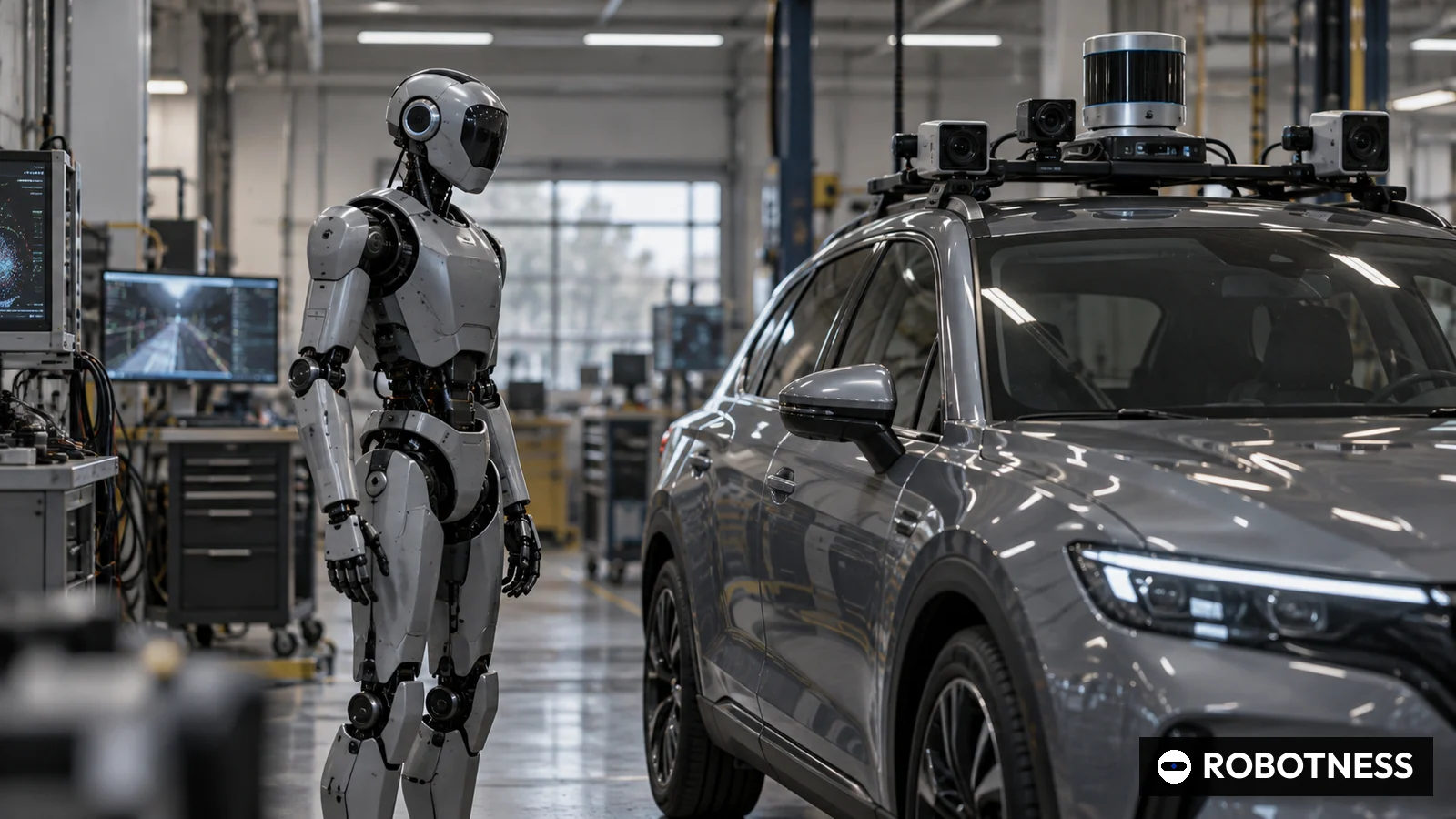
The biggest single payout from the $900 million Mobileye agreed to spend on a humanoid robot start-up goes to the man who runs Mobileye. Under the share purchase agreement signed on 5 January 2026, Amnon Shashua, Mobileye's president and chief executive and the chairman and co-founder of Mentee Robotics, is set to receive about 37.87% of the total consideration, roughly $341 million, according to the company's Form 8-K filing. Shai Shalev-Shwartz, Mobileye's chief technology officer and also a Mentee co-founder, receives about 13.08%, or around $118 million.
The deal, presented at CES in Las Vegas on 6 January, takes the Israeli supplier of driver-assistance chips into general-purpose robots for the first time. Shashua described it in the announcement as the beginning of what he called Mobileye 3.0. The headline price matters less than how it was paid and what Mobileye promised to deliver by 2028, and the filings spell out both.
Most of the founders' stock is locked up for four years
Mobileye said it would pay about $612 million in cash and up to 26,229,714 Class A shares, all of the stock going to Mentee's founders. When the deal closed on 3 February, the company reported paying $611,914,666 in cash and issuing 26,279,824 shares, a slightly higher count that it attributed to a recalculation based on the volume-weighted average closing price over the 30 trading days before signing. The shares were issued without registration under Section 4(a)(2), Rule 506 of Regulation D and Regulation S, the closing 8-K said.
The signing filing shows how tightly the stock is tied to the team. Only 10% of the stock consideration carries a plain six-month lock-up. The other 90% sits with a deferred consideration trustee and is released in two equal portions 24 and 48 months after closing, provided the recipients remain employed. A further $95 million of the price went into escrow to cover post-closing adjustments and indemnification, with founders placing half of their share of it in stock.
Because the chief executive sat on both sides, Shashua recused himself. Mobileye's board approved the purchase on the recommendation of a strategic transaction committee of four disinterested directors, two of them independent, and Intel, the sole holder of Mobileye's Class B stock and its majority owner, also signed off, the company said. The 8-K also discloses that Shashua's son and son-in-law are Mentee employees holding vested and unvested options. Closing required a ruling from the Israeli Tax Authority on the founders' stock under Section 104H, and the agreement carried a 180-day outside date and no termination fee. Goldman Sachs advised Mobileye, with Davis Polk and Erdinast Ben Nathan Toledano as its counsel, while Paul Hastings and Shibolet represented Mentee.
That leaves the question of what roughly $900 million bought from a company Mobileye says was four years old and whose first customer deployments were still ahead of it.
Mentee is selling autonomy without remote operators
Mentee, run by chief executive Lior Wolf, develops a humanoid called MenteeBot. Mobileye's release lists in-house actuators that it says offer high torque density in a compact package, precision motor drivers, hands that sense touch through their motors, and hot-swappable batteries meant to keep robots working without charging breaks. On the software side, the company combines foundation models for scene understanding and spoken instructions with reinforcement-learning models for motion, trains first in simulation with methods it says shrink the gap between simulated and real behaviour, and claims the robot can pick up new skills from a handful of human demonstrations. Its showcase was two robots moving 32 boxes across several racks.
In plain terms, Mentee is betting that a humanoid can learn to walk and handle objects mostly in software before it touches a real warehouse, and that reading contact from motor signals can stand in for costly sensor skins on the hands. The claim Mobileye stressed most is autonomy: it said the 2026 on-site proof-of-concept deployments would run without teleoperation, a technique widely used across the industry to gather training data and to cover gaps during pilots. Series production and commercial launch are targeted for 2028.
A discount to the venture-backed leaders, paid by a company with revenue
The price compares with far richer private valuations set the same quarter. Skild AI raised $1.4 billion at a $14 billion post-money valuation on 14 January, nine days after the Mentee signing, and Apptronik added $520 million to its Series A on 11 February. Figure AI's $1 billion Series C in September 2025 valued it at $39 billion. At the same CES, Hyundai's Boston Dynamics showed the production Atlas, with Hyundai aiming for 30,000 robots a year and a Georgia production debut in 2028, the year Mentee also targets.
- Mentee Robotics
- IL
- Acquired by Mobileye
- 2026-01-05
- 900,000,000
- 900,000,000
- Skild AI
- US
- Series C
- 2026-01-14
- 1,400,000,000
- 14,000,000,000
- Apptronik
- US
- Series A extension
- 2026-02-11
- 520,000,000
- No data
- Figure AI
- US
- Series C
- 2025-09-16
- 1,000,000,000
- 39,000,000,000
- Walden Robotics
- US
- Seed
- 2026-07-15
- 300,000,000
- 1,100,000,000
- Humanoid
- GB
- Series A
- 2026-07-21
- 152,000,000
- 1,350,000,000
Mentee value is the acquisition price from Mobileye's 8-K, not a post-money valuation; other values are disclosed post-money valuations. Figures disclosed, not estimated. Ratio used in text: 900,000,000 / post-money.
As of Oct 1, 2026
Mobileye can afford the bet, though not without strain. It reported 2025 revenue of $1,894 million, up 15%, a GAAP operating loss of $440 million and adjusted operating income of $280 million, and ended the year with $1.836 billion in cash and equivalents. The first-quarter release put the net cash paid for Mentee at $591 million, and cash had fallen to $1,211 million by 28 March. In the same quarter Mobileye booked a goodwill write-down of about $3,788 million, which it attributed to a decline in its market capitalisation and to macroeconomic and geopolitical uncertainty, and authorised up to $250 million of buybacks partly to offset dilution from the Mentee shares. Revenue rose 27% to $558 million and the company lifted its 2026 revenue guidance to between $1,935 million and $2,015 million.
- Cash paid at closing (USD)
- 611,914,666
- Class A shares issued to founders
- 26,279,824
- Escrow (USD)
- 95,000,000
- Amnon Shashua's share, approx. (USD)
- 341,000,000
- Shai Shalev-Shwartz's share, approx. (USD)
- 118,000,000
- Net cash outflow, Q1 2026 (USD)
- 591,000,000
From Mobileye 8-K filings of 5 Jan and 3 Feb 2026 and the Q1 2026 results release. Implied value per share = (900,000,000 minus 611,914,666) / 26,279,824 = about $10.96.
As of Oct 1, 2026
For the wider industry, the deal tests whether automotive suppliers can carry their manufacturing relationships and safety engineering into humanoids. Mobileye pointed to its Responsibility-Sensitive Safety framework, its AI training infrastructure and its ties to high-volume precision manufacturers, alongside a $24.5 billion automotive revenue pipeline over the next eight years.
The risks are concentrated. Buyer and seller share leadership, so shareholders must rely on the committee process for the fairness of the price. Mobileye has said the deal adds only a low-single-digit percentage to 2026 operating expenses, yet its second-quarter release on 23 July disclosed no Mentee pilots or customers and listed a risk that the humanoid industry may not develop as expected.
ROBOTNESS analysis
Mobileye bought a team and a 2028 deadline rather than a product, and the deferred-stock structure is the real price signal.
The evidence sits in the 8-K. About 51% of the consideration, roughly $459 million by our sum of the two disclosed stakes, goes to two sitting Mobileye executives, and 90% of the founders' stock is released only at 24 and 48 months. The cash, 68% of the price, is what Mobileye paid for the company itself; the stock works as a retention plan for the people who must deliver series production. By our calculation the shares were valued at about $10.96 each, which is $900,000,000 minus $611,914,666, divided by 26,279,824 shares. The $591 million net cash outflow equals 32% of Mobileye's year-end 2025 cash.
The strongest counter-argument is that $900 million is modest next to Skild AI's $14 billion or Figure AI's $39 billion valuations, so Mobileye may have bought a credible humanoid stack cheaply and can fund it from an operating business, which venture-backed rivals cannot.
Bull case: simulation-first training and motor-based touch sensing keep unit costs low, the 2026 pilots run without remote operators, and Mobileye's manufacturing partners turn MenteeBot into a 2028 product that opens a second revenue line next to EyeQ chips. Mobileye would then have entered humanoids at a fraction of what rivals' investors paid.
Bear case: pilots slip, humanoid spending weighs on a company that has already written down $3.8 billion of goodwill, and the related-party price becomes a governance overhang as deferred tranches vest. A buyback launched partly to absorb Mentee dilution would then look like a cost of the deal.
Signals to watch:
- A named MenteeBot proof-of-concept customer or site in Mobileye's full-year 2026 results, due around late January 2027 on last year's timing.
- The first deferred stock release in February 2028, 24 months after the 3 February 2026 closing, and whether the founding team is still in place.
- A production partner or plant for the 2028 series-production target, the clearest test of Mobileye's manufacturing argument.
- Mobileye acquires Mentee Robotics (Israel)
- $900 million: $611,914,666 cash plus 26,279,824 Class A shares
- 3 February 2026
- $95 million
- Autonomous on-site proof-of-concept deployments in 2026; series production 2028
- 10% six-month lock-up; 90% released at 24 and 48 months, subject to employment
- Amnon Shashua about 37.87% (~$341M); Shai Shalev-Shwartz about 13.08% (~$118M)
- $591 million (Q1 2026)
- 5 January 2026 / 6 January 2026 (CES)
Why it matters
Mentee is the first humanoid developer bought outright by a listed automotive-technology supplier in 2026, and the price was set as a related-party transaction. That combination makes the deal a template others will be judged against. Automotive suppliers have been circling humanoids because the bill of materials overlaps with what they already make (motors, power electronics, cameras, compute), but until January most had partnered or invested rather than bought.
For Mobileye the purchase changes the equity story. Its pipeline disclosure of $24.5 billion over eight years is entirely automotive; Mentee adds a second, unproven line with a 2028 production date. The way the stock is deferred tells investors that management itself sees the payoff as four years out.
Rival analysis
Against venture-backed US leaders, Mentee is small on capital. Skild AI ($1.4 billion Series C at $14 billion, January 2026) sells a robot-agnostic model; Figure AI ($39 billion post-money after its $1 billion Series C in September 2025) and Apptronik ($520 million Series A extension in February 2026) build complete humanoids with large in-house manufacturing plans. Mentee's distinctive claim is end-to-end autonomy without teleoperation in its first pilots, a bar Mobileye set in public and can now be held to.
The closest structural parallel is Hyundai and Boston Dynamics, which used the same CES to show the production Atlas and set a 2028 Georgia production debut. Both are humanoid programmes inside companies with vehicle-industry supply chains. The difference is scale: Hyundai is a carmaker with its own plants, Mobileye is a fabless chip and software supplier that must rely on partners to build robots.
Valuation context
At $900 million, Mentee was priced at about 6.4% of Skild AI's January post-money valuation and about 2.3% of Figure AI's, by our division of disclosed figures. It sits closer to Walden Robotics ($1.1 billion post-money seed, July 2026) and Humanoid ($1.35 billion post-money, July 2026). An acquisition price is not a post-money valuation, so the comparison is indicative only.
The shares were valued at roughly $10.96 each on the 30-day volume-weighted price before signing, by our calculation. Since 90% of that stock is deferred against continued employment, part of the $900 million is economically closer to compensation than to purchase price, which matters for how Mobileye accounts for it and for how outside shareholders read the dilution, which the company is partly offsetting with a $250 million buyback.
Supply-chain implications
Mobileye designs EyeQ chips and outsources manufacturing; it has no robot factory. The release points to deep relationships with high-volume precision manufacturers, which suggests contract assembly, but no partner has been named. Mentee's in-house actuators and motor drivers are the components that define cost and performance, and their sourcing is undisclosed.
Hot-swappable batteries and motor-based touch sensing both lower hardware cost relative to sensor-skin hands and fixed packs, but they shift risk onto battery cell supply and on the precision of motor current sensing. Watch whether Mobileye discloses a contract manufacturer in Asia or Israel, and whether actuator production stays in house.
Signals to watch
First, a named proof-of-concept customer. Mobileye's Q1 and Q2 2026 releases gave none, so any customer name in the full-year results, expected around late January 2027 on last year's timing, would be the first external validation.
Second, the deferred stock dates of February 2028 and February 2030, which coincide with the production target. Third, operating expense disclosure: Mobileye guided to only a low-single-digit percentage increase in 2026 opex from the deal and $6 million of acquisition-related costs for the year; a step-up in 2027 would show the programme scaling.
Analyst view
Thesis: Mobileye bought a team and a 2028 deadline; the deal is cheap relative to private humanoid valuations but carries unusual governance and execution risk. Confidence: medium. The filings make the terms unusually transparent, which supports the governance reading, but there is no public evidence yet of MenteeBot performance outside company demonstrations, so the commercial outcome is wide open.
What would change our view: a named industrial customer running MenteeBot autonomously in 2026 would raise confidence that the price was a bargain; a quiet slip of the 2028 date or departures from the founding team before the first deferred release would make the deal look like an expensive retention package.
Questions you should be asking
Which customers and sites are lined up for the 2026 proof-of-concept deployments, and what tasks will they measure?
Who will manufacture MenteeBot at series volume in 2028, and will actuators be made in house? How much of the $900 million will be recorded as compensation expense rather than purchase consideration because of the employment condition? How will Mobileye report humanoid spending separately from automotive R&D?