XPeng's IRON humanoid rolls off its first production line after robotics unit raises US$900 million
XPeng said on September 8, 2026 that its IRON humanoid robot has started coming off a production line with more than 80% of core processes automated, ahead of mass production at the end of 2026 and deliveries in 2027. Two weeks earlier its robotics subsidiary Dogotix agreed to raise more than US$900 million at a post-money valuation above US$6.3 billion, including US$600 million from IDG Capital, Alibaba, Tencent and Gaorong Ventures.
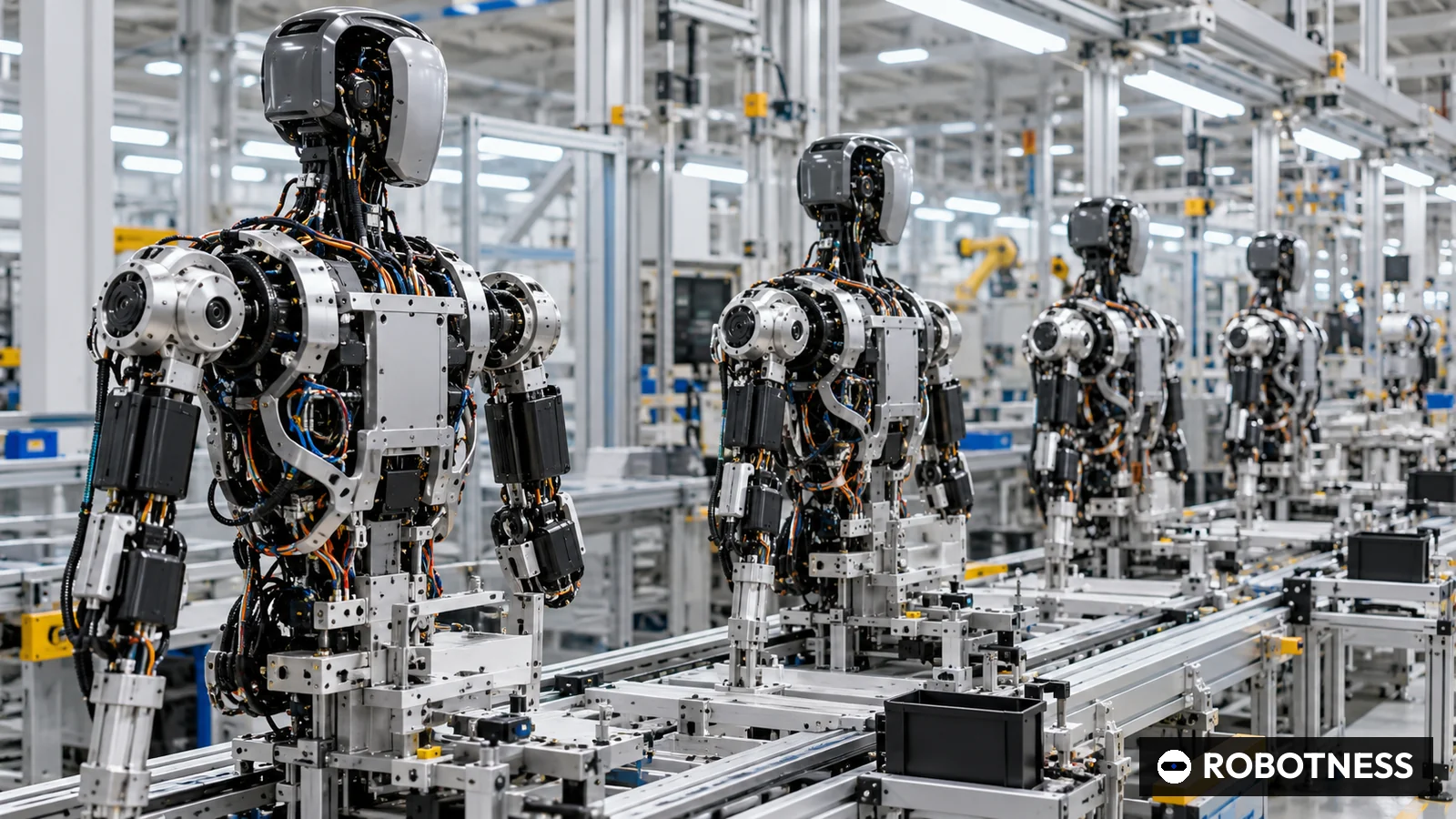
XPeng's IRON humanoid robot has started walking off a production line, the Guangzhou carmaker said on September 8, 2026, marking the move from prototypes to manufacturing for one of China's most closely watched humanoid programmes. The company said more than 80% of the line's core processes are automated and that it applies automotive quality and production management methods. Mass production is scheduled for the end of 2026, with market launch and deliveries in China and abroad planned for 2027.
The announcement followed a financing that gives the robot its own balance sheet. In a filing to the Hong Kong stock exchange on August 24, XPeng said its robotics subsidiary Dogotix Inc., a Cayman Islands company, had signed share purchase agreements to raise about US$900 million. IDG Capital, Alibaba, Tencent and Gaorong Ventures agreed to pay US$600 million for 296,025,600 Series A preferred shares. XPeng itself committed US$200 million for Series A preferred shares, and two companies wholly owned by executive director He Xiaopeng and honorary vice chairman Brian Gu will invest US$100 million in ordinary shares and receive warrants.
The terms value Dogotix at US$5 billion before the money and more than US$6.3 billion after it, according to the filing. XPeng's stake falls to 81.97% after the first closing and to 68.41% assuming the warrants are exercised and an employee incentive plan of up to 15% of Dogotix's share capital is fully granted. Investors can require redemption of their shares if Dogotix fails to complete a qualified initial public offering within seven years, at the higher of their purchase price plus 8% annual compound interest or 120% of the price. The deal is a discloseable and connected transaction under Hong Kong rules but exempt from shareholder approval.
What the robot is
XPeng gives IRON 76 degrees of freedom across the body and 21 in each hand, a fully enclosed flexible lattice body covering, and three of its own Turing AI chips delivering up to 2,250 TOPS of effective computing power. The first commercial deployments will be in XPeng's own stores and campuses, the company said. It did not disclose a price, a production volume or the battery specification.
He Xiaopeng said in the statement that XPeng aims to build a robot with full generalisation capabilities that can become part of everyday life. He added that the production line was built from scratch with no precedent to follow, describing the step as small but the start of production lines for an entirely new product category.
Why a carmaker
XPeng's case rests on reuse. IRON runs on XPeng's own Turing AI chips, and the company says its humanoid line borrows automotive methods for quality control and production management. Its robotics proceeds are earmarked for growth, capital expenditure and working capital of the robotics business, the filing says, which points to further investment in lines and supply rather than research alone.
Competitive context
IRON enters a crowded field of Chinese humanoids already in volume. UBTech Robotics sold 921 full-size humanoids in the first half of 2026 and booked RMB590.3 million of revenue from them, according to its interim results. Unitree Robotics, listed on Shanghai's STAR Market on August 19, reported first-half revenue of RMB1,152.25 million. In the United States, Figure AI raised US$1 billion at a US$39 billion post-money valuation in September 2025 and Skild AI US$1.4 billion at US$14 billion in January 2026, according to the companies. Dogotix's valuation sits well below those US figures and its funding round is smaller than either.
The technical bet is that more joints and more onboard compute make a humanoid useful in less structured settings. Seventy-six degrees of freedom is a high count for a full-size humanoid, and 21 per hand approaches human dexterity on paper. The cost of that complexity is more actuators, more calibration and more points of failure, which is why the automation rate of the line matters as much as the specification.
The risks are timing and demand. XPeng has given dates but no volumes, and first deployments are inside its own network, where the buyer is also the seller. The redemption right attached to the Series A shares creates a seven-year clock for a listing of the robotics business. Investors will want to see paying customers outside XPeng before 2027 deliveries begin.
ROBOTNESS analysis
XPeng has bought IRON a production line and a separate balance sheet, but the robot's commercial case will remain unproven until buyers outside XPeng's own stores sign up in 2027.
The evidence for momentum is concrete: a funded subsidiary with US$600 million of outside money from four major investors, a line with more than 80% of core processes automated, and a dated plan for mass production at the end of 2026. The chips and production methods come from an automotive business that already manufactures at scale.
The strongest counter-argument is that the first customer is XPeng itself. Deploying robots in its own stores and campuses demonstrates capability, not demand, and the company has disclosed no target volume or price.
Bull case: IRON enters mass production on schedule, XPeng uses its retail and service network to show reliable guest-facing work, and Dogotix lists within the seven-year window at a step-up from US$6.3 billion. Shared chips with the car business keep compute costs below rivals.
Bear case: the 76-joint design proves costly to build and maintain, deliveries slip beyond 2027, and investors invoke redemption pressure as the IPO clock runs. Competition from cheaper Unitree and UBTech units squeezes any price XPeng hoped to charge.
- End of 2026: start of IRON mass production as promised in the September 8 release.
- 2027: market launch and first deliveries in China and abroad.
- Around 2033: seven years on from the August 2026 agreements, the window for a qualified IPO before investors' redemption rights apply.
- Dogotix (XPeng Robotics)
- Series A
- 900
- 6,300
- 2026-08-24
- Figure AI
- Series C
- 1000
- 39,000
- 2025-09-16
- Skild AI
- Series C
- 1400
- 14,000
- 2026-01-14
- Apptronik
- Series A extension
- 520
- No data
- 2026-02-11
Dogotix amount and post-money are stated as 'over' US$900 million and 'over' US$6.3 billion in XPeng's HKEX filing of August 24, 2026; amount includes US$200 million from XPeng and US$100 million from executives' companies. Dogotix step-up = post-money / pre-money = 6,300 / 5,000 = 1.26. Peer figures from company announcements. Disclosed, not estimated.
As of Oct 1, 2026
- 3 Turing AI chips, up to 2,250 TOPS
- About US$900 million into Dogotix (agreements signed August 24, 2026)
- US$5 billion pre-money, over US$6.3 billion post-money
- 81.97% after first closing, 68.41% fully diluted
- IRON walks off production line, September 8, 2026
- More than 80% of core processes
- End of 2026
- 76 body, 21 per hand
- IDG Capital, Alibaba, Tencent, Gaorong Ventures (US$600 million)
- 2027, China and international
Why it matters
IRON gives a Chinese carmaker a dedicated humanoid production line with a dated mass-production plan, and the Dogotix round puts a market price on a carmaker's robot business. That matters for every automaker weighing whether to build humanoids in-house or buy them.
The structure also matters. By moving robotics into a separately funded subsidiary with outside investors and an IPO clock, XPeng has created a vehicle that can raise capital and list on its own, insulating the car business from the robot's losses while keeping control.
Rival analysis
UBTech has the volume lead among listed Chinese makers, with 921 full-size humanoids sold in the first half, and Unitree has the profit lead. XPeng's distinctive assets are in-house AI chips and a retail and service network where it can deploy its own robots first.
Globally, Tesla's Optimus is the closest analogue of a carmaker building humanoids, while Figure AI and Skild AI command higher private valuations of US$39 billion and US$14 billion. Dogotix at over US$6.3 billion post-money is priced as a credible challenger rather than a leader.
Valuation context
The step-up inside the round is modest: post-money of over US$6.3 billion against a pre-money of US$5 billion, a ratio of about 1.26 (6.3 / 5.0). The implied price per Series A share is about US$2.03 (600,000,000 / 296,025,600).
The redemption right, at the higher of 8% compound interest or 120% of the purchase price if no qualified IPO occurs within seven years, gives investors downside protection that partly explains why they accepted a valuation below US peers.
Supply-chain implications
A 76-joint humanoid needs more actuators per unit than most rivals, so XPeng's sourcing of motors, reducers and screws will shape its cost curve. Its automotive supply base in South China gives it purchasing scale for electronics, wiring harnesses and batteries that pure robot start-ups lack.
Automation above 80% of core processes means the line itself is a capital asset. The use of proceeds for capital expenditure suggests more lines or capacity will follow if demand materialises.
Signals to watch
First, the start of mass production by the end of 2026 and any disclosed volume. Second, the first external customer for IRON outside XPeng's stores and campuses.
Third, completion of the Dogotix closings and any statement on the IPO path, since the seven-year redemption clause effectively sets a listing deadline.
Analyst view
Thesis: XPeng has turned IRON into a funded, standalone business with a credible manufacturing plan, but commercial demand is untested. Confidence: medium. The financing terms and specifications come from exchange filings and the company's release; volumes, price and customers are not disclosed.
We see Dogotix as an option on carmakers becoming humanoid suppliers. If XPeng can prove that automotive manufacturing discipline lowers humanoid cost, it will set a template other Chinese carmakers are likely to follow.
Questions you should be asking
What volume does XPeng plan for 2027, and at what price will IRON be sold or leased?
Which of the four external investors will act as customers or distribution partners, particularly Alibaba and Tencent?
How reliable is a 76-degree-of-freedom body in daily retail and campus work, and what will maintenance cost?