Hyundai pledges 9 trillion won for a Saemangeum hub that pairs a 30,000-robot plant with a 50,000-GPU data centre
Hyundai Motor Group agreed on February 27, 2026 to invest about 9 trillion won from 2026 in a robotics, AI and hydrogen hub at Saemangeum in North Jeolla. The plan includes a 400 billion won robot cluster with a finished-robot factory sized for about 30,000 units a year, a contract-manufacturing foundry and a parts complex, due in 2029, next to a 5.8 trillion won AI data centre scaled in phases to 50,000 GPUs.
The robot factory made the headlines, yet it is the smallest line in the budget. Of the roughly 9 trillion won that Hyundai Motor Group pledged on February 27, 2026 for an innovation hub on reclaimed land at Saemangeum in Gunsan, North Jeolla province, 400 billion won goes to a robotics manufacturing cluster sized for about 30,000 robots a year. The AI data centre planned beside it gets 5.8 trillion won, according to the group's announcement.
That split matters because Saemangeum is the second 30,000-unit robot plant Hyundai has announced in eight weeks. On January 5, at CES in Las Vegas, the group said it would build a US robotics facility able to make 30,000 Atlas humanoids a year by 2028. The Korean plant has the same nominal size, and the way the money is divided says a good deal about where Hyundai thinks the value in physical AI will sit. On the numbers the group disclosed, the answer is computing power and a manufacturing service for other companies more than the robots themselves.
Two-thirds of the money buys compute, not robots
Hyundai itemised five components in its release: an AI data centre at 5.8 trillion won, solar generation at 1.3 trillion won, a PEM water electrolysis plant at 1 trillion won, the robotics cluster at 400 billion won and an "AI hydrogen" smart city at 400 billion won. The items add up to 8.9 trillion won, which the group rounds to about 9 trillion won. On those disclosed figures the data centre takes 65.2% of the itemised total and the robot cluster 4.5%. The site covers 1.124 million square metres, about 340,000 pyeong, the Korean version of the release said. The group projects about 16 trillion won of economic effect and some 71,000 direct and indirect jobs; both are the company's own projections.
- AI data centre
- 5800
- 65.2
- Up to 50,000 GPUs, phased
- 2027
- 2029
- Solar power
- 1300
- 14.6
- Gigawatt scale by 2035
- 2027
- 2029
- PEM electrolyser
- 1000
- 11.2
- 200 MW class
- 2027
- 2029
- Robotics cluster
- 400
- 4.5
- About 30,000 robots a year
- 2028
- 2029
- AI hydrogen smart city
- 400
- 4.5
- No data
- No data
- No data
Figures from Hyundai Motor Group's February 27, 2026 release. The five itemised components add up to 8,900 billion won, which the group rounds to about 9 trillion won. Share = component / 8,900. Disclosed, not estimated.
As of Oct 1, 2026
The timetable puts compute and power on site first. Construction of the data centre and the solar plant starts in 2027 with completion in 2029, and the data centre's GPU count rises in phases to 50,000 units. The 200 MW class electrolyser also starts work in 2027 and begins operating in 2029, with later expansion. The robotics cluster is the last to break ground, in 2028, and is due for completion in 2029. That order raises the practical question of what the plant will build and for whom.
A robot plant that doubles as a contract manufacturer
The Korean release describes three parts. A factory for finished robots with annual capacity of about 30,000 units, a foundry plant that will take on contract production for small and mid-sized firms that lack manufacturing know-how, and a parts complex. The English release adds a Robot Application Center for verification and training, where software is validated with AI tools before robots are deployed. According to the presidential office's account on the government portal, the plant will produce logistics and industrial robots that keep learning through the data centre. Hyundai did not name a model, and unlike the US plan the Saemangeum release does not mention Atlas.
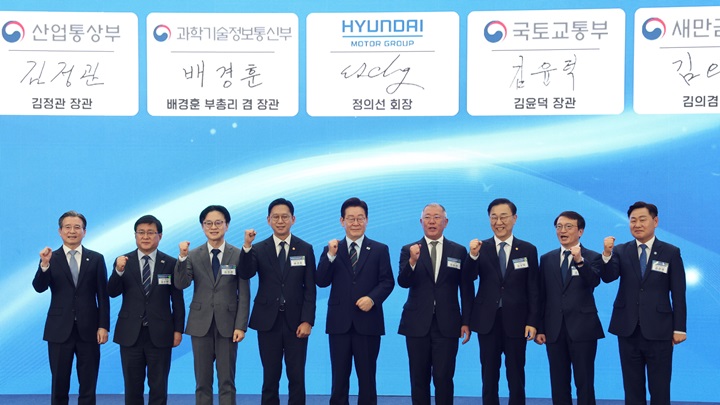
The signing drew an unusual line-up. President Lee Jae Myung attended with Deputy Prime Minister and Science Minister Bae Kyung-hoon, Land Minister Kim Yun-duk, Trade Minister Kim Jung-kwan, Climate and Energy Minister Kim Sung-whan and Jeonbuk Governor Kim Kwan Young, according to Hyundai. The group was represented by Executive Chair Chung Euisun and Vice Chair Chang Jaehoon. Lee said the government would answer with bolder support and sharply lower regulatory barriers, the presidential office said. The land ministry's release described the project as the group's first large-scale investment in a Korean region.
The Korean hub mirrors the American one, piece by piece
The CES strategy supplies the template. Hyundai said then it would invest 26 billion dollars in the United States over 2025 to 2029 and 125.2 trillion won in Korea over five years from 2026; Saemangeum sits inside the Korean figure. Atlas, built by Hyundai-owned Boston Dynamics, is due at the group's Georgia Metaplant in 2028 for parts sequencing and in 2030 for component assembly. Hyundai Mobis is developing actuators and entering the robot components market, Hyundai Glovis handles logistics, and Hyundai Motor and Kia supply plants and production data. The group cited partnerships with NVIDIA, running since January 2025, and with Google DeepMind. Atlas has 56 degrees of freedom and lifts up to 50 kg, Hyundai said.
Capacity claims cluster at five figures, Tesla aside
Set against rivals' own disclosures, Hyundai's two sites add up to 60,000 units of stated annual capacity by 2029. Tesla said on April 22, 2026 that its first Optimus line at Fremont is designed for 1 million robots a year. 1X said on April 30 that its Hayward plant can build up to 10,000 NEO robots a year, and Agility Robotics put its RoboFab capacity at 10,000 Digit units in a June 24 filing exhibit. Disclosed capital per unit of capacity is modest at Saemangeum, about 13.3 million won for each robot of annual capacity on the 400 billion won figure, which points to assembly, test and contract work rather than deep component fabrication on site.
- Hyundai Motor Group
- Saemangeum, Korea
- Not named
- 30,000
- 2029
- 2026-02-27
- Hyundai Motor Group
- United States
- Atlas
- 30,000
- 2028
- 2026-01-05
- Tesla
- Fremont, California
- Optimus (first-generation line)
- 1,000,000
- No data
- 2026-04-22
- 1X Technologies
- Hayward, California
- NEO
- 10,000
- No data
- 2026-04-30
- Agility Robotics
- RoboFab, Salem, Oregon
- Digit
- 10,000
- No data
- 2026-06-24
Stated design capacity, not output. Hyundai figures from its January 5 and February 27, 2026 releases; Tesla from its Q1 2026 update (April 22, 2026); 1X from its April 30, 2026 factory post; Agility from its June 24, 2026 deal exhibit. Saemangeum capex per unit of annual capacity = 400 billion won / 30,000 = about 13.3 million won. Disclosed, not estimated.
As of Oct 1, 2026
Why the data centre is the real robotics bet
Modern robot control increasingly runs on learned models. Robots in service record trajectories and failures, those logs and simulated data train new policies on large GPU clusters, and the updated software is checked before it reaches machines on a shop floor. Hyundai's layout puts every step of that loop on one site, with the factory, the application centre and the 50,000-GPU cluster within the same 1.124 million square metres. The robots built there can be trained and validated against compute next door, and the same cluster also serves autonomous driving and software-defined vehicles, which spreads its cost across the group.
For Korea the plant fills a gap the government has measured. In a June 29, 2026 briefing, the trade ministry put Korea's share of 2025 global humanoid production at 1% against 86% for China, citing market research, and named a Saemangeum robot foundry as one of the country's production hubs. The government has since moved on the site. On April 8 the Saemangeum Committee expanded the investment promotion zone and approved connecting roads, and on April 9 the Saemangeum agency launched a dedicated robot and hydrogen task headquarters to handle Hyundai's project.
The risks are concrete. Capacity is a design figure, and Hyundai has named neither the robot, the customers nor the foundry's clients. Completion in 2029 is late relative to Chinese makers already shipping humanoids. The project depends on power, water, port access and a GPU supply chain the group does not control, and the 16 trillion won and 71,000 job figures are projections rather than commitments. Reclaimed land needs infrastructure first, which is why the April decisions on zoning and roads were preconditions rather than formalities.
ROBOTNESS analysis
Hyundai is spending 14.5 times more at Saemangeum on compute than on robot assembly, a sign that it sees training infrastructure and a contract foundry, not factory floor space, as the scarce assets in Korean robotics.
The evidence is in the itemisation. The data centre takes 5.8 trillion won against 400 billion won for the robot cluster, the cluster itself is split between Hyundai's own robots and contract work for smaller firms, and the application centre exists to validate AI software before deployment. The US plant, by contrast, is tied to a named product and a named first customer in Georgia. Saemangeum looks designed to make Hyundai the place where other Korean robot makers get products built and trained.
The strongest counter-argument is that the data centre is a group asset dressed in robot language. Its stated workloads include autonomous driving, software-defined vehicles and smart factories, so the robotics share of its use may be small, and the robot cluster's 400 billion won may be all that is truly about robots.
Bull case. If the foundry wins Korean SME clients and Hyundai Mobis actuators flow through the parts complex, Saemangeum becomes a domestic alternative to Chinese contract supply by 2030, and Hyundai controls both the hardware line and the training stack for Korean physical AI.
Bear case. If the data centre slips or GPU supply tightens, the robot plant opens in 2029 without its training loop, into a market where Chinese makers have had three more years of volume, and the 30,000 figure stays a design number.
Signals to watch.
- 2027: groundbreaking of the data centre and solar plant, and whether Hyundai specifies the first GPU phase.
- 2028: start of robot cluster construction, in the same year Atlas is due at the Georgia Metaplant.
- 2029: completion of the robot cluster and the first named foundry clients.
The question Hyundai has not answered is which robot will come off the Saemangeum line first, and whose name will be on it.
- 1.124 million square metres (about 340,000 pyeong), Saemangeum, Gunsan
- 1 trillion won 200 MW class PEM electrolyser; 1.3 trillion won solar, gigawatt scale by 2035
- February 27, 2026, signing attended by President Lee Jae Myung
- US facility for 30,000 Atlas robots a year by 2028 (announced January 5, 2026)
- 5.8 trillion won, up to 50,000 GPUs in phases, 2027 to 2029
- 400 billion won; finished-robot factory of about 30,000 units a year, SME contract foundry, parts complex, Robot Application Center
- About 9 trillion won from 2026 (itemised components sum to 8.9 trillion won)
- About 16 trillion won economic effect, about 71,000 direct and indirect jobs
- Construction 2028, completion 2029
Why it matters
Saemangeum gave Korea a dated domestic robot factory with a stated output and a site, at a scale comparable to the plans US makers have disclosed. Much of Korea's robot policy until then had been framed around R&D programmes and alliances; Hyundai attached a capacity figure and a completion year.
The structure matters more than the size. A foundry that builds robots for small and mid-sized companies is a service Korea's robot start-ups have lacked, and it creates a pull for domestic actuators, reducers and sensors through the parts complex. If it works, Hyundai becomes a platform for the Korean industry rather than just another robot maker competing with it.
Rival analysis
Tesla is the outlier on stated capacity, with a Fremont line designed for 1 million Optimus units a year disclosed on April 22, 2026; Hyundai is not trying to match that number. Its 30,000 units per site sit three times above 1X's Hayward capacity of 10,000 NEO units and Agility's 10,000 Digit units at RoboFab, which places Hyundai in the second tier on paper with two sites rather than one.
Among Korean groups, LG Electronics and Doosan Robotics have since set humanoid timelines (LG a bipedal humanoid in early 2027 with NVIDIA, Doosan an industrial humanoid by 2028), while Samsung works with Rainbow Robotics on humanoids. In ROBOTNESS records none of them has disclosed a domestic robot factory with a unit capacity, so Hyundai's foundry could end up building for rivals as well as its own brands.
Valuation context
Hyundai disclosed no return targets for the hub, and the economic effect and job numbers are its own projections. The disclosed capital for robots, 400 billion won for 30,000 units of annual capacity, works out to about 13.3 million won per unit of capacity. That is low for a vertically integrated humanoid plant, which suggests the parts complex will depend on tenants and suppliers rather than Hyundai's own capex.
The data centre is where the balance sheet risk sits. At 5.8 trillion won it is the largest single item and is shared with autonomous driving and vehicle software, so investors should treat it as group infrastructure whose robotics payoff depends on how much of the 50,000-GPU capacity is actually allocated to robot training.
Supply-chain implications
Hyundai Mobis is developing high-performance actuators and said at CES 2026 that it is entering the robot components market; the Saemangeum parts complex is the natural home for that business in Korea. Reducers, motors, sensors and robot hands remain the components the trade ministry later flagged as weak in Korea's supply base.
Compute is the external dependency. A 50,000-GPU cluster depends on accelerator supply that Hyundai does not control, with NVIDIA its named partner since January 2025. The same site also carries the solar and electrolyser projects, so the hub's schedule is bound up with two large energy builds on reclaimed land whose zoning and connecting roads the government only approved in April 2026.
Signals to watch
The first hard milestone is the 2027 groundbreaking of the data centre and solar plant. A named GPU vendor, first-phase GPU count and power contract would show the compute side is real; a slip would push robot training behind the 2029 plant completion.
The second is 2028, when the robot cluster starts construction in the same year Atlas is due at the Georgia Metaplant. Watch whether Hyundai names the Korean robot product and the first foundry clients, and whether Hyundai Mobis discloses external actuator customers. The government's own moves, from the April 2026 zoning expansion to the robot and hydrogen task headquarters, should be followed by land supply and permits.
Analyst view
Thesis: Saemangeum is a compute and foundry play with a robot factory attached, and its value to Hyundai lies in owning the training and contract-manufacturing layer for Korean physical AI. Confidence: medium. The itemised budget and the foundry language support the thesis; what is missing is any named robot, client or GPU vendor.
What would change our view: a disclosure that the plant will build a single Hyundai or Boston Dynamics model at volume would make it a captive factory, and a cut in data centre scope would weaken the link between compute and robots that the thesis rests on.
Questions you should be asking
Which robot models will the Saemangeum factory build first, and will Atlas or a Korean derivative be among them?
How much of the 50,000-GPU data centre is reserved for robot training versus vehicles, and who supplies the accelerators?
What share of the 30,000-unit capacity is reserved for foundry clients, and on what commercial terms will smaller firms get access?
Will Hyundai Mobis build actuators in the Saemangeum parts complex, and for which customers outside the group?