Universal Robots wins a German injunction against Chinese cobot rival Elite Robots as Teradyne's robotics sales reach $91 million
The Hamburg Regional Court on April 21, 2026 granted Teradyne Robotics a preliminary injunction barring Elite Robots Deutschland from distributing software that allegedly copies Universal Robots code. A week later Teradyne reported $91 million of first-quarter robotics revenue, about 7% of a record $1,282 million group total.
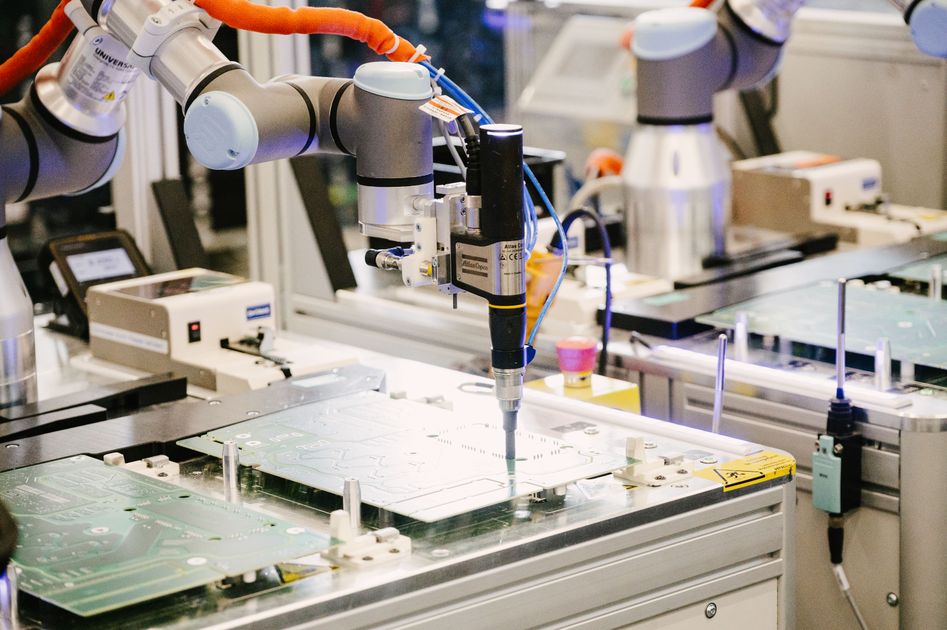
Universal Robots, the Danish collaborative robot maker owned by Teradyne, has won the first round of its legal campaign against low-cost Chinese competitors in Europe. On April 21, 2026 Teradyne Robotics said the Regional Court of Hamburg had issued a preliminary injunction against Elite Robots Deutschland GmbH in a copyright case over Universal Robots software.
Under the order, as described by Teradyne, Elite Robots Deutschland must immediately stop offering or distributing the infringing software, and products that contain it, in Germany. The company must also disclose comprehensive information about the infringing acts, including the customers it supplied. Teradyne said it may take action against Elite Robots' distributors and partners if they continue to offer the software.
How the case developed
Teradyne said it began proceedings in February 2026. On March 10 it went public, describing Elite Robots as a Chinese robot company operating in Germany through a subsidiary and saying it had already sent a cease-and-desist letter. In that statement Teradyne framed the dispute as a question of European industrial resilience, arguing that weak protection of intellectual property would let non-European competitors gain an unfair advantage. It cited survey figures that 48% of European manufacturers see robotics as the most transformative technology to 2030, 68% name productivity as their top automation driver and 84% report positive employee responses to robots.
Jean-Pierre Hathout, president of Teradyne Robotics Group, said after the ruling that the company believes it has irrefutable evidence of copyright infringement, and that it had chosen to take a stand against competitors copying its proprietary hardware or software design. He also stressed that this is not a final ruling. A preliminary injunction is an interim measure, and the merits can still be contested.
A busy April
Two days later, on April 23, Teradyne Robotics and contract manufacturer Flex expanded their partnership. Flex already makes key components for Universal Robots cobots and uses UR cobots and Mobile Industrial Robots autonomous mobile robots in its own plants, building on a relationship of about 20 years in semiconductor equipment. The companies said they would work together on physical AI and adaptive automation across Flex's global manufacturing footprint.
On April 28 Teradyne reported first-quarter 2026 revenue of $1,282 million, up from $686 million a year earlier. Semiconductor Test brought in $1,111 million, Robotics $91 million and Product Test $80 million. Chief executive Greg Smith said about 70% of revenue was tied to AI-related demand. The release also noted that severance charges in the fourth quarter of 2025 and first quarter of 2025 related mainly to Robotics restructuring affecting about 200 and 150 employees respectively. Teradyne guided second-quarter revenue to $1,150 million to $1,250 million.
- Semiconductor Test
- 1111
- 86.7
- Robotics (Universal Robots, MiR)
- 91
- 7.1
- Product Test
- 80
- 6.2
- Group total
- 1282
- 100
Revenue as reported by Teradyne on April 28, 2026. Share = segment revenue / group revenue, rounded to one decimal. Group Q1 2025 revenue was $686 million.
As of Oct 1, 2026
Company background
Teradyne Robotics, headquartered in Odense, Denmark, owns Universal Robots and Mobile Industrial Robots. Universal Robots sells lightweight cobot arms programmed through its PolyScope software, a combination that made it the reference brand in collaborative robots and also the template that many newer entrants follow. In March 2026 the company launched an imitation learning system with Scale AI called UR AI Trainer, aimed at moving AI-trained tasks from the lab to the factory.
Why software is the battleground
Cobot arms have become commodities in mechanical terms, and price competition from Chinese makers has intensified. What keeps customers loyal is the software layer: the programming interface, the ecosystem of grippers and accessories, and the integrator know-how built around it. If a competitor's software closely mirrors PolyScope, integrators can switch hardware with little retraining. Teradyne's choice of a copyright claim on software, rather than a hardware patent alone, targets exactly that switching cost.
Risks and open questions
The Hamburg order covers Germany only and is provisional. Teradyne's public statements did not name the specific code at issue or the scale of Elite Robots' German sales. Robotics remains a small share of Teradyne's business at about 7% of first-quarter revenue, and two rounds of restructuring suggest the unit is still under cost pressure.
What to watch
Main proceedings in Hamburg, any action against Elite Robots distributors, and Teradyne's second-quarter results in late July will show whether the legal strategy and the Flex alliance translate into growth.
ROBOTNESS analysis
Teradyne is using European courts to defend a software moat that price alone can no longer protect.
The evidence is the sequence of moves. A copyright case aimed at software, an injunction that reaches customer lists, and an explicit threat to distributors all target the channel through which cheaper arms reach European integrators. The Flex deal adds a manufacturing partner that can lower UR's own costs.
The strongest counter-argument is that a provisional order in one country does little against a market where Chinese makers compete on hardware price and can rewrite contested software. Customers may also read litigation as a sign that UR fears losing on product merit.
Bull case. If the main proceedings confirm the injunction, distributors across Europe will think twice before carrying lookalike software, and UR keeps its premium. Combined with Flex manufacturing and AI-trained applications, robotics revenue can resume growth.
Bear case. Elite Robots and others adjust their code and keep selling, while UR carries legal costs and restructuring. Robotics at $91 million a quarter stays a side business inside a semiconductor test group riding AI demand.
Signals to watch.
- Main proceedings in Hamburg in 2026, and any appeal by Elite Robots Deutschland.
- Late July 2026: Teradyne's second-quarter Robotics revenue against the $91 million first-quarter figure.
- Any filings by Teradyne against other Chinese cobot makers in European courts in 2026.
- Regional Court of Hamburg
- Germany; stop distribution of infringing software and products, disclose customers
- Preliminary injunction, announced April 21, 2026
- Elite Robots Deutschland GmbH
- February 2026
- $91 million
- $1,282 million
- April 23, 2026
Why it matters
This is the first publicly reported court order a Western cobot leader has obtained against a Chinese rival's German subsidiary over software. It sets a template other European and US robot makers can follow, and it targets the integrator channel where purchasing decisions are made.
The ruling also arrives as Brussels debates industrial resilience. Teradyne explicitly framed IP enforcement as a European competitiveness issue, which positions it as an ally of policy makers rather than only a litigant.
Rival analysis
Chinese cobot makers have grown on price and fast product cycles. Elite Robots is one of several. A software injunction does not stop rivals selling hardware with their own software, so its effect depends on how close competing interfaces are to PolyScope.
In Europe, UR also competes with NEURA Robotics and with the cobot lines of ABB and KUKA. Those rivals sell their own software stacks and are not affected by the case.
Valuation context
Robotics produced $91 million of Teradyne's $1,282 million first-quarter revenue, or 7.1%. Semiconductor Test produced 86.7%. Investors therefore value Teradyne mainly on AI test demand, and the robotics unit's legal costs and restructuring have little effect on the group multiple.
That gap creates an option for Teradyne. A robotics business that is small within the group but strategically positioned in Europe could be run for margin, partnered or separated over time.
Supply-chain implications
Flex manufactures key components for UR cobots and uses UR and MiR robots in its own plants. The expanded partnership gives UR access to a global contract manufacturing network that can bring its costs closer to Asian rivals.
For European integrators, the injunction adds compliance risk to carrying lookalike products in Germany, which may steer purchasing toward established brands in the short term.
Signals to watch
Main proceedings in Hamburg, any appeal, and whether Teradyne files against distributors will show how far the legal strategy reaches.
Quarterly Robotics revenue is the commercial signal. A rise from $91 million would suggest the restructuring and Flex alliance are working.
Analyst view
Thesis: Teradyne is converting UR's software position into a legal moat in Europe while cutting costs in robotics. Confidence: medium. The court order and Q1 figures are confirmed in Teradyne releases, but the order is provisional and covers one country.
We would raise confidence if the main proceedings confirm the injunction and robotics revenue grows for two consecutive quarters.
Questions you should be asking
Which specific software components did the court find likely infringing, and how large were Elite Robots' German sales?
Will Teradyne pursue similar cases in other EU states or at the Unified Patent Court? Does Flex's role extend to full cobot assembly?