Paris-based Inbolt raises $12.5 million to take its AI robot vision from car plants to data centres
Inbolt, which sells 3D vision and AI software that lets industrial robots correct their motions in real time, said on 30 September 2026 it raised $12.5 million in a round led by Shift4Good. The money funds expansion in the US and Asia-Pacific and a move into data centres and electronics manufacturing, taking total funding to $34 million.
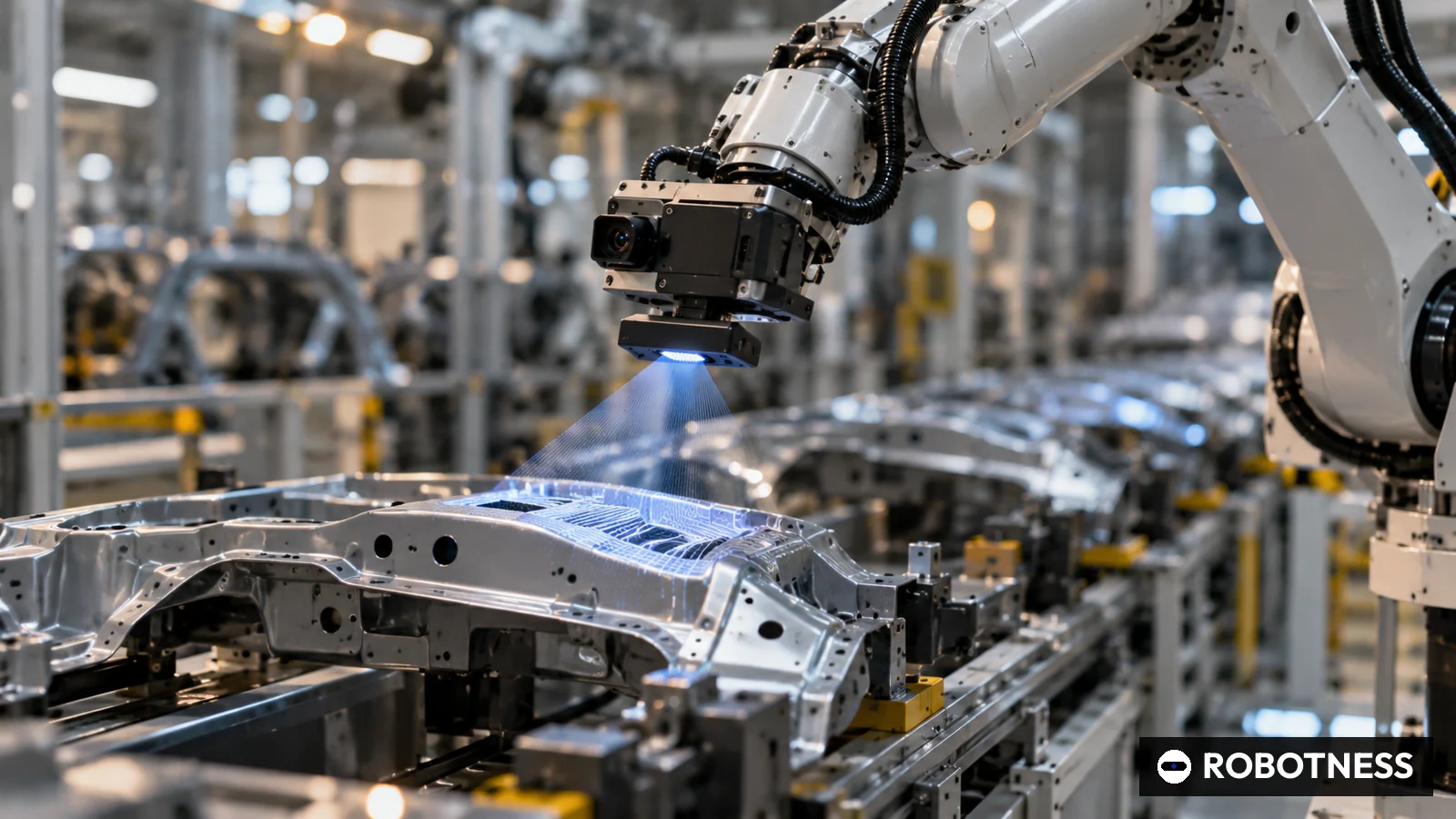
Inbolt, a Paris developer of AI vision software for industrial robots, said on 30 September 2026 that it had raised $12.5 million in a round led by Shift4Good. The company plans to use the money to grow in the United States and Asia-Pacific and to move beyond automotive plants into data centres and electronics manufacturing.
The round
Bridges Climate Transition Partners, BNP Paribas Développement and Ora Global joined the round, according to the company's announcement. Inbolt did not give the round a series name and did not disclose a valuation. It said the raise brings its total funding to $34 million. BNP Paribas Développement is a returning backer: it was among the existing investors named when Inbolt closed a €15 million Series A led by Exor Ventures in September 2024.
What Inbolt sells
Inbolt pairs a 3D camera with AI software so that a robot can perceive the part or workstation in front of it and correct its trajectory inside the control loop, instead of repeating a fixed path. The company says the system is trained from a CAD model in minutes, runs on new and existing lines, and works with arms from FANUC, ABB, KUKA, Yaskawa, Comau and Universal Robots.
The company said it now has more than 200 robots deployed in more than 100 factories across three continents, with customers including Bosch, Beko, Flex, Ford, Stellantis and Toyota. It reported compound annual revenue growth of more than 500% over two years and opened a Detroit office in 2026. When it announced its Series A two years ago, Inbolt said it was in production at more than 20 industrial sites.
Background
Rudy Cohen, Albane Dersy and Louis Dumas founded Inbolt in Paris in 2019, and Cohen is chief executive. In the announcement Cohen argued that industrial robots have run without sight for about fifty years and that software, rather than new hardware, is what lets them cope with parts that are not where the program expects. Julien Baumont, a partner at Shift4Good, described the investment as part of AI moving off screens and into factories and machines.
Competitive context
Inbolt competes with the vision options that arm makers sell for their own robots and with independent machine-vision suppliers. Its pitch is brand independence, so that a plant running FANUC, KUKA and Universal Robots arms side by side can use one guidance layer. The same multi-vendor logic drives software companies such as Dresden's Wandelbots, whose NOVA platform programs robots from different makers, and Japan's Qibitech, which raised a Series B for vendor-agnostic robot control on the same day as Inbolt.
ROBOTNESS analysis
Inbolt's raise is a bet that the next wave of factory automation spending goes into retrofitting the installed base of blind robots rather than buying new machines, and the push into data centres tests whether that logic travels beyond car plants.
The customer list supports the thesis. Ford, Stellantis and Toyota already own large fleets of conventional arms, and Inbolt's growth from more than 20 sites in 2024 to more than 100 factories in 2026, by its own count, came from adding perception to robots those plants already had. The round is small next to the capital going to humanoid and robot-model companies this week, as the table shows, but it is backed by revenue in a segment where buyers already hold budgets.
- SiMa.ai
- US
- Edge AI chips for physical AI
- Series C
- 150
- 2026-09-28
- Inbolt
- FR
- AI 3D vision for industrial robots
- Unnamed
- 12.5
- 2026-09-30
- Destro AI
- US
- Warehouse multi-robot orchestration
- Seed
- 8
- 2026-09-29
- Tangent Robotics
- US
- Tactile robot hands
- Pre-seed
- 4.5
- 2026-09-30
- Qibitech
- JP
- Vendor-agnostic robot control software
- Series B
- No data
- 2026-09-30
Amounts as disclosed on each company's primary announcement; Qibitech disclosed about JPY 600 million and is not converted. Inbolt share of disclosed USD total = 12.5 / 175 = 7.1%. Figures disclosed, not estimated.
As of Oct 1, 2026
The strongest counter-argument is that robot makers are moving up the stack themselves. FANUC and Yaskawa both announced AI partnerships in 2026, and if built-in perception becomes good and cheap enough, an independent vision layer loses much of its reason to exist. Data centres and electronics plants also differ from car body shops, with smaller parts, tighter tolerances and higher cycle counts, so a record in automotive does not transfer automatically.
- 2024-09-19
- Series A
- 15
- EUR
- Exor Ventures
- 2026-09-30
- Unnamed
- 12.5
- USD
- Shift4Good
Amounts in millions of the currency the company disclosed. Company-stated total raised after the 2026 round: USD 34m. Latest round as share of total = 12.5 / 34 = 36.8%. Days between announcements = 741. Figures disclosed, not estimated.
As of Oct 1, 2026
In the bull case Inbolt names its first data-centre or electronics customers within a year, keeps growth near the reported pace and uses the Detroit office to win more North American plants, setting up a larger round in 2027. In the bear case arm makers bundle comparable vision at little extra cost, automotive capital spending slows, and $12.5 million proves thin for expansion on two new continents at once.
Three signals would confirm or break the thesis.
- By 31 March 2027, whether Inbolt names a data-centre or electronics customer.
- By 30 June 2027, an updated deployment count above the 200 robots and 100 factories stated in September 2026.
- Over the next 12 months, any FANUC, ABB, KUKA or Yaskawa launch of native AI guidance that overlaps with Inbolt's product.
- $12.5 million
- 30 September 2026
- 200+ robots in 100+ factories on three continents (company-stated)
- $34 million (company-stated)
- US and Asia-Pacific expansion; data centres and electronics manufacturing
- Shift4Good
- €15 million Series A led by Exor Ventures, September 2024
- FANUC, ABB, KUKA, Yaskawa, Comau, Universal Robots
- Bridges Climate Transition Partners, BNP Paribas Développement, Ora Global
Why it matters
Most of the robots that will work in factories in 2030 are already installed, and they run fixed programs. Inbolt sells the cheapest route to making those machines tolerant of variation: a camera and software rather than a new cell. A $12.5 million round is small, but it is one of the few disclosed 2026 rounds in robotics where the company can point to named automotive buyers and more than 100 plants in production.
The move into data centres matters because rack assembly and server handling are among the fastest-growing manual workloads tied to AI capital spending. If Inbolt's guidance works there, it gains a buyer segment that is spending heavily and is less exposed to the car cycle.
Rival analysis
Inbolt's direct rivals are the vision packages from arm makers and established machine-vision suppliers. The arm makers own the controller and the customer relationship, which is a structural advantage; Inbolt's answer is that a single layer across FANUC, ABB, KUKA, Yaskawa, Comau and Universal Robots arms is worth more to a mixed-fleet plant than six separate options.
The nearest software peers in the ROBOTNESS database are multi-vendor platforms such as Wandelbots (Dresden) and Qibitech (Tokyo). They orchestrate or program robots across brands; Inbolt adds perception at the arm. Over time these layers could converge, either through partnerships or acquisitions by controller makers who want the capability without building it.
Valuation context
Inbolt disclosed no valuation for this or earlier rounds, so the desk makes no valuation comparison. What can be measured: the 2026 round equals 36.8% of the $34 million the company says it has raised in total, and 741 days separated the Series A announcement (19 September 2024) from this one. Of the five robotics rounds the desk verified between 28 September and 1 October 2026, Inbolt's is the second largest by disclosed USD amount and about 7.1% of the $175 million disclosed in total.
The absence of a series label and the mix of climate-focused investors (Shift4Good, Bridges Climate Transition Partners) suggests the round was positioned on industrial efficiency rather than on a step-up in valuation. That is our reading, not a company statement.
Supply-chain implications
Inbolt's hardware exposure is limited to 3D cameras and compute fitted to existing arms; the robot itself is the customer's. That keeps capital needs low but makes the company dependent on access to controller interfaces from FANUC, ABB, KUKA, Yaskawa, Comau and Universal Robots. Any tightening of those interfaces, or bundling of native vision, would hit Inbolt before it hit integrators.
Geographically, revenue is concentrated in European and North American automotive plants. The Asia-Pacific push named in the announcement would bring it closer to Japanese and Chinese arm makers' home markets, where built-in vision is common.
Signals to watch
First, a named data-centre or electronics customer by the end of March 2027. Second, an updated deployment count beyond 200 robots and 100 factories by mid-2027. Third, product moves by the major arm makers on native AI guidance over the next year, especially FANUC and Yaskawa, which already have AI partnerships in place in 2026.
Analyst view
Thesis: Inbolt is positioned to profit from retrofitting the installed robot base, and its data-centre push is the test of whether that market extends beyond automotive. Confidence: medium. The customer list and the growth from more than 20 sites to more than 100 factories are concrete, but revenue figures are not disclosed in absolute terms, and the competitive response from arm makers is the main unknown.
We would raise confidence on a named non-automotive customer and lower it if a major arm maker launches comparable AI guidance as a standard feature.
Questions you should be asking
What share of revenue comes from automotive today, and what share does management expect from data centres and electronics by 2028? How many of the 200-plus robots run on arms from each of the six supported brands? Are there formal partnership agreements with any arm maker for controller access? What is the absolute revenue behind the 500% compound growth figure?