Universal Robots launches Gen 7 cobot platform as Teradyne takes its fight with Chinese rivals to Europe's patent court
Universal Robots unveiled its seventh-generation platform on September 14, 2026, with three new g-Series arms, a CB7 controller offering 40% more compute in a 30% smaller footprint, and native ROS 2 support. Two weeks earlier its parent Teradyne Robotics sued the German subsidiary of China's JAKA at the Unified Patent Court, its second European IP action against a Chinese cobot maker this year.
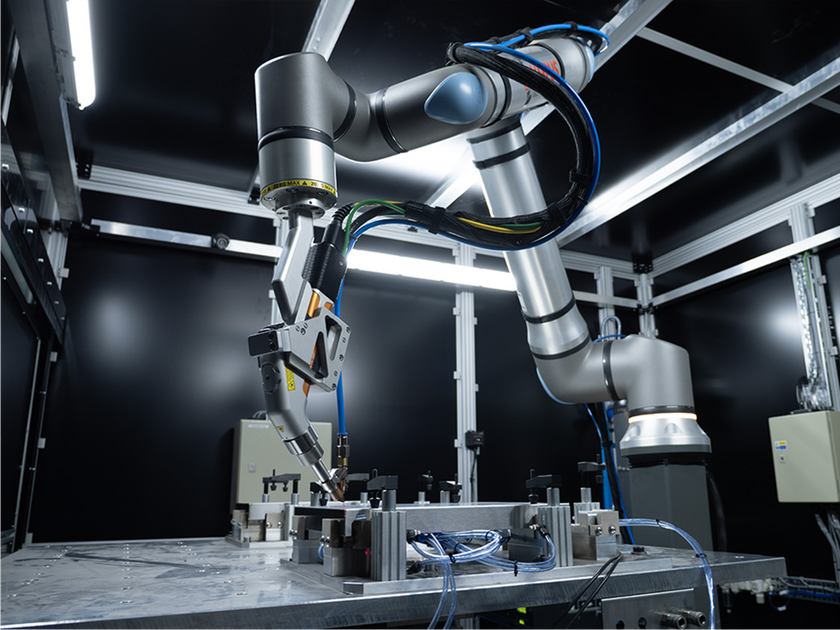
Universal Robots, the Danish company that popularised collaborative robot arms, introduced its seventh-generation platform at the IMTS trade show in Chicago on September 14, 2026. The launch pairs three new arms with a new controller, teach pendant and software stack that the company describes as ready for AI applications out of the box. It comes as Teradyne Robotics, the group that owns Universal Robots, steps up legal action in Europe against Chinese cobot makers it accuses of copying its technology.
The hardware
The new g-Series consists of the UR10g-1750, the UR17g-1300 and the UR18g-950. Universal Robots said the names give payload in kilograms and reach in millimetres, so the range runs from a 10 kg arm with 1,750 mm reach to an 18 kg arm with 950 mm reach. The company did not publish prices or shipping dates in its announcement.
The CB7 Core controller offers 40% more computing power than previous generations in a footprint 30% smaller, according to the company. It supports communication over several industrial networks at once, comes in a standalone version and a compact version for integration into control cabinets, and works with the existing e-Series and UR Series arms as well as the new g-Series. That backward compatibility matters for the large installed base. Universal Robots says its robots are used in more than 100,000 industrial deployments worldwide.
The TP7 Core teach pendant is more than 20% lighter than its predecessor, has a full HD display, configurable buttons and a virtual joystick. A new SP7 Smart Panel mounts on the tool flange so operators can program and guide the arm by hand at the tool, with a safety-rated freedrive function, status LEDs and three configurable buttons.
Software, safety and security
Gen 7 runs the PolyScope X operating system, offers open APIs and supports communication over ROS 2, the open-source robot middleware widely used in research and by AI developers. The company said the platform is certified to ISO 10218-1, the international safety standard for industrial robots, and complies with IEC 62443-4-1 at maturity level 3 for secure product development. More than 20 partners, including Cognex, Schunk, Robotiq and Inbolt, showed applications on the platform through the UR+ ecosystem.
The company presented Gen 7 as the base for moving AI applications from the lab into production. The pitch is less about a single robot and more about compute headroom and open interfaces, so that vision systems and AI models from partners can run close to the arm.
The legal offensive
On August 27, Teradyne Robotics said it had started a patent infringement case at the Unified Patent Court's local division in Copenhagen against the German subsidiary of JAKA, a Chinese collaborative robot maker. The company alleges infringement of software and hardware patents across a broad range of JAKA cobot models marketed in the EU. It said a ruling could have effect in 17 of the 18 EU member states that currently take part in the UPC system, as well as in the United Kingdom and Spain. Hathout said the case shows that Teradyne Robotics will enforce its patents and IP rights against what it considers illegal and unfair copying.
It is the company's second European action of 2026. On March 10, Teradyne Robotics announced a copyright lawsuit in Germany against the German subsidiary of Elite Robots, another Chinese cobot maker, over Universal Robots software, and said it had reported safety concerns about the products to European authorities. On April 21, the Regional Court of Hamburg granted a preliminary injunction prohibiting Elite Robots Deutschland GmbH from offering or distributing the infringing software and products containing it in Germany and requiring it to disclose information about the infringement and its customers. The ruling is not final.
- UR10g-1750
- 10
- 1750
- 5.71
- UR17g-1300
- 17
- 1300
- 13.08
- UR18g-950
- 18
- 950
- 18.95
Payload and reach from model names as explained by Universal Robots. Payload per metre of reach = payload / (reach / 1000), rounded to two decimals.
As of Oct 1, 2026
The business behind it
Teradyne's robotics segment, which includes Universal Robots and the mobile robot maker MiR, reported revenue of $100 million in the second quarter of 2026, out of group revenue of $1,329 million, according to Teradyne's results published on July 28. Semiconductor test contributed $1,122 million. Robotics is therefore about 7.5% of Teradyne's sales, a small share for a business that the group positions at the centre of its physical-AI strategy. On September 15, Teradyne Robotics named Jacob Pascual Pape, a former Universal Robots commercial leader, as chief commercial officer.
- Semiconductor Test
- 1122
- 84.4
- Product Test
- 107
- 8.1
- Robotics (Universal Robots, MiR)
- 100
- 7.5
- Group total
- 1329
- 100
From Teradyne's second-quarter 2026 results of July 28, 2026. Share = segment revenue / group revenue, rounded to one decimal.
As of Oct 1, 2026
What it means for the market
The cobot market that Universal Robots created has filled with lower-priced competitors, many from China. Gen 7 answers on product, with more compute, open interfaces and certified safety and security. The lawsuits answer on IP. Together they show a strategy of defending premium pricing in Europe through technology and law, rather than by matching prices.
Risks and open questions
Universal Robots has not said when the g-Series ships or at what price. Patent cases at the UPC take time, and JAKA has not publicly responded in materials reviewed by ROBOTNESS. Litigation can also deter customers who simply want cheaper arms and do not care about the origin of the software.
ROBOTNESS analysis
Universal Robots is defending its position in Europe on two fronts, a more open and compute-rich platform and aggressive IP enforcement, because price alone no longer protects the category it created.
The evidence is the timing. A patent suit against JAKA on August 27, a product launch on September 14 and a new chief commercial officer on September 15 followed a copyright injunction against Elite Robots in April. The pattern points to a deliberate effort to raise the cost of imitation while lifting the value of the original.
The strongest counter-argument is that customers in price-sensitive segments may not follow. If Chinese cobots are good enough for simple tasks, lawsuits limited to specific software and hardware features may slow but not stop them.
Bull case: the UPC grants relief across most of the EU, distributors of challenged products become cautious, and Gen 7's compute and ROS 2 support make UR the default arm for AI-driven applications from partners. Robotics revenue grows faster than in recent quarters.
Bear case: the cases drag on, competitors design around the patents, and the g-Series ships late. Universal Robots keeps premium customers but loses volume in general industry.
- Q4 2026: price and shipping dates for the g-Series and CB7 controller.
- Teradyne third-quarter 2026 results, against group revenue guidance of $1.2 billion to $1.3 billion in group revenue.
- 2027: first procedural decisions in the UPC case against JAKA and the outcome of the main proceedings against Elite Robots in Germany.
- Gen 7 platform, IMTS Chicago, September 14, 2026
- UR10g-1750, UR17g-1300, UR18g-950
- PolyScope X, open APIs, ROS 2 communication
- CB7 Core, 40% more compute, 30% smaller footprint
- UPC Copenhagen local division vs JAKA German subsidiary, August 27, 2026
- 10 kg to 18 kg
- ISO 10218-1; IEC 62443-4-1 ML3
- Hamburg Regional Court preliminary injunction vs Elite Robots Deutschland, April 21, 2026
- More than 100,000 deployments (company figure)
- $100 million
Why it matters
Universal Robots defined the collaborative robot category and remains the reference supplier in Europe. Its seventh-generation platform sets the baseline that integrators and AI software partners will build on for the next several years, and its decision to support ROS 2 and open APIs aligns the world's most widely deployed cobot with the tools used by robot AI developers.
The legal campaign matters because it tests whether European IP law can slow low-cost competition in industrial robots. The Unified Patent Court offers one action covering most of the EU, and a win against JAKA would show other incumbents a route that national courts did not easily provide.
Rival analysis
JAKA and Elite Robots are Chinese cobot makers that have expanded in Europe through German subsidiaries, according to Teradyne's filings and announcements. Teradyne alleges copying of patented hardware and software features. Other European and Japanese incumbents in cobots, such as ABB Robotics, KUKA and FANUC, have not announced comparable actions in 2026 in materials reviewed by ROBOTNESS.
On product, Gen 7's 18 kg arm with 950 mm reach and the 10 kg arm with 1,750 mm reach target palletising, machine tending and long-reach handling, segments where competitors have gained share with lower prices. UR's argument is total value: safety certification, cybersecurity compliance, a partner ecosystem and backward compatibility with its installed base.
Valuation context
Universal Robots is not separately listed, so its value sits inside Teradyne. In the second quarter of 2026, robotics revenue was $100 million out of $1,329 million, or about 7.5% of group revenue, while semiconductor test generated $1,122 million. Investors value Teradyne mainly on semiconductor test, and robotics is a call option on physical AI.
That makes Gen 7's commercial success and the outcome of the IP cases relevant to whether robotics can become a larger share of Teradyne's earnings. Teradyne guided group revenue of $1.2 billion to $1.3 billion for the third quarter of 2026.
Supply-chain implications
The CB7 controller's added compute and multi-network communication shift more processing to the robot cell, which benefits vision and AI partners such as Cognex and Inbolt, and gripper makers such as Schunk and Robotiq. The UR+ ecosystem of more than 20 partners shown at launch is a supply chain of its own, built around UR's interfaces.
IEC 62443-4-1 maturity level 3 compliance responds to growing cybersecurity requirements for connected machinery in Europe, including those under the new Machinery Regulation from January 2027. Suppliers that cannot document secure development may find it harder to integrate with certified platforms.
Signals to watch
The first signal is commercial: published prices and shipping dates for the g-Series and the CB7 controller, and how quickly existing customers upgrade. The second is Teradyne's third-quarter 2026 robotics revenue against the $100 million reported for the second quarter.
The third is legal: procedural steps in the UPC case against JAKA, and the main proceedings against Elite Robots in Germany following the April preliminary injunction.
Analyst view
Thesis: Universal Robots is shifting from competing on being first to competing on being the safe, certified and open standard, and it is using IP enforcement to protect that position in Europe.
Confidence: medium. The product details and legal filings are disclosed by the company, and the Hamburg injunction is a concrete result. Confidence is limited because pricing, shipping dates and court outcomes are not yet known, and patent cases can take years.
Questions you should be asking
When will the g-Series ship, and how will its prices compare with the e-Series and UR Series?
Which specific JAKA products and patents are covered by the UPC claim, and will Teradyne seek a preliminary injunction?
Will other European incumbents follow with their own UPC actions against Chinese cobot suppliers?