Symbotic swings to a $55 million quarterly profit as revenue rises 22% to $721 million
Symbotic reported revenue of $720.8 million for its fiscal third quarter ended June 27, 2026, up 22% from a year earlier, and net income of $55 million against a $21 million loss. The warehouse robotics maker guided fourth-quarter revenue to $760 million to $780 million and adjusted EBITDA to $100 million to $105 million.
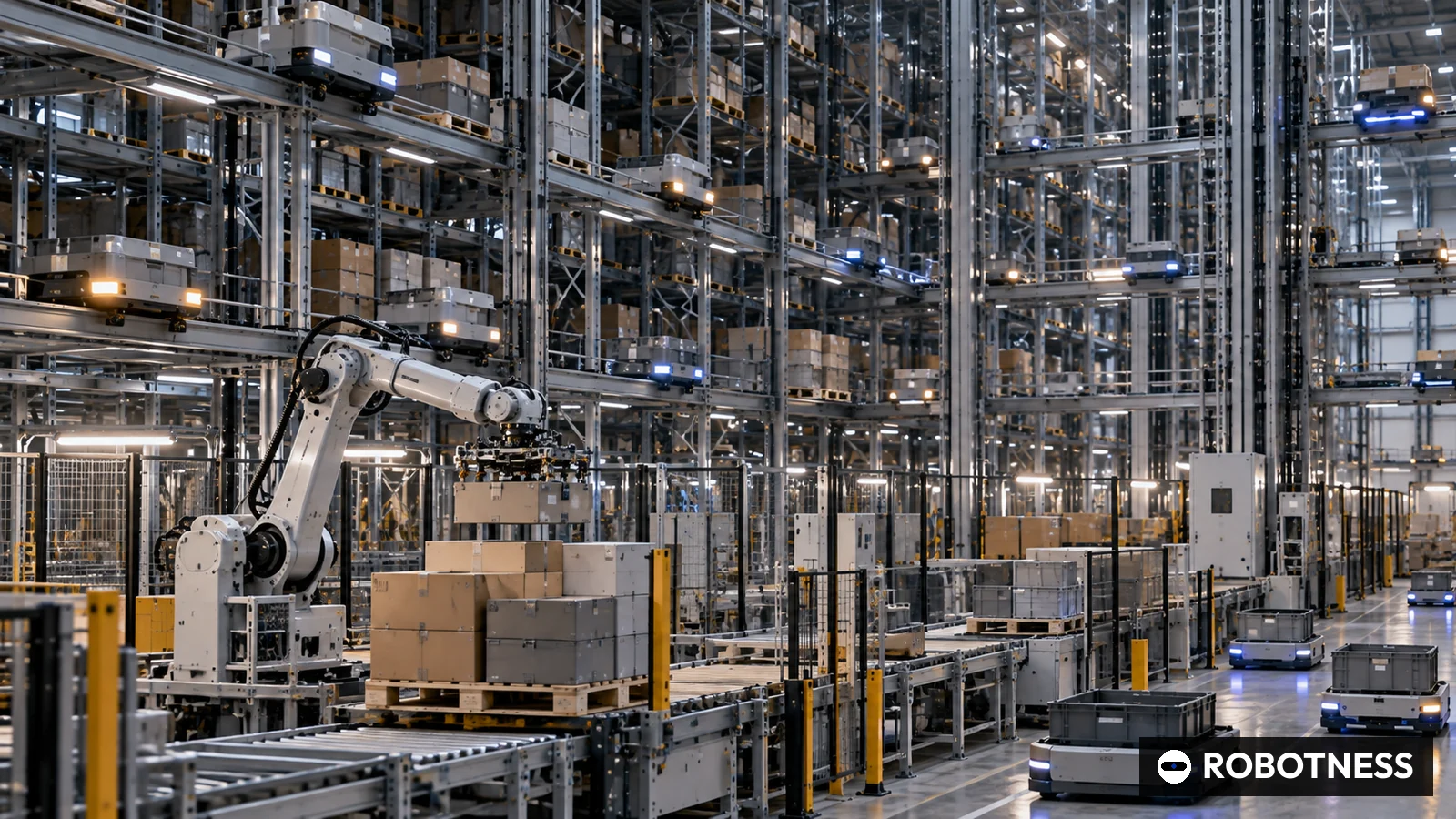
Symbotic, the warehouse automation company whose largest customer is Walmart, reported a net profit of $55 million for its fiscal third quarter, reversing a $21 million loss a year earlier, according to results filed with the U.S. Securities and Exchange Commission on August 5, 2026. Revenue for the three months ended June 27 rose 22% to $720.8 million from $592.1 million.
Adjusted EBITDA more than doubled to $95 million from $45 million, the company said. Gross margin was 22.3%, and 25.0% on an adjusted basis. For the first nine months of the fiscal year, revenue reached $2,027.3 million, net income $77.8 million and adjusted EBITDA $239.9 million, with a nine-month gross margin of 21.9%.
The company guided fourth-quarter revenue to between $760 million and $780 million and adjusted EBITDA to between $100 million and $105 million. At the midpoint, that implies full fiscal-year 2026 revenue of roughly $2.8 billion, calculated by adding the $770 million midpoint to the reported nine-month total. Symbotic said it had 77 systems in deployment.
Cash and cash equivalents stood at $1.7 billion at quarter end, down from $2.0 billion three months earlier. Operating expenses were $128.0 million, including $43.8 million of research and development. The company also announced that Steve Pagliuca, former co-chair of Bain Capital, had been elected to its board.
Chief Executive Rick Cohen said Symbotic was well on track against its key objectives and saw growing opportunities to broaden its scope with customers. The filings point to three strands that define that scope: the acquisition of Walmart's Advanced Systems and Robotics business, a commercial agreement with Nueva Wal Mart de México, and the GreenBox Systems joint venture, now doing business as Exol, which offers automated warehousing as a service. The quarterly report carries the Exol stake as an equity method investment of $140.5 million and shows $20.2 million paid in the nine months for the Walmart robotics business.
Symbotic's systems use fleets of autonomous mobile robots that travel through a dense storage structure, retrieving and placing cases of goods so that a distribution center can build store-ready mixed pallets with far fewer people. The software that schedules those robots is the core of the product, which makes Symbotic as much a fleet orchestration company as a hardware vendor.
Among listed peers, Norway's AutoStore reported second-quarter 2026 revenue of $192.1 million on August 13, up 43.4%, and Teradyne said on July 28 that its Robotics group, which includes collaborative arms and mobile robots, booked $100 million in the quarter. KION Group, whose Intelligent Automation Solutions segment covers warehouse automation, posted segment revenue of EUR 861 million, up 23%, on July 30. Symbotic is the largest of the four by quarterly revenue.
For global investors the quarter marks a shift in the debate. Symbotic's growth has long been measured in system starts and backlog; the move to a positive net income, with adjusted EBITDA margin rising to about 13.2% from about 7.6% a year ago, shifts attention to how far margins can rise as more systems complete installation.
The risks remain concentration and cash. Walmart and its affiliates sit behind the acquisition, the Mexico agreement and Exol, so any change in Walmart's capital plans would hit Symbotic directly. Cash fell by about $300 million in the quarter, and gross margin of 22.3% leaves limited cushion if installation costs rise.
The next markers are the fourth-quarter report, due in late 2026, where the company must deliver $760 million to $780 million of revenue, and any disclosure of Exol customers outside the Walmart group.
- Symbotic
- FQ3 2026 (to Jun 27)
- 720.8
- USD
- 22
- No data
- AutoStore
- Q2 2026
- 192.1
- USD
- 43.4
- 217.6
- Teradyne Robotics
- Q2 2026
- 100
- USD
- 33.3
- No data
- KION Intelligent Automation Solutions
- Q2 2026
- 861
- EUR
- 23
- 873
Figures as reported by each company. Teradyne Robotics growth computed as Q2 2026 $100m / Q2 2025 $75m minus 1. Order intake null where not disclosed in the release. Currencies not converted.
As of Oct 1, 2026
ROBOTNESS analysis
Symbotic has crossed into profitability on Walmart-driven volume, and the next leg depends on whether Exol and the Mexico deal turn one anchor customer into a broader base.
The evidence is in the margin path. Adjusted EBITDA rose 111% year on year while revenue rose 22%, so each incremental dollar of revenue is carrying more profit as deployments mature. The fourth-quarter guide of $100 million to $105 million in adjusted EBITDA extends that trend.
The strongest counter-argument is that the profit comes from one customer family. If Walmart slows new distribution center builds, Symbotic has few independent buyers at comparable scale to replace that demand.
Bull case. Exol signs non-Walmart customers for warehouse-as-a-service, Mexico installations ramp, and adjusted EBITDA margin moves into the mid-teens. Symbotic becomes the default platform for grocery and general merchandise case picking in North America.
Bear case. Cash keeps falling at the third-quarter pace, Walmart reprioritizes capex, and gross margin stalls near 22%. The market then values Symbotic as a captive supplier rather than a platform.
Signals to watch:
- Fourth-quarter fiscal 2026 results, expected in November to December 2026, against the $760 million to $780 million guide
- First named Exol customer outside the Walmart group
- Cash balance relative to the $1.7 billion reported for June 27, 2026
- $1.7 billion (prior quarter $2.0 billion)
- Steve Pagliuca elected
- Fiscal Q3 2026, ended June 27, 2026
- $720.8 million, up 22%
- $55 million (Q3 FY25: $21 million loss)
- Revenue $760 to $780 million; adj. EBITDA $100 to $105 million
- 22.3% (adjusted 25.0%)
- $95 million (Q3 FY25: $45 million)
- 77
Why it matters
Among the listed automation suppliers compared here Symbotic has the largest quarterly revenue, and its swing to profit is the clearest evidence so far that dense robotic case handling can earn money at scale. That matters for every private AMR and storage company raising capital on the promise of eventual margins.
The quarter also shows that the model is capital heavy on the customer side but improving on Symbotic's side. Adjusted EBITDA growth of 111% against revenue growth of 22% is operating leverage, not a one-off.
Rival analysis
AutoStore grows faster, 43.4% in its second quarter, with gross margin of 72.2%, because it sells a cube storage product through partners rather than delivering whole systems. Teradyne's Robotics group is smaller at $100 million a quarter. KION's automation segment is larger in revenue base than AutoStore but saw order intake fall 40%.
Symbotic's moat is integration depth with Walmart. Its weakness against AutoStore is margin structure; against KION it is customer breadth.
Valuation context
Using reported figures, Symbotic's quarterly revenue is about 3.8 times AutoStore's and 7.2 times Teradyne Robotics' (ratio = Symbotic Q3 revenue / peer quarterly revenue). Adjusted EBITDA margin was about 13.2% (95 / 720.8) compared with AutoStore's 44.9%.
The market's question is therefore not growth but how much of AutoStore-style margin a full-system integrator can ever reach. The fourth-quarter guide implies roughly 13% adjusted EBITDA margin at the midpoint ($102.5 million / $770 million).
Supply-chain implications
Symbotic's systems are built from steel storage structures, mobile robots, and controls, assembled on site over many months. The acquisition of Walmart's Advanced Systems and Robotics business brings more of the robotics know-how in house.
Installation labor and steel are the main cost pressures. A gross margin of 22.3% indicates that a large share of revenue is pass-through build cost, which is why mix shift toward software and service matters.
Signals to watch
The fourth-quarter report will show whether revenue lands within $760 million to $780 million and whether cash stabilizes. Watch also for the number of systems in deployment against the 77 reported this quarter.
Any Exol announcement naming a customer outside Walmart would be the first proof that warehouse-as-a-service broadens Symbotic's base.
Analyst view
Thesis: profitability is real and driven by operating leverage, but diversification remains unproven. Confidence: medium. The numbers come straight from SEC-filed results; the main uncertainty is customer concentration, which the filings acknowledge but do not quantify in the sections reviewed.
We would treat cash burn as the near-term watch item and Exol customer wins as the medium-term one.
Questions you should be asking
What share of fiscal 2026 revenue comes from Walmart and its affiliates combined?
What explains the $300 million decline in cash during a profitable quarter: working capital, capex or Exol funding?
When will Exol disclose its first non-Walmart deployment?