Amazon unveils a next-generation Proteus robot that takes spoken instructions, tied to a €10 billion upgrade of its European warehouses
Amazon unveiled a next-generation version of its Proteus autonomous mobile robot that employees can direct in natural language, at its Delivering the Future event in London on June 4, 2026. The company said it will invest more than €10 billion over the coming years to expand and modernize its European fulfillment network, deploy the new Proteus in Europe in the first half of 2027, expand its STARK tote-handling system to 15 European sites by 2027 and add 25,000 fulfillment jobs in Europe.
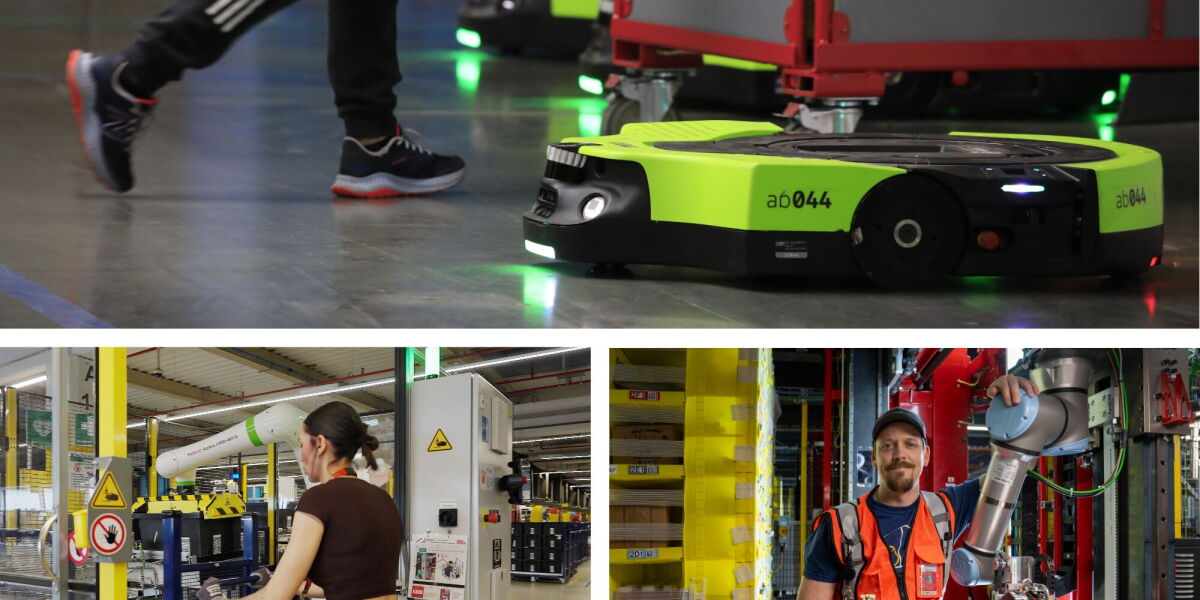
Amazon unveiled a next-generation version of Proteus, its autonomous mobile robot, at its Delivering the Future event in London on June 4, 2026, alongside a commitment to invest more than €10 billion over the coming years to expand and modernize its fulfillment centers in Europe. The company said it plans to deploy the new Proteus in Europe in the first half of 2027.
The new robot is designed to take instructions in plain language. Amazon said advances in AI allow the next-generation Proteus to understand natural language, so employees can assign it tasks the way they would brief a colleague. Scott Dresser, vice president of Amazon Robotics, said a worker tells the robot what needs to be done and it works out the priority, the route and the timing, acting as an assistant for moving material. The robot is in a pilot phase in Amazon's labs.
The scope of the machine is also wider. The original Proteus, which Amazon describes as its first fully autonomous mobile robot, works only in dock areas and is deployed at 25 fulfillment centers in the United States. The next-generation version is intended to work anywhere on a site where items need to be moved, taking over material movement that still requires manual labor. Amazon did not publish payload, speed or size specifications.
Two other systems are part of the European plan. STARK, a collaborative tote-handling robot that picks full totes off conveyors and places them on carts, was first piloted in Barcelona and is planned to expand to 15 sites across Europe by 2027; Amazon said the idea came from an operations employee. Vulcan, which Amazon calls its first robotic system with a sense of touch, has been extended to more complex picking tasks at its facility in Hamburg, Germany.
On jobs, Amazon said it plans to grow its European fulfillment workforce by 25,000 in the coming years and will invest $1 billion in its Career Choice education program by 2030. More than 300,000 employees have taken part in Career Choice globally, including 30,000 in the United Kingdom, according to the company. Amazon said it invested €60 billion across Europe in 2025 and supports 1.5 million jobs on the continent. Armin Cossmann, vice president of operations in Europe, said the changes are meant to support employees while keeping up the pace of customer service.
The announcement builds on a fleet that is already large. Amazon said on July 1, 2025 that it had deployed its millionth robot, delivered to a fulfillment center in Japan, across a network of more than 300 facilities, and that its DeepFleet AI model improved robot fleet travel time by 10%. Vulcan was introduced in May 2025 at a Delivering the Future event in Dortmund, Germany, where Amazon said it could pick and stow about 75% of the types of items stored in its fulfillment centers, using force feedback sensors and stereo vision.
Natural-language control matters because the bottleneck in warehouse robotics has shifted from hardware to orchestration. Mobile robots today follow routes and missions defined by software engineers or warehouse management systems. A robot that accepts spoken or typed instructions from floor staff could be redeployed between tasks without reprogramming, which is the same promise that vision-language-action models make for robot arms.
Amazon develops most of its warehouse robots in house, which sets it apart from retailers that buy from suppliers. Symbotic builds case-handling systems for Walmart and reported 70 systems in deployment at the end of March 2026. AutoStore, the Norwegian cube storage maker, reported about 89,000 robots in operation at the end of the first quarter. Mobile robot specialists such as Locus Robotics and Geek+ sell fleets to third-party logistics companies that cannot build their own.
For the global market, Amazon's move signals that large operators now expect AI interfaces, not only better hardware, to raise the return on warehouse robots. It also puts pressure on suppliers to offer similar capabilities to large retailers and logistics groups.
The open questions are specifics and labor. Amazon gave no unit numbers for the next-generation Proteus, no split of the €10 billion between robotics and buildings, and no performance data from the lab pilot. European works councils and unions will watch whether robot deployment and the promised 25,000 jobs move together.
The next checkpoints are the first European deployment of the next-generation Proteus, planned for the first half of 2027, the rollout of STARK to 15 sites by 2027, and any Amazon disclosure of an updated robot count.
- Amazon
- Robots deployed worldwide
- 1,000,000
- 2025-07-01
- Amazon
- U.S. fulfillment centers using original Proteus
- 25
- 2026-06-04
- Amazon
- European sites planned for STARK
- 15
- by 2027
- AutoStore
- Robots in operation
- 89,000
- 2026-03-31
- Symbotic
- Systems in deployment
- 70
- 2026-03-28
Each figure as stated by the company; metrics differ by business model and are not directly comparable. AutoStore figure is approximate as published in its Q1 2026 presentation. Figures disclosed, not estimated.
As of Oct 1, 2026
ROBOTNESS analysis
Amazon is making language the control layer for its warehouse fleet, and its €10 billion European program gives that bet a concrete deployment path from the first half of 2027.
The evidence is in what Amazon chose to show. The headline robot is not faster or stronger than its predecessor in any published metric; its new feature is that people can tell it what to do. Combined with DeepFleet, which already coordinates the fleet, and Vulcan's tactile picking, Amazon is assembling a stack in which AI decides and routes work across many robot types.
The strongest counter-argument is that Amazon published no performance data. A lab pilot with no unit count or productivity figures is a product preview, and natural-language control could prove less reliable on a busy floor than predefined missions.
Bull case. The next-generation Proteus reaches European sites on schedule in 2027, cuts manual material movement across whole buildings and becomes the template for Amazon's global network. Suppliers race to match the interface, and Amazon's cost per unit shipped falls.
Bear case. The pilot slips, safety certification for free-roaming robots in mixed human areas takes longer in Europe, and labor negotiations slow deployment. The €10 billion is spent mainly on conventional capacity.
Signals to watch:
- First European deployment of the next-generation Proteus, targeted for the first half of 2027
- STARK reaching 15 European sites by the end of 2027
- Any new Amazon robot count or DeepFleet efficiency figure, last given on July 1, 2025
- 25,000 new European fulfillment roles planned
- Tote-handling robot, piloted in Barcelona, 15 European sites by 2027
- Tactile picking expanded at Hamburg, Germany
- $1 billion for Career Choice by 2030
- 1 million robots deployed as of July 1, 2025
- June 4, 2026, Delivering the Future event, London
- Deployed at 25 U.S. fulfillment centers, dock areas only
- More than €10 billion over the coming years
- Natural-language task assignment, works site-wide; Europe deployment planned H1 2027
Why it matters
Amazon runs the largest fleet of warehouse robots in the world, so its design choices shape what customers expect from every supplier. Making natural language the way staff direct robots signals that the next phase of warehouse automation will compete on software and AI interfaces as much as on hardware.
The European program also matters for policy. By pairing a €10 billion investment with 25,000 new jobs and training spending, Amazon is framing automation in Europe as job-creating, an argument that will be tested by unions and regulators.
Rival analysis
Symbotic and AutoStore sell systems to retailers that do not build their own robots, while mobile robot makers such as Locus Robotics, Geek+ and Hai Robotics target third-party logistics. Ocado sells grid-based automation to grocers. None has announced a natural-language interface for fleet tasks at Amazon's scale.
Amazon's advantage is vertical integration and data from more than 300 facilities. Its weakness, from an industry view, is that its technology is not for sale, so rivals compete for everyone else.
Valuation context
Amazon did not break out robotics spending within the €10 billion, so the program cannot be valued directly. For scale, the €10 billion compares with €60 billion that Amazon said it invested across Europe in 2025, about 16.7% of that annual figure (10 / 60).
The 25,000 planned jobs imply roughly €400,000 of investment per new role (10 billion / 25,000), a ratio that includes buildings and equipment, not only robots.
Supply-chain implications
Amazon designs its robots in house but buys components such as batteries, motors, sensors and compute from outside suppliers. A site-wide Proteus with natural-language control will need more onboard compute and perception than dock-area units.
Europe-wide deployment of STARK and Proteus also requires conformity with EU machinery rules for mobile robots working near people, which could set the pace of rollout.
Signals to watch
The first half of 2027 is the stated window for European Proteus deployment. Any slippage, or a smaller first rollout, would show how hard the natural-language approach is to industrialize.
Watch for Amazon to update its global robot count and DeepFleet efficiency figures, and for suppliers to announce language interfaces for their own fleets.
Analyst view
Thesis: Amazon is shifting the frontier of warehouse automation from hardware to AI control, and Europe will be the first large test. Confidence: medium. The facts come from Amazon's own announcements; there is no published performance data for the new robot, and timelines are targets.
We would treat the next-generation Proteus as a credible direction rather than a proven product until European sites report results.
Questions you should be asking
How many next-generation Proteus units does Amazon plan to deploy in Europe in 2027?
What share of the €10 billion is for robotics versus new buildings?
Which AI model powers the natural-language interface, and does it run on the robot or in the cloud?