Amazon FAR's OmniRetarget takes ICRA 2026's top paper prize for turning human motion into humanoid training data
OmniRetarget, a motion retargeting method from Amazon's Frontier AI & Robotics team and university collaborators, won both the Best Conference Paper Award and the Best Paper Award on Robot Manipulation and Locomotion at IEEE ICRA 2026 in Vienna. The method preserves contacts between body, objects and terrain, and the authors used it to generate more than 8 hours of trajectories that trained a Unitree G1 to perform parkour and box carrying in the real world without real-robot fine-tuning.
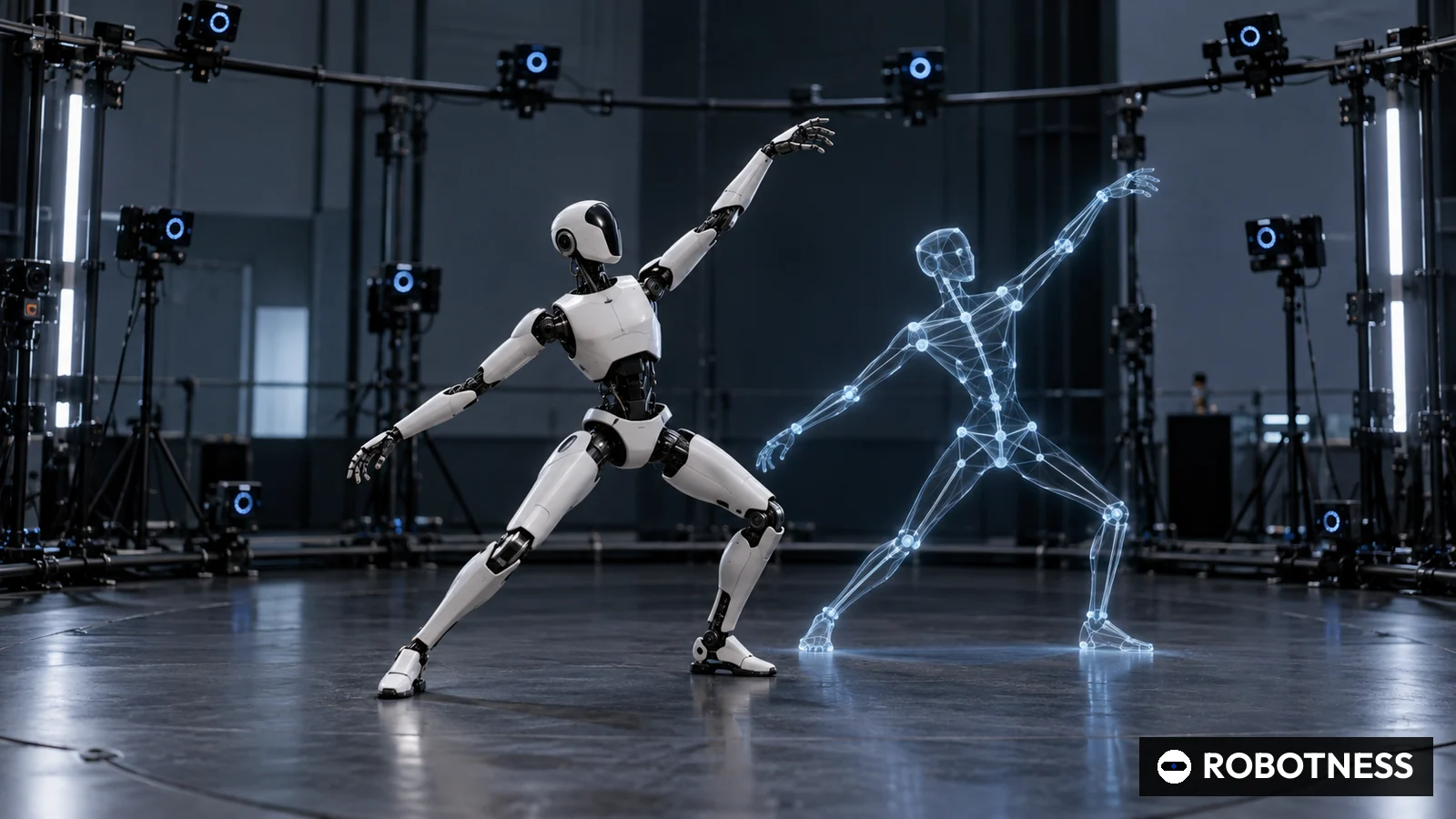
A paper from Amazon's Frontier AI & Robotics (FAR) group on converting human movement into usable training data for humanoid robots won the Best Conference Paper Award at the IEEE International Conference on Robotics and Automation (ICRA 2026), held in Vienna from June 1 to June 5. The same paper, OmniRetarget, also took the Best Paper Award on Robot Manipulation and Locomotion, according to the project page and the IEEE Robotics and Automation Society.
The nine authors are Lujie Yang, Xiaoyu Huang and Zhen Wu, who contributed equally, together with Angjoo Kanazawa, Pieter Abbeel, Carmelo Sferrazza, C. Karen Liu, Rocky Duan and Guanya Shi. All list Amazon FAR as an affiliation, and several hold academic posts at MIT, UC Berkeley, Stanford University and Carnegie Mellon University, the project page shows. The work first appeared on arXiv on September 30, 2025, and the third version was posted on June 15, 2026.
The problem OmniRetarget addresses is a bottleneck that every humanoid developer training with reinforcement learning runs into. Teams record human motion, map it onto the robot's skeleton and use the result as a reference for a control policy. Because a robot's limbs, mass and joint limits differ from a person's, conventional retargeting produces what the authors call physically implausible artifacts, such as feet sliding on the floor or hands passing through objects. It also ignores how the person was touching a box, a chair or a wall, which matters most for loco-manipulation.
The authors' answer is an interaction mesh that links points on the body to nearby objects and terrain and records their relative positions and contacts. OmniRetarget then deforms the human mesh onto the robot mesh using Laplacian deformation while enforcing kinematic constraints, the arXiv abstract says. Because the relationships are preserved rather than the exact poses, one human demonstration can be expanded into many variants with different object sizes, object positions, terrain heights and robot bodies, the IEEE Robotics and Automation Society article explains.
Applied to the public OMOMO and LAFAN1 motion datasets and to in-house motion capture, the method produced more than 8 hours of robot trajectories, according to the paper; the project page puts the figure at more than 9 hours. The team released a dataset on Hugging Face and code in Amazon FAR's holosoma repository, and compared its output against two widely used retargeting baselines, GMR and PHC.
The reinforcement learning policies trained on that data used only 5 reward terms and 4 domain randomization terms, and relied exclusively on proprioceptive sensing, the project page states. On a Unitree G1, a humanoid of about 1.3 meters, they executed long-horizon parkour and loco-manipulation sequences of up to 30 seconds, including carrying boxes, climbing onto platforms, crawling, rolling and wall flips, transferred zero-shot from simulation.
The double award stands out in a field of 36 finalists spread across eleven award groups listed by the conference. Other winners announced by the institutions themselves include LASER, a multi-robot timber manufacturing scheduler from the University of Stuttgart that won the Best Student Paper Award on June 4, and a camera-conditioned imitation learning paper from the Toyota Technological Institute at Chicago, Toyota Research Institute and Johns Hopkins University that won the Best Paper Award on Robot Learning.
For industry, the result goes to cost and speed. Humanoid companies such as Figure AI, Agility Robotics, Apptronik and Boston Dynamics all need large volumes of physically valid whole-body motion. Boston Dynamics said in a May 18, 2026 blog post that Atlas practised lifting a loaded fridge for millions of simulated hours on GPUs and then moved a load of more than 100 pounds. OmniRetarget attacks the step before that simulation, the quality of the reference motion.
The authors are candid about the limits. The method cannot automatically correct errors in the source motion, such as a misplaced hand in the human capture, Lujie Yang told the IEEE Robotics and Automation Society. The real-robot results were shown on one platform, and the policies relied on proprioception rather than vision, which means scene geometry had to be known in advance.
- Best Conference Paper Award
- OmniRetarget
- Amazon FAR, MIT, UC Berkeley, Stanford, CMU
- No data
- Best Paper Award on Robot Manipulation and Locomotion
- OmniRetarget
- Amazon FAR, MIT, UC Berkeley, Stanford, CMU
- 5
- Best Paper Award on Robot Learning
- Do You Know Where Your Camera Is? View-Invariant Policy Learning with Camera Conditioning
- TTIC, Toyota Research Institute, Johns Hopkins University
- 4
- Best Student Paper Award
- LASER: multi-robot timber manufacturing scheduling
- University of Stuttgart
- No data
- Best Paper Award in Automation (finalist only)
- LASER
- University of Stuttgart
- 4
Winners as stated by the OmniRetarget project page, the IEEE Robotics and Automation Society, Johns Hopkins University and the University of Stuttgart. Finalist counts from the ICRA 2026 awards page; null where the conference did not publish a finalist list for that award.
As of Oct 1, 2026
ROBOTNESS analysis
Data quality, not model size, is becoming the scarce input for humanoid whole-body skills, and OmniRetarget shows that a well-built retargeting step can substitute for expensive real-robot collection.
The evidence is in the training recipe. A policy that needs only 5 reward terms and 4 randomization terms to perform 30-second parkour sequences is a sign that the reference data is doing most of the work, which is what the authors set out to show. The one-to-many augmentation also changes the economics of motion capture, since a single session can be multiplied across object sizes, terrains and robots.
The strongest counter-argument is that whole-body agility is not where humanoid revenue sits today. Paying customers want reliable manipulation in factories and warehouses, and a proprioceptive policy that has memorised a scene does not solve perception, grasping under uncertainty or recovery from failure.
Bull case. Retargeting pipelines like this one become standard tooling, cutting the time to teach a humanoid a new whole-body task from weeks of reward tuning to days. Amazon, with its own warehouses as a test bed, is positioned to turn the method into an in-house advantage.
Bear case. Vision-language-action models trained on teleoperation data, or video world models, make kinematic retargeting a niche step. The open release then helps rivals as much as Amazon, and the award becomes an academic milestone with little commercial follow-through.
Signals to watch:
- Whether Amazon FAR publishes vision-based or manipulation-heavy follow-ups to OmniRetarget before the Conference on Robot Learning in late 2026.
- Downloads and forks of the OmniRetarget dataset on Hugging Face and the holosoma repository over the fourth quarter of 2026.
- Award decisions at IROS 2026 and CoRL 2026, which will show whether reviewers keep rewarding data-generation work over new policy architectures.
- ICRA 2026 Best Conference Paper Award and Best Paper Award on Robot Manipulation and Locomotion
- Unitree G1, about 1.3 m tall
- arXiv 2509.26633, v1 September 30, 2025; v3 June 15, 2026
- IEEE ICRA 2026, Vienna, June 1 to 5, 2026
- Dataset on Hugging Face; code in amazon-far/holosoma
- Up to 30 seconds of parkour and loco-manipulation, zero-shot sim-to-real
- More than 8 hours of trajectories (paper abstract); project page states more than 9 hours
- 5 reward terms, 4 domain randomization terms, proprioception only
- Amazon Frontier AI & Robotics (FAR)
- MIT, UC Berkeley, Stanford University, Carnegie Mellon University
Why it matters
Most humanoid programs now train whole-body skills with reinforcement learning in simulation, and the reference motion fed into that training is the least glamorous and most labour-intensive part of the pipeline. OmniRetarget treats retargeting as a data generation problem rather than a pose-matching exercise, and the ICRA committee's decision to give it both the conference-wide prize and the manipulation and locomotion prize signals that the research community sees this step as a real constraint on progress.
The practical consequence is leverage. If one motion capture session can be turned into many physically valid variants across object sizes, terrains and robot bodies, the marginal cost of a new skill falls. That is particularly relevant for companies that do not own large teleoperation fleets.
Rival analysis
The paper benchmarks itself against GMR and PHC, two retargeting approaches commonly used by academic and industrial groups training humanoids on human motion. Commercial humanoid developers such as Figure AI, Agility Robotics, Apptronik and Boston Dynamics run their own internal pipelines and disclose little about them. Boston Dynamics' May 18, 2026 post on training Atlas to carry a loaded fridge describes reinforcement learning with domain randomization across weight, friction and motor variation, which is the stage OmniRetarget feeds.
The contrast with vision-language-action approaches matters. Groups building generalist manipulation models rely on teleoperated robot data or human video. OmniRetarget sits on the motion capture and simulation side of the field, and its strength is whole-body contact, not semantic task understanding.
Valuation context
Amazon does not break out the cost or headcount of FAR, so no direct valuation link exists. The relevant context is what humanoid developers are being valued at for capabilities that depend on this type of training. Figure AI raised $1 billion at a $39 billion post-money valuation in September 2025, Skild AI raised $1.4 billion at $14 billion in January 2026, and Apptronik disclosed a $520 million Series A extension in February 2026, according to their own announcements.
Those valuations price in the ability to teach robots new skills cheaply. Research that lowers the cost of whole-body data supports the thesis behind those prices, but it also weakens any single company's moat if the method is open, as OmniRetarget's code and data are.
Supply-chain implications
The real-robot results were produced on the Unitree G1, a Chinese-made humanoid that has become a default research platform. That dependence is worth noting for Western labs and for policy makers who track hardware sourcing. The method itself is hardware-agnostic in principle, since retargeting to a different robot mesh is part of the augmentation.
On the compute side, the pipeline shifts effort from robot time to simulation time. That favours organisations with access to GPU capacity, which Amazon has through its cloud business.
Signals to watch
The first signal is follow-up work that adds vision to these policies, since proprioception-only control requires known scene geometry. The second is whether other humanoid developers cite or adopt the holosoma code in public releases. The third is whether Amazon connects FAR research to warehouse robotics deployments in its own disclosures.
Conference cycles give dates. CoRL 2026 and IROS 2026 later in the year, and ICRA 2027, will show whether retargeting and data-generation papers keep winning recognition.
Analyst view
Thesis: OmniRetarget is evidence that the bottleneck for humanoid whole-body skills is moving from algorithms to data quality, and that open tooling will spread that capability quickly. Confidence: medium.
The reasons for medium rather than high confidence are that the demonstrations are confined to one robot, rely on proprioception and were selected by the authors. The reasons for not going lower are the double award after peer review, the release of code and data that allows replication, and the consistency with Boston Dynamics' own account of simulation-first training.
Questions you should be asking
Can interaction-preserving retargeting be combined with onboard vision so that the robot does not need prior knowledge of the scene? How well does the method handle source motions captured from video rather than marker-based motion capture?
Will Amazon apply the work to its own robots or keep it as open research? And how will hardware makers outside China respond if the best open humanoid training pipelines continue to be demonstrated on Unitree platforms?