Sharpa brings a touch-covered robot, a lighter 21-joint hand and a haptic glove to IROS, building its own data loop for dexterity
Singapore-based Sharpa launched three products at IROS 2026 in Pittsburgh: the D01 robot with whole-body electronic skin, the W02 hand with 21 active degrees of freedom at under 750 grams, and the AE01 haptic glove for teleoperation and data capture. Together they give the company the hardware to collect, replay and learn from touch-rich manipulation data.
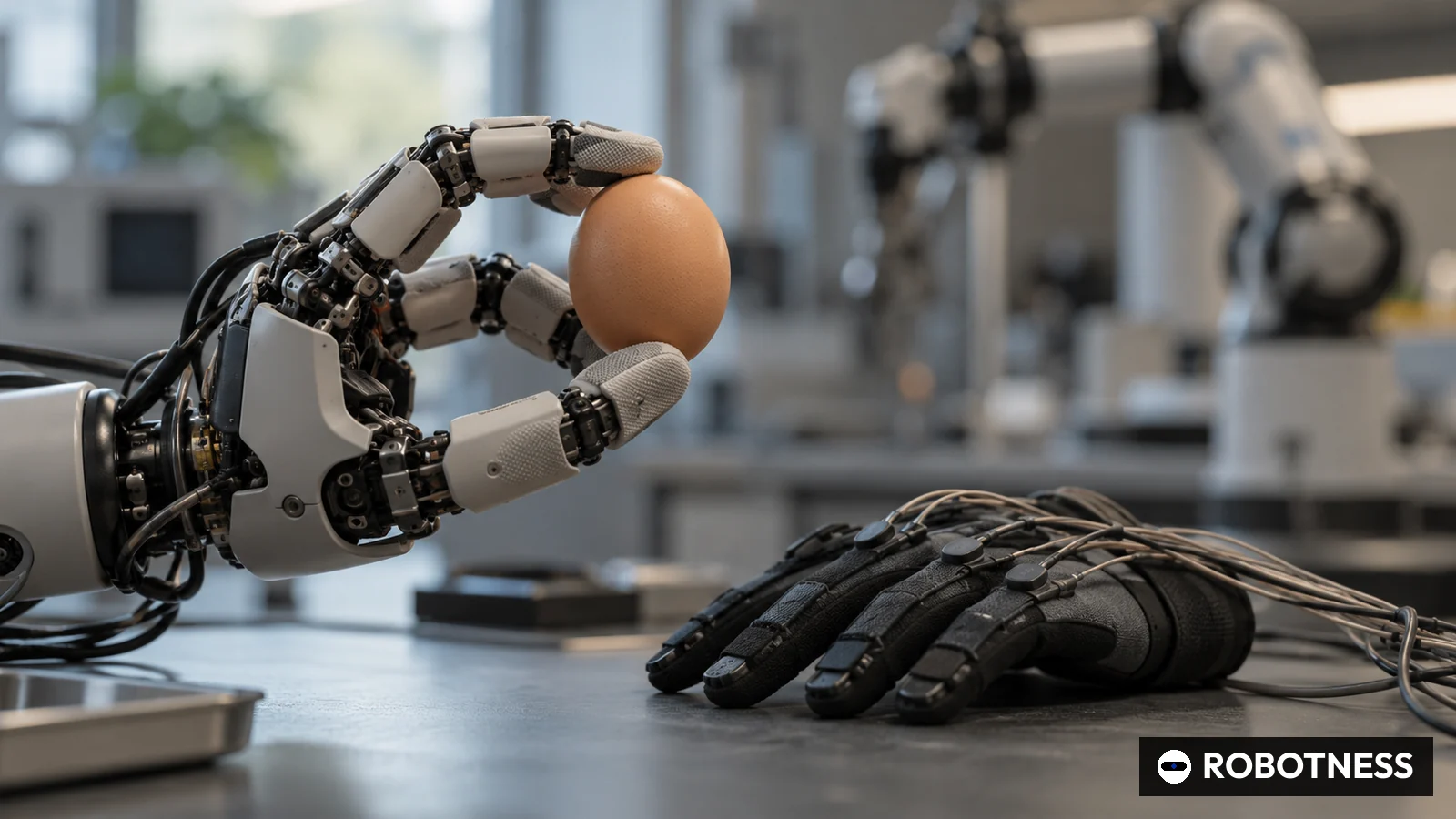
Sharpa's newest hand has one joint fewer than its last. The W02, unveiled at the IROS 2026 robotics conference in Pittsburgh, has 21 active degrees of freedom and weighs under 750 grams, the company said in a release dated 28 September, while its earlier SharpaWave hand has 22. The trade, a joint given up for weight and skin, says a lot about where dexterous robotics is heading.
Sharpa, founded in 2024 and headquartered in Singapore, launched three products at once: the D01 robot, the W02 hand and the AE01 haptic data glove. Read separately they are spec sheets. Read together they form a loop in which a human demonstrates a task through a glove, a robot repeats it with tactile hands, and the data trains Sharpa's models. The question this article answers is whether that loop is a moat or simply a bundle.
A robot wrapped in skin, built for human workspaces
The D01 combines Sharpa Wave hands, arms with seven degrees of freedom and electronic skin across the body, according to the release. Sharpa gives an arm payload-to-weight ratio of roughly 1:1, a maximum end-effector speed above 10.5 metres per second, a 1,000 Hz communication rate and end-effector repeatability of 0.2 millimetres. The skin samples at 100 Hz with a force resolution of 0.2 newtons, and human-scale spherical wrists are meant to let the machine work in spaces designed for people. The release does not say whether the D01 walks, rolls or sits on a fixed base, and gives no price or delivery date.
The W02 builds on Sharpa's W01 hand, the release says. It pairs Sharpa's Dynamic Tactile Array at the fingertips, rated from 5 millinewtons to 30 newtons at 1 millimetre spatial resolution, with electronic skin across fingers and palm covering 0.1 to 20 newtons at 5 millimetre resolution. It is rated IP54 and offers what Sharpa calls zero-gap grasping, closing fully enough to pick up chopsticks or fine cords.
The AE01 is a haptic exoskeleton glove for teleoperation and egocentric data capture. It has 22 degrees of freedom read by 22 encoders, 256 levels of vibrotactile feedback at each fingertip, position repeatability under 1 millimetre, and needs no calibration, according to Sharpa.
- D01 robot
- Max end-effector speed (above)
- 10.5
- m/s
- D01 robot
- End-effector repeatability
- 0.2
- mm
- D01 robot
- Communication rate
- 1000
- Hz
- D01 robot
- Skin tactile sampling rate
- 100
- Hz
- W02 hand
- Active degrees of freedom
- 21
- DOF
- W02 hand
- Max fingertip force range
- 30
- N
- AE01 glove
- Degrees of freedom (encoders)
- 22
- DOF
- AE01 glove
- Vibrotactile levels per fingertip
- 256
- levels
Company figures from Sharpa's release of 28 September 2026. No prices or delivery dates were given.
As of Oct 1, 2026
The company behind the hands
Sharpa says it was founded in 2024. A December 2025 release placed its global headquarters in Singapore, manufacturing and R&D in Shanghai and business operations in Mountain View, and said the SharpaWave hand, with 22 active degrees of freedom and more than 1,000 tactile pixels per fingertip, had entered mass production. At CES 2026 the company, which said it had more than 100 employees, showed a full-body robot called North and a hierarchical vision-tactile-language-action model called CraftNet, split into an interaction layer and a motion layer. In June 2026 NVIDIA chose dual Sharpa hands for its Isaac GR00T reference humanoid, a pairing ROBOTNESS reported at the time. Sharpa has not disclosed funding.
Sharpa has also quoted different fingertip sensitivities for the same Wave hand: 0.005 newtons in December 2025 and 0.02 newtons in June 2026. The company has not explained the difference, which may reflect different measurement methods.
How the W02 compares with rival hands
On maker-published figures, the W02 is light for its joint count. At a ceiling of 750 grams over 21 active joints it carries about 36 grams per actuated degree of freedom, by ROBOTNESS's calculation. Unitree's Dex5-1 weighs 1,100 grams with 16 active joints, about 69 grams each. Shadow Robot's Dexterous Hand has 20 actuated joints and a 4.3 kg full system, though that figure includes more than the hand. Wonik Robotics' Allegro Hand, a research staple, has 16 torque-controlled joints across four fingers.
- W02
- Sharpa
- Singapore
- 21
- 750
- 35.7
- SharpaWave
- Sharpa
- Singapore
- 22
- No data
- No data
- Dex5-1
- Unitree
- China
- 16
- 1100
- 68.8
- Dexterous Hand
- Shadow Robot
- UK
- 20
- 4300
- 215
- Allegro Hand
- Wonik Robotics
- Korea
- 16
- No data
- No data
Figures from each maker's own page or release. W02 weight is a ceiling (under 750 g). Shadow weight is the 4.3 kg full system. Unitree Dex5-1 has 20 DOF in total, 16 active. Derived column = weight / active DOF. Not a performance ranking.
As of Oct 1, 2026
Weight per joint matters because a hand sits at the end of an arm. Every gram there costs payload and dynamic performance, and Sharpa's claimed 1:1 payload-to-weight ratio on the D01 arm depends on light end effectors.
Why touch and a glove matter to robot learning
Most robot learning today relies on vision and joint positions. Contact, how hard a fingertip presses and where an object slips, is largely missing from training data because few hands can sense it and few teleoperation rigs can feed it back to the operator. The AE01 addresses the second half: an operator feels vibration at the fingertips while steering a robot, and the demonstration is recorded with matching hand poses. That is the input a model such as CraftNet needs.
There are open questions. Sharpa gave no prices, volumes or customers for the new products beyond saying they serve robotics companies, research institutions and food service. The D01's mobility and degrees of freedom outside the arms are not stated. The glove has 22 degrees of freedom and the new hand 21, so mapping between them requires retargeting, while the glove matches the 22-joint Wave one to one.
ROBOTNESS analysis
Sharpa is turning itself from a hand supplier into the owner of a tactile data pipeline, and the AE01 glove matters more to that strategy than the D01 robot.
The evidence is in the launch mix. A component maker would ship a better hand. Sharpa shipped a hand, a robot that carries it and a glove that records human skill in the same tactile vocabulary, and it already has a model, CraftNet, built to consume that data. The NVIDIA reference design gives it a distribution channel into labs that will generate more such data.
The strongest counter-argument is price. Chinese hand makers such as Unitree sell into the same research and humanoid market, and a glove is easier to copy than a tactile sensor. If customers treat hands as interchangeable parts, Sharpa's loop stays inside its own labs and the company competes on unit cost.
Bull case. Labs using the GR00T reference humanoid standardise on Sharpa hands and AE01 gloves for data collection, giving Sharpa the largest tactile manipulation dataset outside the big model companies and a licensing or model business on top of hardware.
Bear case. Rivals match the W02's joint count and weight at lower prices, the D01 finds no volume buyer, and Sharpa remains a premium component supplier whose differentiation erodes with each hardware cycle.
Signals to watch:
- Published prices and shipping dates for D01, W02 and AE01, which Sharpa has not given; a list price or first delivery before the end of the first quarter of 2027 would show commercial intent.
- A disclosed funding round or valuation. Sharpa called itself a unicorn in June 2026 without stating figures.
- Any CraftNet benchmark or open dataset built from AE01 demonstrations, which would test whether the data loop produces better manipulation.
What would change our view is evidence that customers buy the glove without the hand; that would make Sharpa a data-tools company first.
- Founded 2024; HQ Singapore, R&D and manufacturing in Shanghai
- D01 robot, W02 hand, AE01 haptic glove at IROS 2026, Pittsburgh
- 21 active DOF, under 750 g, IP54
- 7-DOF arms, end-effector speed above 10.5 m/s, 0.2 mm repeatability
- 22 DOF, 22 encoders, 256-level vibrotactile feedback per fingertip
- 28 September 2026 (US Eastern time)
- 5 mN to 30 N at 1 mm resolution
- Not disclosed
Why it matters
Dexterous manipulation is the bottleneck between humanoids that walk and humanoids that work. Vision-based policies plateau on contact-rich tasks such as inserting connectors or handling soft goods, because the training data lacks force and slip information. A vendor that can supply both tactile hands and a way to record human demonstrations with matching tactile channels addresses that gap directly.
Sharpa's launch also widens its revenue base. Until now the company was mostly a hand supplier. With D01 it sells a complete manipulation platform, and with AE01 it sells into the data-collection budgets that every robot-learning team now carries.
Rival analysis
Unitree is the volume reference in hands as in humanoids, and its Dex5-1 is heavier per joint but sold alongside Unitree's robots, which gives it a ready installed base. Shadow Robot remains the research benchmark for anthropomorphic dexterity, with 20 actuated joints but a heavy full system. Wonik Robotics' Allegro Hand is the low-cost research standard with 16 joints and is backed by a large Korean public-private raise ROBOTNESS covered in August.
Sharpa's differentiation is tactile coverage and weight. Its risk is that larger humanoid makers build hands in-house, removing the biggest potential customers from the market.
Valuation context
Sharpa has not disclosed any funding round, investors or valuation; its June 2026 NVIDIA release described it as a unicorn without figures, so ROBOTNESS records no valuation. Comparable disclosed figures in the manipulation-heavy segment include Walden Robotics' $300 million seed at a $1.1 billion valuation in July 2026 and Humanoid's $152 million Series A at $1.35 billion, both in ROBOTNESS records.
Until Sharpa files or announces terms, any valuation claim should be treated as unverified. A round led by a strategic such as a chipmaker or a humanoid OEM would be the clearest validation of the data-loop thesis.
Supply-chain implications
Sharpa manufactures in Shanghai and is headquartered in Singapore, a structure common among robotics companies that want Chinese supply chains with a non-Chinese corporate base. Its hands depend on micro actuators, encoders and camera-based tactile sensors, and the December 2025 release described automated reliability testing for thousands of microscale components.
That footprint exposes Sharpa to export-control and tariff risk on sales into the US, where it runs business operations in Mountain View and where NVIDIA's reference design is promoted. The company has not disclosed suppliers.
Signals to watch
First, commercial terms: prices, lead times and named customers for W02, D01 and AE01. Second, adoption of Sharpa hands beyond the NVIDIA reference design, especially by a humanoid maker with volume.
Third, CraftNet results. A paper or benchmark showing gains from tactile data captured with AE01 would turn the loop from a marketing story into a technical moat. Fourth, the release of the production North robot, which Sharpa said in January would come in mid-2026; its status is not addressed in the IROS release.
Analyst view
Thesis: Sharpa's strategic asset is the tactile data loop, and the AE01 glove is the product to watch.
Confidence: low to medium. The specifications are detailed and the NVIDIA design win is real, but there are no prices, volumes, customers or financials, and some sensitivity figures are inconsistent across releases. We would raise confidence on disclosed commercial deployments or a funded data program.
Questions you should be asking
What are the prices and delivery dates for D01, W02 and AE01, and what volumes does the Shanghai plant support?
Is the W01 referenced in the release the same product as SharpaWave, and why did the W02 drop one active joint?
How does Sharpa reconcile the 0.005 N and 0.02 N sensitivity figures quoted for the Wave fingertip?
Does the D01 have a mobile base, and how many degrees of freedom does it have in total?
What happened to the production North robot announced for mid-2026?