Japan approves AI robotics strategy targeting a 30% global share and 20 trillion yen market by 2040
Japan's inter-ministerial AI robotics council on March 26, 2026 endorsed a national strategy that aims to win more than 30% of a multi-purpose robot market the government expects to reach about 60 trillion yen by 2040. The plan promises an open-source domestic robot foundation model by around June 2027, names 16 deployment fields and defers concrete sector targets to a roadmap revision due in May.
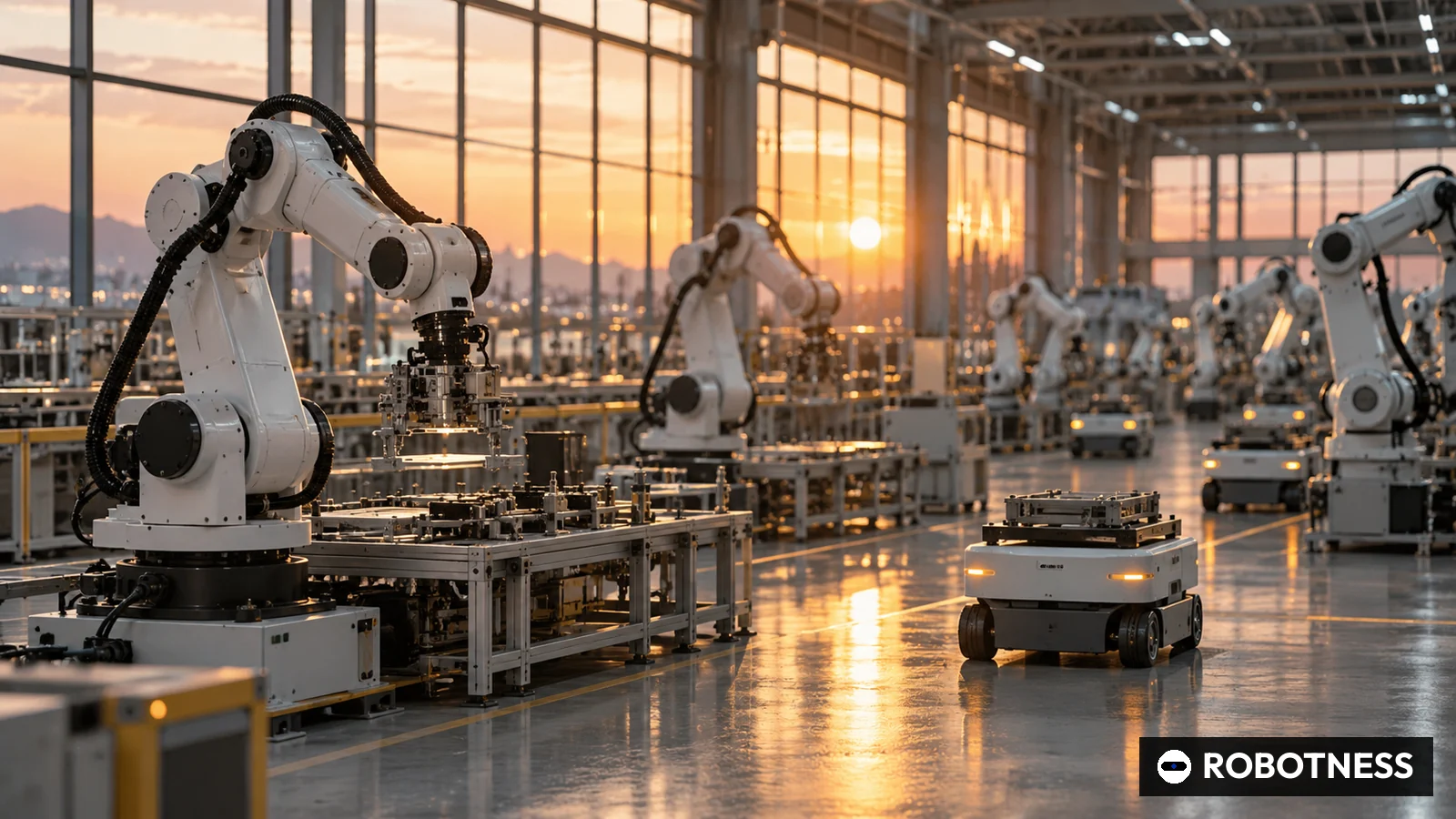
Japan's government on March 26, 2026 endorsed a national AI robotics strategy that aims to capture more than 30% of the global market for multi-purpose robots, which it expects to grow to about 60 trillion yen by 2040, giving Japanese companies a market of roughly 20 trillion yen. The document, titled AI Robotics Strategy: Accelerating Social Implementation and Opening Up a Huge Market, was approved without objection at the second meeting of the inter-ministerial liaison council on AI robotics, chaired by Wataru Sakata, Assistant Chief Cabinet Secretary for domestic affairs, according to the council's published minutes.
The strategy's most concrete technical commitment is a domestically developed robot foundation model. The text says the AI Robot Association (AIRoA) will release a beta version as open source around June 2027. The plan names 16 fields for deployment: small-batch manufacturing, shipbuilding, logistics, civil engineering, building construction, infrastructure maintenance, retail, hospitality, elder care, security services, agriculture, forestry, waste processing, disaster response, police work and defense. It also singles out eight common tasks for near-term rollout across those fields, namely indoor and outdoor inspection, indoor and outdoor transport, cleaning, loading and palletizing, handling, and welding and painting.
The measures are grouped in three blocks. On the supply side, the government will support robot makers and system integrators, help startups move from prototypes to volume production in partnership with automotive and industrial supply chains, and strengthen design and manufacturing of motors, reducers and sensors, components the strategy describes as among the best in the world. It calls for a gradual shift to what it terms the Software Defined Robot, in which functions are separated from hardware and defined and updated in software, and for edge semiconductors designed backward from the functions robots need. On the demand side, it links field deployment to a data loop in which installations generate data, data improves models, and better models lower costs and widen adoption. A cross-cutting block creates a Center of Excellence that combines physical test beds with computing resources and simulation, together with a safety certification regime backed by rigorous verification.
Public purchasing is meant to provide the first large orders. The strategy proposes trials and model projects with fire departments for disaster response, a review of design and construction standards in public works based on robot evaluations, and in defense a significant expansion of research and development, trial operation by the Self-Defense Forces and consideration of larger-scale procurement. For the safety and standards work it names the Japan Robot Association (JARA), the Robot Revolution and Industrial IoT Initiative (RRI) and the Japan AI Safety Institute (AISI) as partners.
The council first met on January 16, 2026 with a mandate to finish a strategy within fiscal 2025, which ended on March 31. The March 26 minutes record that a revised roadmap with concrete targets and measures is to follow in May, that the strategy is to be reflected in the government's Basic Policy on economic and fiscal management in June, and that it will be reported to the AI and semiconductor working group of the Japan Growth Strategy Council. Hideaki Ibuki, director general of the Manufacturing Industries Bureau at the Ministry of Economy, Trade and Industry (METI), serves as vice chair.
The document is unusually blunt about where Japan stands. It says Japanese makers held about 70% of the industrial robot market centred on automobiles and semiconductors in 2022, yet trail in AI development aimed at robot deployment and in designing AI and hardware as one system, and that their presence in the expanding service robot market is shrinking. It also concedes that the 2015 New Robot Strategy and the 2019 robot social transformation plan, which funded research, robot-friendly environments and integrator training, produced only limited real-world deployment because they did not create sustained demand.
Industry data released two months earlier show why the government is focused on demand at home. JARA reported on January 23, 2026 that its members' robot orders rose 27.8% in calendar 2025 to 925.8 billion yen and production rose 21.0% to 837.3 billion yen. Exports climbed 36.2% to 694.5 billion yen, while domestic shipments fell 8.9% to 176.3 billion yen. Japanese makers are selling more robots abroad and fewer at home, the opposite of what a labour-short economy would be expected to need.
- Orders
- 925.8
- 27.8
- Production
- 837.3
- 21
- Exports
- 694.5
- 36.2
- Domestic shipments
- 176.3
- -8.9
Source: Japan Robot Association press release, January 23, 2026 (members only). Domestic share of shipments = domestic / (domestic + exports) = 20.2%. Figures disclosed, not estimated.
As of Oct 1, 2026
The international comparison is equally stark. According to the International Federation of Robotics (IFR), China installed 295,000 industrial robots in 2024, more than six times Japan's 44,500, and Chinese suppliers held 57% of their home market. Installations fell 4% in Japan, 9% in the United States and 3% in South Korea that year. Seoul's Ministry of Trade, Industry and Energy launched a K-Humanoid Alliance on April 10, 2025 with the stated aim of making South Korea the leading humanoid robot nation by 2030.
- China
- 295,000
- No data
- Japan
- 44,500
- -4
- United States
- 34,200
- -9
- South Korea
- 30,600
- -3
- Germany
- 26,982
- -5
Source: IFR World Robotics 2025 press release, September 25, 2025. China's 2024 total was a record; IFR did not give a percentage change in the release. Figures disclosed, not estimated.
As of Oct 1, 2026
The foundation model at the centre of the plan is a large AI model trained on robot motion, camera and sensor data, so that one model can be adapted to many robot bodies and tasks instead of each application being programmed by hand. AIRoA, the body charged with building it, was founded in December 2024 and launched publicly in March 2025 with 11 regular and five supporting members, including Toyota, NEC, Fujitsu and KDDI, under chair Tetsuya Ogata. The strategy's phrase for the shift it expects is a move in AI competition from scale, meaning web text and raw compute, to integration and operational capability, an area where it argues Japanese factories and component makers have an edge.
For established makers such as FANUC, Yaskawa Electric and Kawasaki Heavy Industries, the document points both ways. Its emphasis on motors, reducers, sensors and edge chips plays to Japan's installed industrial base. Its call for hardware-agnostic software, open interfaces and standardized data formats, which it sets against vertically integrated models, invites competition in the layer above the robot arm, where the strategy admits Japan is behind.
The March text leaves important questions open. It sets no budget, contains no unit or installation targets, and assigns the quantitative goals by sector to the May roadmap. The 16 fields span ministries from health and labour to defense, which makes coordination the main execution risk. The June 2027 date for a beta foundation model will be judged against open models already published by US and Chinese groups.
The next checkpoints are the May roadmap revision, which the minutes say will set concrete targets and measures, and the June Basic Policy, which will show whether the strategy receives priority in the fiscal 2027 budget request.
ROBOTNESS analysis
Japan is betting that its lead in robot hardware and components can be converted into a lead in robot data, but the March strategy is a statement of targets without money, and its value depends on what the May roadmap and the fiscal 2027 budget attach to it.
The evidence for the bet is in the numbers the government chose to publish. A 70% share in industrial robots, a 20 trillion yen goal that is roughly 24 times JARA members' 2025 production, and an admission that service robots and AI integration are weak together describe an industry with manufacturing scale and a software gap. The plan's tools, a shared foundation model, a national test and compute centre and state procurement in disaster response, construction and defense, are aimed squarely at that gap.
The strongest counter-argument is that Japan has written robot strategies before. The 2015 and 2019 plans, by the government's own account, did not create lasting demand, and the March 2026 text again stops short of funding figures or installation targets. Domestic shipments fell 8.9% in 2025 even as exports rose 36.2%, which suggests the constraint is customer economics in Japan, something a strategy document cannot change by itself.
Bull case. If the May roadmap attaches sector-level deployment targets and the June Basic Policy carries them into the fiscal 2027 budget, public buyers in defense, construction and disaster response could provide the anchor orders that integrators have lacked. An open AIRoA model released on time in 2027 would give smaller makers and integrators a common software base built on Japanese factory data.
Bear case. Without dedicated funding, the 16 fields fragment into ministry pilots and the foundation model arrives in mid-2027 into a field crowded by US and Chinese open models. Chinese suppliers, already at 57% of their home market, keep pushing price down, and Japanese makers continue to grow abroad while the domestic installed base stagnates.
Signals to watch:
- May 2026: the revised implementation roadmap, which the council minutes say will add concrete targets and measures by sector.
- June 2026: whether the Basic Policy on economic and fiscal management names AI robotics as a priority with budget language.
- Around June 2027: the open-source beta of the AIRoA robot foundation model, and which robot makers commit to train or deploy on it.
- Wataru Sakata, Assistant Chief Cabinet Secretary (domestic affairs)
- 16 fields, 8 common near-term tasks
- March 26, 2026, 2nd meeting of the inter-ministerial AI robotics liaison council
- Over 30% global share, about 20 trillion yen market
- Roadmap revision with concrete targets in May 2026; Basic Policy in June 2026
- Open-source beta by AIRoA around June 2027
- 925.8 billion yen, up 27.8%
- About 60 trillion yen for multi-purpose robots
Why it matters
This is the first whole-of-government robot strategy in Japan since the 2015 New Robot Strategy, and it is coordinated by the Cabinet Secretariat rather than METI alone. That matters because the demand it wants to create sits in ministries that rarely buy robots: fire services, public works, police and the Self-Defense Forces. A liaison council chaired at Assistant Chief Cabinet Secretary level gives the plan a mechanism to push those ministries.
The second reason is the explicit shift in what Japan says it is competing on. The document frames AI competition as moving from scale to integration and operational capability. That is a strategic choice to compete on field data from factories, construction sites and care facilities rather than on frontier model size, where the text concedes the US leads.
Rival analysis
China is the reference point the numbers invite. IFR data show 295,000 installations in China in 2024 against 44,500 in Japan, and a 57% domestic share for Chinese suppliers. Japan's plan does not try to match that installation volume; it targets value, a 20 trillion yen market, and the component layer where Japanese suppliers are strong.
South Korea is the closer analogue. Its K-Humanoid Alliance, launched by the trade ministry on April 10, 2025, organized companies and research institutes around a 2030 humanoid goal. Japan's text, by contrast, never makes humanoids its centrepiece and spreads effort over 16 fields and eight tasks such as inspection and transport. That is a more conservative but more deployable portfolio.
Valuation context
The strategy is a policy document and moves no valuations directly. Its derived scale is useful context: the 20 trillion yen goal for 2040 is about 23.9 times the 837.3 billion yen of robot production JARA members reported for 2025, although the strategy's multi-purpose robot market is broader than JARA's manipulator statistics.
For listed makers the relevant figures to track are domestic orders. JARA's 2025 data show exports at 694.5 billion yen and domestic shipments at 176.3 billion yen, so domestic sales were about 20% of combined domestic and export shipments. Any rise in that share after public procurement starts would be the first measurable sign the policy is working.
Supply-chain implications
The strategy names motors, reducers and sensors as world-class Japanese components to be strengthened, which points to the precision reducer and servo suppliers that sit beneath both Japanese and foreign robot makers. It also calls for edge semiconductors designed backward from robot functions, integrating logic, memory and microcontrollers, and for affordable design tools and circuit IP.
The Software Defined Robot concept and the push for standardized interfaces and data formats would loosen the bundling of controller, software and arm that large Japanese makers rely on. Integrators and component suppliers gain from open interfaces; vertically integrated arm makers face more competition above the hardware layer.
Signals to watch
May 2026 roadmap revision with sector-level quantitative targets. June 2026 Basic Policy wording and any reference to dedicated AI robotics funding. August 2026 budget requests from METI, the defense ministry and the land ministry for robot procurement and the Center of Excellence.
January 2027 JARA annual statistics for a reversal in domestic shipments. Around June 2027 the AIRoA open-source model beta, its license and which makers adopt it.
Analyst view
Thesis: the strategy correctly identifies Japan's gap, software and deployment rather than hardware, and chooses credible tools, but it is underpowered until money and targets are attached. Confidence: medium.
Reasons for medium rather than high confidence: the minutes commit to a May roadmap with targets and to the June Basic Policy, which is a real process, and procurement by defense and public works is within the state's direct control. Reasons against higher confidence: the March text carries no budget, previous strategies under-delivered by the government's own account, and domestic demand fell in 2025 despite a strong export cycle.
Questions you should be asking
How much funding will the fiscal 2027 budget assign to the Center of Excellence and to AIRoA's foundation model, and will the model be released under a license that allows commercial use by foreign makers?
Will the defense ministry's consideration of larger-scale procurement turn into multi-year contracts, and will safety certification for AI-controlled robots be developed in step with ISO work or as a Japan-specific regime?