London's Humanoid raises $152 million at a $1.35 billion valuation as Schaeffler and Bosch buy in
Humanoid, a two-year-old London robotics company, closed a $152 million Series A led by Prime Movers Lab at a $1.35 billion post-money valuation, with industrial partners Schaeffler and Bosch joining the round. The company says the money will fund mass manufacturing of its wheeled humanoid, a Beta fleet from the fourth quarter of 2026 and its KinetIQ AI software.
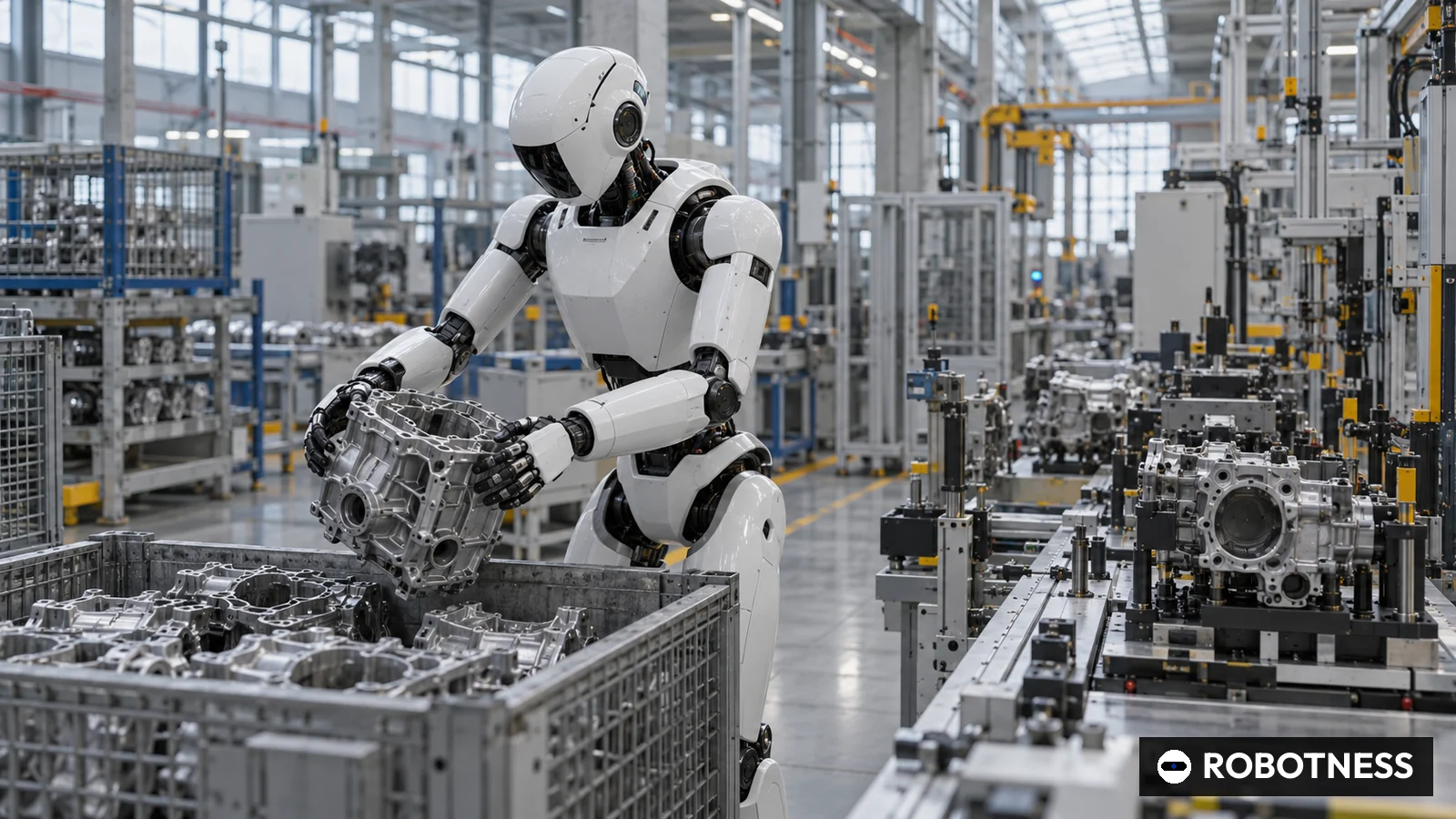
Humanoid, a London company founded in 2024 to build general-purpose robots for factories and warehouses, said on July 21, 2026 that it had raised $152 million in a Series A round at a post-money valuation of $1.35 billion. The company described itself as Europe's first pure-play humanoid robotics company to pass the $1 billion mark.
Prime Movers Lab led the round. Schaeffler, the German bearings and drivetrain group, and Bosch took part alongside Fubon Financial Holding Venture Capital of Taiwan and Aglaé Ventures. Humanoid said the round brings its total funding to $270 million, which implies that it raised about $118 million before this Series A.
What the money is for
The company listed four uses for the capital: development of a next-generation robot platform, commercial deployments in logistics, manufacturing and retail, mass manufacturing of its wheel-based robots, and work on KinetIQ, the proprietary AI system that plans and controls its machines. Humanoid said Beta units of the wheeled robot will roll out in the fourth quarter of 2026. It also said Bosch acts as its contract manufacturing partner, which puts series assembly in the hands of one of Germany's largest industrial groups rather than a start-up plant.
Humanoid sells two variants of its first model, the HMND 01 Alpha Wheeled and the HMND 01 Alpha Bipedal. In December 2025 the company said the bipedal version had walked stably 48 hours after assembly and had been developed in five months, against what it called an industry norm of 18 to 24 months. The release for the Series A did not give payload, speed or battery figures for either machine.
The Schaeffler contract behind the valuation
The strongest commercial evidence sits in an agreement announced on May 13, 2026. Under it, Schaeffler plans to deploy a four-digit number of Humanoid's wheeled robots across its global plants by 2032. The first phase runs from December 2026 to June 2027, starting with box handling in live production at Herzogenaurach in Bavaria and a three-month capability demonstration followed by a three-month on-site validation at Schweinfurt. Humanoid supplies the robots as a service, bundling fleet software, maintenance, round-the-clock support and updates.
The same contract runs in the other direction. Schaeffler became Humanoid's preferred supplier of joint actuators, covering more than 50% of the start-up's actuator demand through 2031, which the companies said should amount to a seven-digit number of units. Humanoid called the arrangement the largest publicly announced commercial agreement in the industry. Financial terms were not disclosed.
Humanoid has also run proofs of concept with Siemens in industrial logistics and, in March 2026, an automotive logistics trial with SAP and the automotive supplier Martur Fompak. It announced a partnership with Bosch on May 21, 2026 after a separate pilot. The company says it now employs more than 250 people across London, Boston, Vancouver and San Diego, and is led by founder and chief executive Artem Sokolov.
Where it sits among rivals
The round is small next to the capital raised by American humanoid developers. Figure AI raised $1 billion at a $39 billion post-money valuation in September 2025, and Skild AI, which builds robot foundation models rather than hardware, raised $1.4 billion at $14 billion in January 2026. Apptronik closed a $520 million Series A extension in February 2026. Inside Europe, the benchmark is NEURA Robotics of Metzingen, which announced a Series C of up to $1.4 billion on June 10, 2026 without disclosing a valuation.
- Humanoid
- GB
- 2024
- Series A
- 152
- 1.35
- 2026-07-21
- NEURA Robotics
- DE
- 2019
- Series C (up to)
- 1400
- No data
- 2026-06-10
- Apptronik
- US
- 2016
- Series A extension
- 520
- No data
- 2026-02-11
- Skild AI
- US
- 2023
- Series C
- 1400
- 14
- 2026-01-14
- Figure AI
- US
- No data
- Series C
- 1000
- 39
- 2025-09-16
- 1X Technologies
- US
- 2014
- Series B
- 100
- No data
- 2024-01-13
Latest disclosed round per company from company announcements. Figures disclosed, not estimated; null means not disclosed. NEURA amount is the announced maximum.
As of Oct 1, 2026
Humanoid's choice of a wheeled base for its first volume product is a practical one. A wheeled torso avoids the balance and fall-safety problems of legs on flat factory floors, draws less power and is easier to certify, while keeping arms and a camera head at human working height. Legs matter on stairs and uneven ground, which are rare in the box-handling jobs Schaeffler has described.
What it means for European industry
The investor list matters as much as the sum. Schaeffler and Bosch are now customers, suppliers and shareholders of the same start-up, and both also backed NEURA's Series C. Europe's large drivetrain and automation suppliers appear to be spreading bets across several humanoid makers to secure future actuator and drive volume for their own component businesses.
Risks and open questions
Humanoid has not published unit economics, a production rate for Bosch's contract line, or revenue. The Schaeffler figures are targets to 2032, and the first live phase only begins in December 2026. A $1.35 billion valuation for a company with Beta hardware still to ship assumes the pilots convert into paid fleets on schedule.
What to watch
The signals are the Beta rollout in the fourth quarter of 2026, the start of the Herzogenaurach deployment in December 2026, the end of the first Schaeffler phase in June 2027, and whether Bosch discloses capacity for the contract line.
ROBOTNESS analysis
Humanoid's valuation rests less on its robot than on having locked Europe's drivetrain suppliers into its supply chain and its customer list at the same time.
The evidence is in the structure. Schaeffler is buying robots, supplying more than half of the actuators and holding equity, while Bosch builds the machines and also invested. That reduces two of the biggest risks for a hardware start-up, component cost and manufacturing scale, and gives investors a named industrial buyer with a dated rollout.
The strongest counter-argument is that circular deals flatter demand. A supplier that also sells actuators to the start-up has a reason to place orders, and a four-digit robot target over six years across a global plant network is modest per site.
Bull case: the Herzogenaurach phase meets its targets in the first half of 2027, Schaeffler moves to volume orders, and the actuator agreement gives Humanoid a cost curve that lets it price robots-as-a-service below a shift worker's cost in Germany. A follow-on round at a multiple of today's price would follow.
Bear case: the wheeled robot proves too slow or unreliable for live production, the pilot extends, and US rivals with ten times the capital ship comparable machines first. Humanoid would then depend on its strategic shareholders for funding on their terms.
- Q4 2026: Beta units of the wheeled robot reach customers, as the company has promised.
- December 2026: first systems go live in Schaeffler's Herzogenaurach production.
- June 2027: end of the first Schaeffler deployment phase and any decision on scale-up.
- Series A, announced July 21, 2026
- More than 250
- $152 million
- 2024, London, by Artem Sokolov
- Q4 2026 (wheeled robot)
- $270 million
- Prime Movers Lab
- Schaeffler, four-digit robot fleet by 2032
- Schaeffler, Bosch, Fubon Financial Holding Venture Capital, Aglaé Ventures
- $1.35 billion
Why it matters
Humanoid is the first European company focused only on humanoids to reach a disclosed valuation above $1 billion, and it did so with industrial groups rather than only financial investors on the cap table. Schaeffler and Bosch together cover customer demand, actuator supply and contract manufacturing, the three things that usually break hardware start-ups between pilot and volume.
For European buyers the round also creates a domestic alternative to US and Chinese humanoid suppliers at a moment when automotive and tier-one plants in Germany are testing such machines. Procurement teams that worry about data access, service presence and export controls now have two funded European options, Humanoid and NEURA Robotics.
Rival analysis
Figure AI ($1 billion at $39 billion, September 2025) and Apptronik ($520 million extension, February 2026) have far deeper pockets and are focused on bipedal designs for automotive and logistics customers in the US. Humanoid's wheeled-first strategy targets the same box-handling jobs with a simpler machine and may reach paid deployment earlier, but it concedes mobility on stairs and rough ground.
In Europe, NEURA Robotics is the closest rival for the same German industrial buyers and shares two investors, Bosch and Schaeffler. NEURA sells a broad portfolio from cobots to its 4NE1 humanoid, while Humanoid is a single-category bet. The overlap means Bosch and Schaeffler will see both companies' performance data, which gives them leverage over both.
Valuation context
At $1.35 billion post-money, the implied pre-money valuation is about $1.2 billion (post-money minus $152 million). The round sold roughly 11.3% of the company ($152 million divided by $1.35 billion). Before this round Humanoid had raised about $118 million ($270 million total minus $152 million), so most of its capital so far arrived in one step.
Compared with Figure AI's $39 billion and Skild AI's $14 billion, Humanoid is valued at a fraction of US leaders. The gap reflects both US capital depth and the fact that Humanoid has not yet shipped Beta units. A strong Schaeffler phase could justify a sharp step-up, but there is no disclosed revenue to anchor a multiple today.
Supply-chain implications
Schaeffler will supply more than 50% of Humanoid's joint actuators through 2031, described as a seven-digit unit volume. Bosch is contract manufacturer. NVIDIA provides compute technologies the company announced in January 2026. That leaves Humanoid as a designer and software company with outsourced heavy industry, a model similar to how consumer electronics brands use contract assemblers.
The dependency cuts both ways. Concentrating actuators and assembly with two German groups lowers capital needs but limits pricing power and creates single points of failure. Watch whether Humanoid qualifies a second actuator source for the remaining share of demand and where that source is located.
Signals to watch
Beta units shipping in the fourth quarter of 2026 is the first test of the manufacturing set-up with Bosch. The second is the go-live at Schaeffler's Herzogenaurach plant in December 2026, followed by results from Schweinfurt's demonstration and validation phases.
Beyond that, the end of the first Schaeffler phase in June 2027 should show whether the contract moves into volume. Any new customer from retail, which the company named as a target sector, would broaden the story beyond its own shareholders.
Analyst view
Thesis: Humanoid has bought itself an industrial supply chain earlier than most humanoid start-ups, which makes it a credible European volume contender for wheeled logistics robots, but its valuation is ahead of verified field performance.
Confidence: medium. The investor and supplier structure is disclosed and specific, and the deployment schedule is dated. Confidence is not high because no revenue, unit cost or reliability data has been published, and the anchor customer is also an investor and supplier.
Questions you should be asking
How many Beta units will ship in the fourth quarter of 2026, and at what monthly rate can Bosch's contract line produce them?
What share of the Schaeffler fleet target is contractually committed rather than planned, and what are the pricing terms of the Robot-as-a-Service model?
Who supplies the remaining actuators outside the Schaeffler share, and does KinetIQ run on hardware from a single compute vendor?