UBTech sells 921 full-size humanoids in first half as robot revenue rises 1,445%
UBTech Robotics said revenue doubled to RMB1,269.1 million in the six months to June 30, 2026, driven by RMB590.3 million of full-size humanoid robot sales, up from RMB38.2 million a year earlier. The Hong Kong-listed company sold 921 Walker-class units and narrowed its loss for the period by 23.0% to RMB338.8 million, while one customer accounted for 24% of revenue.
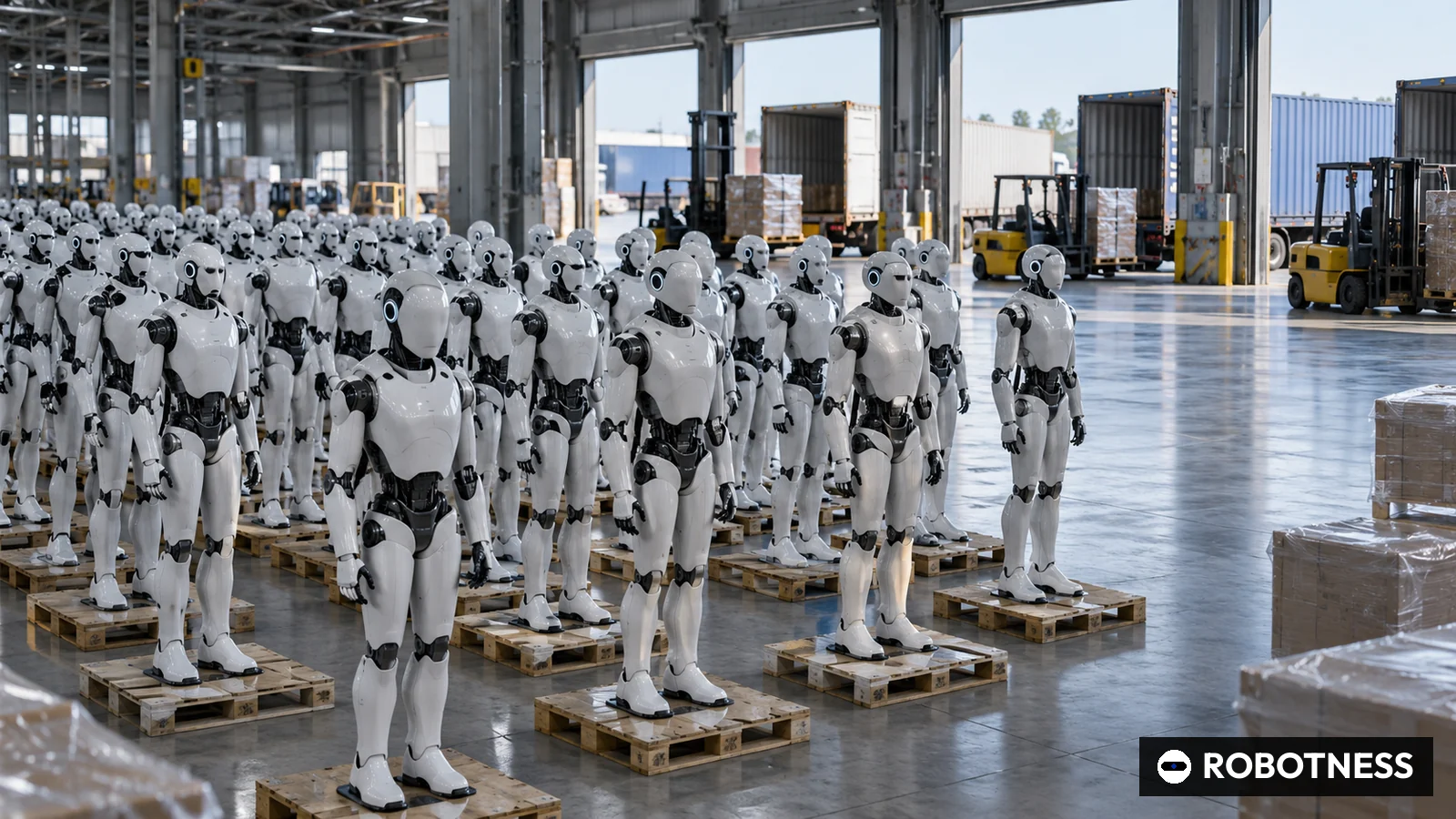
UBTech Robotics sold 921 full-size humanoid robots in the first half of 2026 and booked RMB590.3 million of revenue from them, up 1,445.0% from RMB38.2 million a year earlier, the Shenzhen company said in its interim results announcement to the Hong Kong stock exchange on August 28. Unit sales rose 1,946.7%. The humanoid line became UBTech's largest business, lifting group revenue 104.2% to RMB1,269.1 million from RMB621.5 million.
The mix shift improved profitability. Gross profit rose 160.9% to RMB566.9 million and gross margin widened to 44.7% from 35.0%, the filing shows. The loss for the period narrowed 23.0% to RMB338.8 million from RMB440.0 million, and the loss attributable to owners fell to RMB311.5 million from RMB413.6 million. Adjusted EBITDA, a non-IFRS measure the company reports, was a loss of RMB174.1 million against RMB321.8 million a year earlier. Research and development expenses rose 38.9% to RMB303.1 million.
The other product lines moved less. Non-embodied humanoid robots brought in RMB32.7 million, up 21.9%. Revenue from other smart robots fell 18.8% to RMB245.8 million, and smart hardware devices rose 2.9% to RMB259.4 million. A new line of garden machinery and automotive components contributed RMB139.2 million, which UBTech attributes to its acquisition of Fenglong.
Customers and concentration
The announcement shows how dependent the surge is on a small number of buyers. One customer accounted for RMB308.5 million, or 24% of group revenue, in the half, UBTech said, without naming it. In its interim report published on September 24 the company said it had completed project deliveries to Fortune Global 500 clients including OPmobility, Jabil, Foxconn and Honda. UBTech had 2,744 employees at June 30.
The company framed the first half as proof that it can manufacture at scale. The interim report says UBTech overcame quality and delivery challenges in mass production of full-size humanoids, which it said supports the achievement of an annual production target of 10,000 units. It did not give a delivery forecast for the second half in either document reviewed.
On software, UBTech said its Thinker 1.0 embodied model ranked first on nine embodied intelligence leaderboards and that it expects to release an upgraded Thinker-WM 2.0 in the second half of 2026. The Walker S2 that anchors its factory deployments is marketed as able to swap its own battery in about three minutes, which the company presents as the basis for continuous operation on production lines.
Capital markets activity
The results arrived during a busy period of filings. UBTech completed the conversion of unlisted shares into H shares under the H-share full circulation programme on July 16, after receiving a CSRC filing notice on July 3 and exchange approval on July 10. Shareholders approved an H share incentive scheme on August 26, and on September 23 the company said it had submitted a further full circulation application to the CSRC. Wider tradable supply and an employee share scheme both matter for a stock that has relied on placings to fund expansion.
Competitive context
UBTech now reports the highest half-year revenue of the three Chinese robot makers with public filings in the table below, but not the highest profit. Unitree Robotics, which listed on Shanghai's STAR Market on August 19, reported first-half revenue of RMB1,152.25 million and net profit attributable to shareholders of RMB274.00 million. Hai Robotics, a warehouse robot maker that filed for a Hong Kong listing in September, disclosed first-half revenue of RMB1,118.1 million and a net loss of RMB430.9 million in its application proof. Overseas, Figure AI and Agility Robotics remain private and do not publish unit sales.
The technology explains why industrial buyers are interested. A full-size humanoid such as Walker S2 can work in spaces designed for people, along conveyors and at material racks, without rebuilding the line. Battery swapping removes the charging downtime that has limited earlier humanoid trials, and models such as Thinker aim to let one robot learn several handling tasks rather than being programmed for each.
The open questions are breadth and margin. A single customer at 24% of revenue means the second half depends on whether orders spread beyond the largest buyer. Gross margin of 44.7% is healthy for hardware, but the group still lost RMB338.8 million, and research spending is rising faster than any line except humanoids. Annual results, due by March 31, 2027 under Hong Kong rules, will show whether the 10,000-unit production target translated into deliveries.
ROBOTNESS analysis
UBTech has shown that industrial humanoids can now be sold by the hundreds, but its second half must prove that demand extends beyond one dominant buyer.
The evidence is clear in the filing: 921 units, RMB590.3 million of humanoid revenue, gross margin up 9.7 percentage points and the period loss down 23.0%. Named deliveries to OPmobility, Jabil, Foxconn and Honda point to automotive and electronics plants as the first real market.
The strongest counter-argument is concentration. One customer produced RMB308.5 million, equal to 52% of the humanoid revenue figure (308.5 / 590.3), and UBTech does not identify it or say which products it bought. Without that buyer, the growth curve would look much flatter.
Bull case: the 10,000-unit production target is met, Thinker-WM 2.0 ships on schedule, and the Fortune Global 500 pilots convert into fleet orders. Operating leverage on a 44.7% gross margin would close the remaining loss quickly.
Bear case: the largest customer slows purchases, unit prices fall as Unitree and other Chinese makers compete for the same plants, and higher research spending keeps losses near current levels. Fresh share supply from full circulation and placings would then weigh on the stock.
- By December 31, 2026: release of Thinker-WM 2.0, promised for the second half.
- Early each month: HKEX monthly returns showing share issuance and any new placings.
- By March 31, 2027: full-year 2026 results with second-half humanoid units and customer concentration.
- UBTech Robotics
- HKEX 9880
- 1269.1
- 104.2
- 44.7
- -338.8
- Unitree Robotics
- SSE STAR 688836
- 1152.25
- 48.54
- No data
- 274
- Hai Robotics
- HKEX application proof
- 1118.1
- No data
- 34.4
- -430.9
UBTech: interim results announcement, August 28, 2026 (loss for the period). Unitree: STAR Market listing announcement, August 18, 2026 (net profit attributable to shareholders; half-year gross margin not disclosed there). Hai Robotics: HKEX application proof, September 2026 (net loss; prior-year comparison not used). Figures disclosed, not estimated.
As of Oct 1, 2026
- 2,744 at June 30, 2026
- 44.7% (35.0% a year earlier)
- RMB303.1 million, up 38.9%
- RMB1,269.1 million, up 104.2%
- RMB308.5 million, 24% of revenue
- Six months to June 30, 2026
- RMB338.8 million, narrowed 23.0%
- 921 units, up 1,946.7%
- RMB590.3 million, up 1,445.0%
Why it matters
These are among the first half-year figures from a listed company to show a humanoid robot business at hundreds of units and more than half a billion yuan of revenue. They move the debate from whether factories will buy humanoids to how many, at what price and from how many customers.
For investors the filing also sets a benchmark for unit economics. RMB590.3 million across 921 units implies average revenue of about RMB641,000 per full-size humanoid (590.3 million / 921), a figure that every rival selling into Chinese factories will be measured against.
Rival analysis
Unitree, now listed in Shanghai, reported higher profit on slightly lower group revenue in the same half, but it sells mostly research and education platforms, while UBTech's growth comes from industrial sites. Hai Robotics, which filed in Hong Kong, shows the alternative path of warehouse automation with RMB1,118.1 million of half-year revenue and a gross margin of 34.4%.
In the West, Figure AI, Agility Robotics and Apptronik have announced factory and logistics pilots but disclose neither units nor revenue. UBTech's advantage is a public record of deliveries; its disadvantage is a customer base concentrated in one large buyer and in Chinese plants.
Valuation context
UBTech's own valuation is not in the filings reviewed, but its peer Unitree used UBTech as a comparable and put it at 19.37 times sales in its August 18 listing announcement, against Unitree's 35.89 times. The difference reflects profit: Unitree earns money, UBTech still loses it.
On our arithmetic, annualising the first half's RMB1,269.1 million gives about RMB2.5 billion of revenue (1,269.1 x 2). That simple run rate ignores seasonality and should be treated as a reference point rather than a forecast.
Supply-chain implications
Full-size humanoid revenue of RMB590.3 million implies demand for joint actuators, reducers, batteries and cameras on a scale Chinese suppliers have not yet seen from a single customer. The Walker S2 relies on pure RGB binocular stereo vision in its head, according to UBTech's product page, which reduces dependence on lidar and depth sensors.
The Fenglong acquisition adds garden machinery and automotive components manufacturing, which gives UBTech in-house metalworking and parts capacity. That may matter more for humanoid cost control than the RMB139.2 million of revenue it contributed.
Signals to watch
First, any announcement of large Walker orders or framework agreements. A second named customer above 10% of revenue would ease the concentration risk.
Second, the release of Thinker-WM 2.0 before year end, and third, the outcome of the September 23 CSRC full circulation application, which would increase tradable H shares.
Analyst view
Thesis: UBTech has crossed from pilot to production in industrial humanoids, but its earnings quality depends on diversifying beyond one customer. Confidence: medium. The revenue and unit data are disclosed in exchange filings and unambiguous; the identity of the 24% customer and the order backlog are not disclosed, which limits visibility.
We would watch revenue per unit as closely as unit counts. If competition from Unitree and others pushes average revenue per humanoid well below the first half's implied RMB641,000, margin gains could stall even as volumes rise.
Questions you should be asking
Who is the customer that accounted for RMB308.5 million, and is it a distributor, an automaker or a government-linked buyer?
What share of the 921 units went to paid production work rather than data collection or training centres?
How many units has UBTech actually produced against the 10,000-unit annual target cited in its interim report?