Humanoid shipments jump 432% to nearly 25,000 in the first half as Chinese makers take over 95% of the market, IDC says
Global humanoid robot shipments reached nearly 25,000 units in the first half of 2026, up 432.1% year on year, with market value above $740 million, IDC said on September 29. China took about 77.9% of shipments, Chinese vendors supplied more than 95%, and IDC raised its 2030 forecast by about 50% to more than 750,000 units.
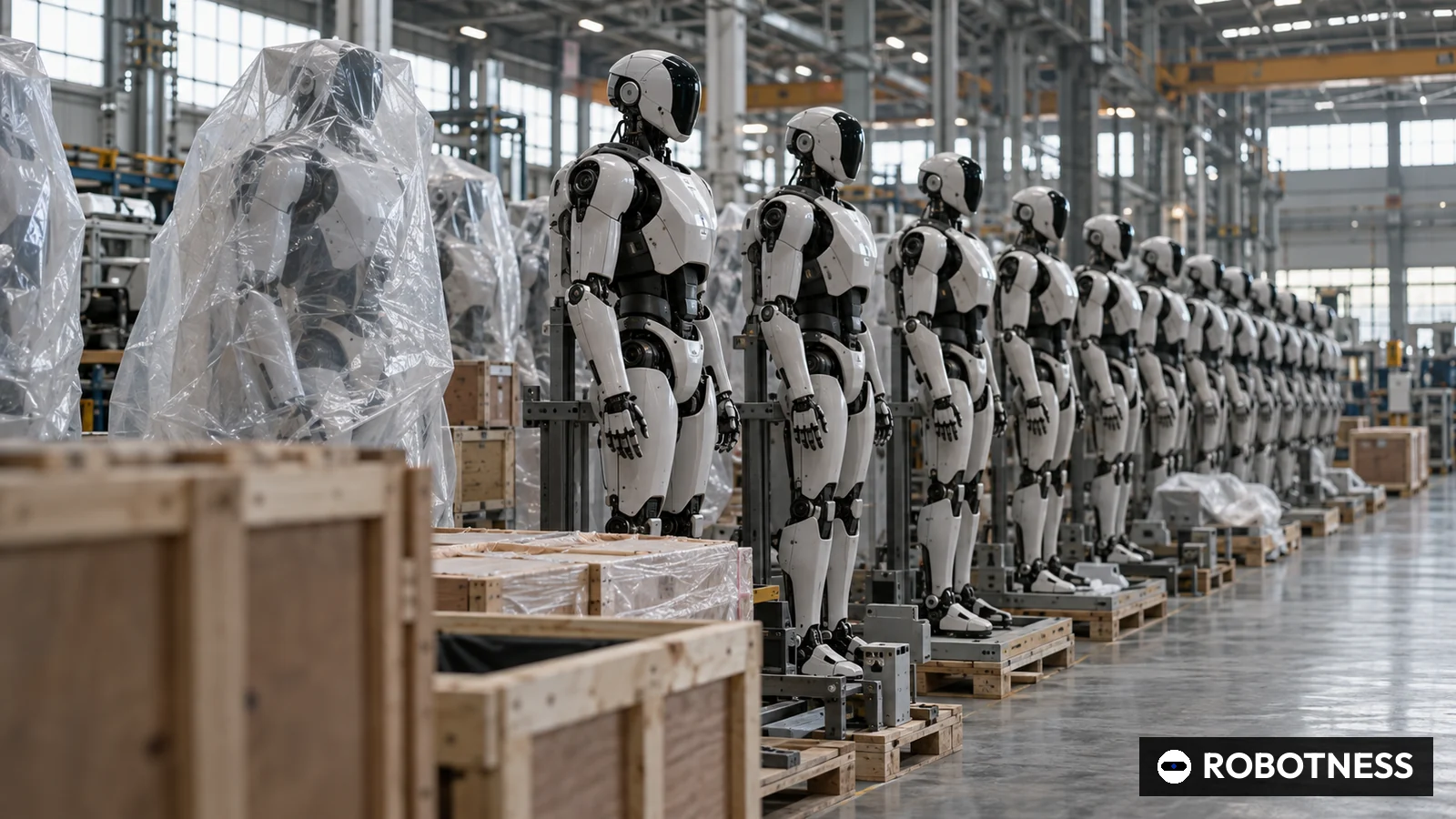
Humanoid robots are leaving the lab faster than most forecasts assumed, and almost all of them are Chinese. Global shipments reached nearly 25,000 units in the first half of 2026, up 432.1% from a year earlier, IDC said in a report published on September 29. The market was worth more than $740 million, an increase of 322.7%.
China accounted for the bulk of that growth. Shipments in China exceeded 19,000 units, up 426.3%, giving the country about 77.9% of global volume, according to IDC. Measured by the nationality of the vendor rather than the destination, Chinese makers supplied more than 95% of all humanoids shipped worldwide in the period.
- Global shipments (units)
- 25,000
- 432.1
- China shipments (units)
- 19,000
- 426.3
- Global market value (USD m)
- 740
- 322.7
- China share of global shipments (%)
- 77.9
- No data
- Chinese vendors' share of global shipments (%)
- 95
- No data
- Research, education, demo and government share, H1 2026 (%)
- 69
- No data
- Same share, full year 2025 (%)
- 83.8
- No data
- Global shipment forecast for 2030 (units)
- 750,000
- No data
- Implied global shipments, H1 2025 (units, derived)
- 4,698
- No data
- Average value per unit, H1 2026 (USD, derived)
- 29,600
- -20.6
Source IDC, Sept 29, 2026. IDC figures are rounded ('nearly 25,000', 'more than 19,000', 'more than $740 million', 'more than 95%'). Derived rows by ROBOTNESS: H1 2025 units = 25,000 / (1 + 4.321); value per unit = 740,000,000 / 25,000; change in value per unit = (1 + 3.227) / (1 + 4.321) minus 1. Derived values are indicative.
As of Oct 1, 2026
IDC raised its long-term outlook on the back of the numbers. It now expects global humanoid shipments to exceed 750,000 units in 2030, about 50% above its previous forecast. Lily Li, research manager at IDC China, said rapid iteration of embodied AI models, a maturing supply chain and continued cost reductions should allow humanoids to prove their commercial value in more real-world settings. She said competition is shifting away from mechanical structure and hardware specifications toward overall embodied intelligence.
The mix of buyers is starting to change. Research and education, performances and exhibitions, and government data-collection centres together took 83.8% of shipments in 2025, IDC said, but their share fell to 69% in the first half of 2026. Industrial manufacturing, retail, transport and logistics, leisure and tourism, and household consumption are the emerging uses. IDC named AgiBot, UBTech and Galbot as vendors concentrating on industrial deployments.
IDC's rounded figures also allow a rough reading of prices. Dividing market value by units gives average revenue of about $29,600 per humanoid in the first half, a ROBOTNESS calculation. Because units grew faster than value, average value per unit fell by about 21% from a year earlier, and the growth rate implies a first-half 2025 base of roughly 4,700 units. The decline is consistent with a shift toward lower-priced models, although IDC did not publish a breakdown by price band or robot size.
The listed Chinese makers have shown similar momentum in their own disclosures. UBTech reported selling 921 full-size humanoids in the first half of 2026, and Unitree raised RMB6.1 billion when it listed on Shanghai's STAR Market in August. Both now trade as public benchmarks for a sector that, by IDC's count, is overwhelmingly Chinese.
Outside China the numbers are far smaller. Agility Robotics, one of the most commercially advanced US humanoid makers, disclosed $1.8 million of 2025 sales in the S-4 filing for its planned Nasdaq listing. Figure AI raised $1 billion at a $39 billion post-money valuation in September 2025 on expectations of future production. South Korea's government, in a plan adopted on September 30, put China's share of the humanoid market at 87%, the United States at 3% and Korea at 1%.
- UBTech
- CN
- Full-size humanoids sold, H1 2026 (units)
- 921
- 2026-08-28
- Unitree
- CN
- STAR Market IPO proceeds (RMB bn)
- 6.1
- 2026-08-18
- Agility Robotics
- US
- 2025 sales (USD m)
- 1.8
- 2026-09-04
- Figure AI
- US
- Series C post-money valuation (USD bn)
- 39
- 2025-09-16
Figures as disclosed by the companies in their interim report, listing documents, S-4 filing and funding announcement. Metrics differ by company and are not directly comparable.
As of Oct 1, 2026
For suppliers and buyers elsewhere, the data set the terms of competition. Makers of actuators, reducers, sensors and compute modules for humanoids face a customer base that is mostly Chinese, and Western humanoid companies will be measured against Chinese cost curves at volumes they have not yet reached. Governments are reacting. Korea's plan to buy more than 1,700 robots in 2027 explicitly cites the Chinese lead as the reason to create public demand.
The figures carry caveats. IDC counts shipments, not robots doing paid work, and more than two thirds of first-half volume still went to research, education, demonstrations and government data centres, where buyers often purchase for data collection or display. IDC publishes rounded totals, so per-unit values derived from them are indicative. Market share estimates also differ by source, because the Korean government's 87% for China and IDC's 77.9% by destination and 95% by vendor rest on different and undisclosed bases.
The next checkpoints are company disclosures. STAR Market companies, Unitree among them, must publish third-quarter reports within one month of the quarter's end, by October 31. UBTech's full-year results are due by the end of March 2027 under Hong Kong listing rules, and IDC's full-year 2026 data should follow early next year.
ROBOTNESS analysis
China's humanoid lead has become a volume lead, but the buyer mix shows a market still carried by research and state demand rather than proven by factory payback.
The evidence for the first half is strong. Shipments grew 432.1%, Chinese vendors supplied more than 95% of the world's humanoids, and IDC raised its 2030 forecast by about half. The evidence for the second half is the buyer mix, with 69% of units still going to research, education, exhibitions and government data centres.
The strongest counter-argument is the direction of travel. By ROBOTNESS arithmetic on IDC's shares, commercial and other emerging uses rose from 16.2% of shipments in 2025 to 31% in the first half of 2026, on a far larger base. If that share keeps doubling, the research-and-demo phase may end sooner than sceptics expect.
In the bull case falling unit prices open factory, retail and logistics demand, Chinese makers report rising gross margins on industrial orders, and IDC's 750,000-unit forecast for 2030 starts to look conservative. Suppliers that sit in the Chinese bill of materials gain the most.
In the bear case government data-centre and education orders slow once initial budgets are spent, inventories build at smaller makers, and price cuts outrun cost reductions. Shipments would then overstate real adoption, and the gap between units shipped and robots at work would widen.
Signals to watch
- October 31, 2026: Unitree's third-quarter report on the STAR Market, the first public read on second-half demand.
- March 31, 2027: deadline for UBTech's 2026 annual results, including full-year humanoid unit sales.
- Early 2027: IDC's full-year 2026 humanoid data and any change to the application mix.
- IDC, published September 29, 2026
- more than 750,000 units, about 50% above prior forecast
- more than 95%
- about 77.9%
- more than 19,000 units (+426.3%)
- nearly 25,000 units (+432.1%)
- more than $740 million (+322.7%)
- 69% in H1 2026, from 83.8% in 2025
Why it matters
This is the first independent half-year count to show humanoid volume in the tens of thousands, and it puts a number on what was previously anecdote. With Chinese vendors supplying more than 95% of global units, the industry's scale economics are now being set almost entirely in one country.
The 50% upgrade to IDC's 2030 forecast also matters for capital allocation. Component suppliers, chipmakers and investors use such forecasts to size capacity, and a 750,000-unit market in 2030 is large enough to justify dedicated actuator and reducer lines.
Rival analysis
Among Chinese makers, IDC names AgiBot, UBTech and Galbot as the vendors pushing into industrial use, while Unitree, now listed on the STAR Market, is the best-known supplier of smaller and research platforms. UBTech's 921 full-size units in the first half show that the large-robot segment is still a fraction of total volume.
US competitors are at a different stage. Agility Robotics disclosed $1.8 million of 2025 sales, and Figure AI's $39 billion valuation rests on future production. Korea, by its own government's estimate, holds 1% of the humanoid market.
Valuation context
The ROBOTNESS estimate of about $29,600 average revenue per unit in the first half, down about 21% year on year, frames valuation debates. Chinese makers are competing on price at volume, while Western peers are valued on expected performance per robot.
Public-market comparables now exist in Unitree and UBTech, which gives private Chinese makers preparing listings a benchmark. For Western companies, the IDC data raise the bar, since investors can compare unit economics against Chinese peers shipping thousands of units.
Supply-chain implications
With Chinese vendors at more than 95% of shipments, demand for humanoid components is concentrated in Chinese bills of materials. Domestic suppliers of motors, reducers, lead screws and sensors gain scale first, which lowers their costs further.
For non-Chinese suppliers the question is access. Korea's plan to favour domestic parts in public procurement and similar moves elsewhere could split the supply chain into Chinese and non-Chinese tracks, each with different cost bases.
Signals to watch
Unitree's third-quarter report, due by October 31, will be the first public test of second-half demand. UBTech's annual results, due by the end of March 2027, will show whether full-size humanoid sales kept pace.
IDC's full-year data, expected early in 2027, will show whether the share of research, education and government buyers keeps falling below 69%.
Analyst view
Thesis: Chinese humanoid volume is real and accelerating, but its commercial quality is still unproven. Confidence is medium. IDC is an independent counter with a consistent method, which supports the volume claim, but it publishes rounded totals and no price or size breakdown.
We would raise confidence in commercial adoption if company reports show industrial customers and repeat orders growing faster than research and education sales. We would lower it if second-half shipments slow as government and education budgets are used up.
Questions you should be asking
How many of the 25,000 units are full-size humanoids rather than smaller research and education models, and how does average price differ between them?
What share of shipped robots is in paid, daily operation? How much of China's volume depends on government data-collection centres, and how long will that funding last?