China writes embodied AI into its 15th Five-Year Plan as industrial robot output climbs 28% to 773,000 units
China's legislature approved the 2026 to 2030 development outline on March 12, naming embodied AI a future industry and calling for national training grounds, integrated brain-and-cerebellum robot models and faster humanoid deployment. Official data show industrial robot output rose 28.0% to 773,074 sets in 2025 and 33.2% in the first quarter of 2026.
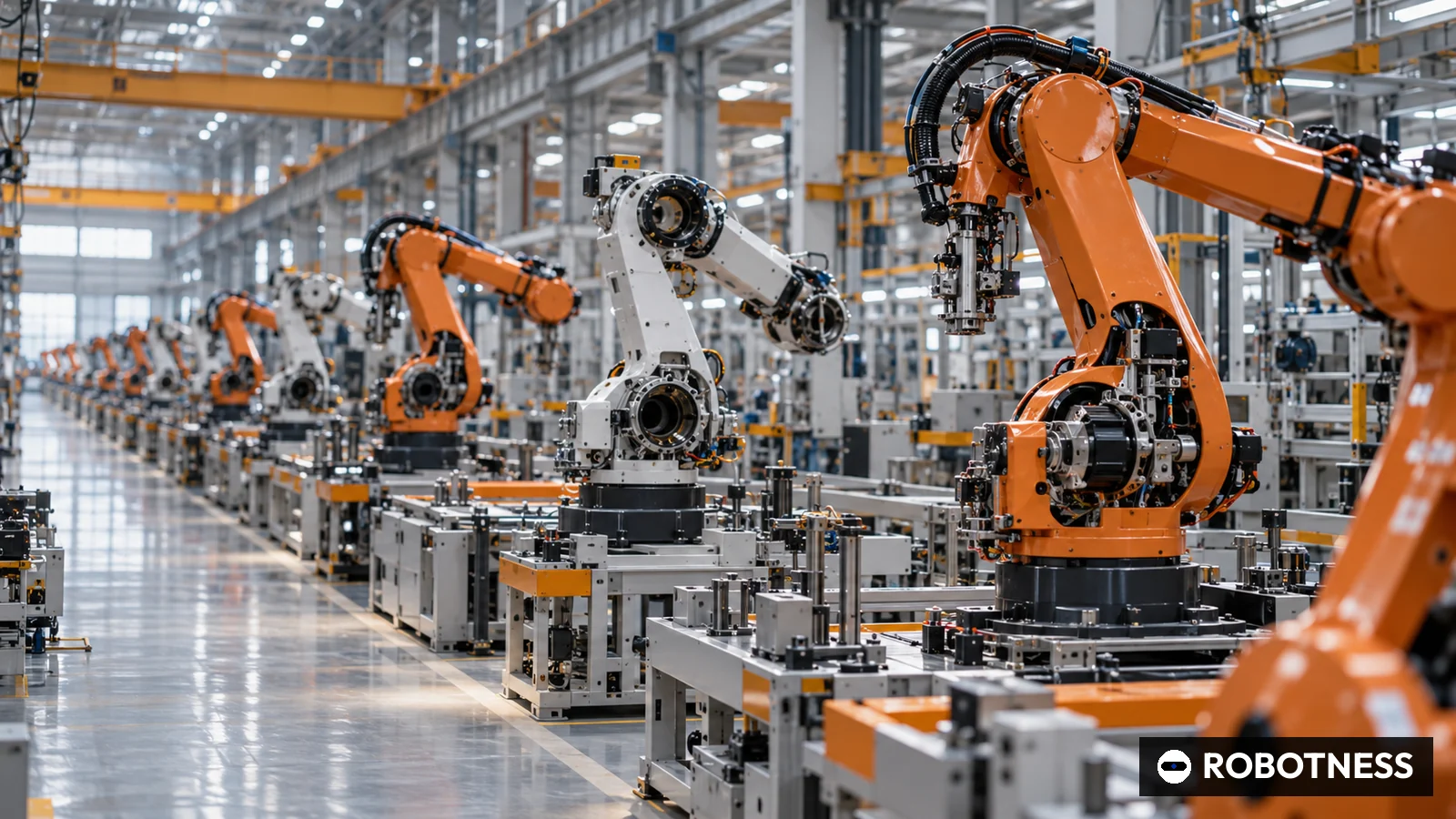
China's National People's Congress approved the outline of the 15th Five-Year Plan for National Economic and Social Development on March 12, 2026, according to the resolution the legislature adopted at the close of its fourth annual session. The outline, which steers economic policy from 2026 through 2030, places embodied artificial intelligence on its list of future industries that Beijing wants to turn into new sources of growth, and it names robotics among the strategic emerging industries the state intends to build into pillar sectors.
The endorsement lands on an industry that is already expanding quickly. Industrial robot output at China's manufacturers above the statistical size threshold reached 773,074 sets in 2025, up 28.0% from a year earlier, the National Bureau of Statistics (NBS) reported on January 19. Service robot output rose 16.1% to 18,581,081 sets. In the government work report he delivered on March 5, Premier Li Qiang cited the 28% rise in industrial robot output as a marker of industrial upgrading, next to 9.4% growth in high-tech manufacturing value added.
In the chapter on future industries, the outline groups embodied AI with quantum technology, bio-manufacturing, hydrogen and fusion energy, brain-computer interfaces and sixth-generation mobile communications. For this group it promises a mechanism for rising investment and shared risk, demonstration projects, and work on multiple technology routes, typical application scenarios, viable business models and market supervision rules. It also calls for national future-industry research institutes, proof-of-concept centres and a set of future-industry pilot zones in regions with strong research and manufacturing bases.
The most specific language sits in Box 3, a list of ten new industries and tracks that also covers integrated circuits, new batteries, commercial space and brain-computer interfaces. Its embodied AI entry tells planners to coordinate the siting of embodied AI training grounds, to advance collaborative training that mixes virtual and real environments, to research physical AI, to develop embodied models and algorithms that integrate a 'big brain' with a 'small brain', to tackle robot bodies and core components, and to speed up product upgrades and deployment of humanoid robots and other form factors. The same box lists intelligent surgical robots under high-end medical devices.
The plan also describes where the machines should go. Box 10, which sets out the 'AI Plus' action, asks for new forms of work built on human and machine collaboration and for embodied AI to be used in jobs that face labour shortages or high environmental hazards. The AI chapter separately encourages innovation in multimodal models, agents, embodied intelligence and swarm intelligence as part of a search for paths toward general AI. In industry usage, the 'big brain' refers to a large model that perceives, reasons and plans, while the 'small brain' handles real-time motion control; the training grounds are physical sites where robots gather task data that is then combined with simulation.
Standards work moved in parallel. On February 28 the humanoid robot and embodied AI standardization technical committee under the Ministry of Industry and Information Technology (MIIT) released a Humanoid Robot and Embodied AI Standard System (2026 edition), drafted with more than 120 research institutes and companies, according to a notice from the Zhuhai Bureau of Industry and Information Technology. The framework has six parts covering foundational and common standards, brain-like and intelligent computing, limbs and components, complete machines and systems, applications, and safety and ethics.
Output data since the plan's approval show momentum carrying into 2026. Industrial robot production reached 143,608 sets in January and February, up 31.1%, and the NBS chief industrial statistician said faster robot production and equipment upgrades helped lift general equipment value added by 8.9%. First-quarter output reached 237,554 sets, up 33.2%, the bureau reported on April 16. Service robots slowed sharply, growing 1.0% in the first two months and 2.6% in the quarter to 4,439,918 sets.
China's weight in the global market explains why the plan matters beyond its borders. The International Federation of Robotics (IFR) counted 295,000 industrial robot installations in China in 2024, 54% of the world total of 542,000, against 44,500 in Japan, 34,200 in the United States, 30,600 in South Korea and 26,982 in Germany [[table:0]]. Chinese suppliers held 57% of their home market in 2024, up from 47% a year earlier, the federation said.
Several questions remain open. The outline sets no unit targets, budgets or deadlines for embodied AI, leaving those to the national special plans it says will be drafted alongside it. The statistics also need care: the 2024 communique reported 556,000 industrial robot sets, while the 2025 growth rate of 28.0% is calculated on a comparable enterprise basis, so the two levels cannot simply be divided [[table:1]]. And NBS output counts production, including units built for export, while the IFR counts installations.
ROBOTNESS analysis
The 15th Five-Year Plan turns embodied AI from a provincial and ministerial enthusiasm into a national planning commitment, and the production data show China entering that commitment with scale it did not have five years ago.
The evidence is in the plan's texture. Embodied AI appears in four places in the outline, in the future-industries chapter, in the AI chapter, in Box 3 and in the AI Plus action, and each carries a different job, from funding mechanisms and technology priorities to deployment settings. Pairing training grounds with integrated 'big brain and small brain' models gives the sector a coherent technical agenda that couples real task data at scale with simulation, rather than a slogan.
The strongest counter-argument is that the document is a list without numbers. Beijing has named many future industries before, and the outline itself warns against plans that multiply without effect. Without quantified targets, the money and procurement that decide winners will come later and may be spread thin across provinces that all want a humanoid cluster.
Bull case. The risk-sharing mechanism and pilot zones channel patient capital and public demand into a sector where Chinese suppliers already supply most of their home market. If labour-short and hazardous jobs become funded deployment sites, unit volumes could compound the way industrial robot output did in 2025.
Bear case. Output growth in service robots has already stalled to low single digits in early 2026, a reminder that policy can lift supply faster than real demand. Duplicate capacity, price wars and thin margins could follow, and humanoids may stay in showrooms longer than the plan implies.
Signals to watch:
- Mid-October 2026: NBS September and third-quarter industrial output data, the first read on whether 30%-plus robot growth holds through the year.
- During 2026: MIIT and NDRC special plans for robotics and future industries under the 15th Five-Year Plan, which should add the targets the outline omits.
- March 2027: the next government work report, which will show whether embodied AI moves from a listed future industry to named funding lines.
- China
- 295,000
- 7
- 54
- Japan
- 44,500
- -4
- No data
- United States
- 34,200
- No data
- No data
- Republic of Korea
- 30,600
- -3
- No data
- Germany
- 26,982
- -5
- No data
- World
- 542,000
- No data
- 100
IFR World Robotics 2025 press releases of 25 Sept 2025. Installations, not production. Changes and shares as disclosed by IFR; null where not disclosed.
As of Oct 1, 2026
- 2024
- 556,000
- 14.2
- 10,519,000
- 15.6
- 2025
- 773,074
- 28
- 18,581,081
- 16.1
- Dec 2025
- 90,116
- 14.7
- 1,564,018
- 4.6
- Jan-Feb 2026
- 143,608
- 31.1
- 2,547,480
- 1
- Q1 2026
- 237,554
- 33.2
- 4,439,918
- 2.6
NBS releases for enterprises above the size threshold. 2024 figures as published in the 2024 communique, rounded to 10,000 sets. YoY rates are NBS figures on a comparable basis and cannot be derived from the levels shown.
As of Oct 1, 2026
- 2026 to 2030
- March 12, 2026, by the 4th session of the 14th NPC
- MIIT committee, 2026 edition, six parts, 120+ drafters
- Listed future industry; Box 3 priority; AI Plus deployment
- 18,581,081 sets, +16.1%
- 773,074 sets, +28.0%
- 295,000 units, 54% of world
- 237,554 sets, +33.2%
Why it matters
A five-year plan outline is the top document in China's planning hierarchy. Ministries, provinces and state-owned enterprises write their own plans to fit it, so naming embodied AI in the future-industries chapter, in Box 3 and in the AI Plus action gives every local government a mandate to fund training grounds, pilot zones and procurement.
The outline also signals what kind of robotics Beijing wants. It ties humanoids to integrated models, core components and real-world training rather than to stage demonstrations, and it names labour-short and high-hazard jobs as the target market, which points policy money toward industrial and public-sector deployment first.
Rival analysis
Other governments are moving, but with different tools. IFR data show Japan, South Korea and Germany each installed fewer industrial robots in 2024 than a year earlier, while China installed a record 295,000 units. Korea and Japan have announced humanoid and physical AI programmes since, yet none ties them to a national plan of the same legal weight.
The comparison that matters for suppliers is market share. Chinese vendors held 57% of their home market in 2024, according to the IFR, up ten points in a year. A plan that funds core components and complete machines at home makes it harder for Japanese, European and US arm makers to win that share back.
Valuation context
The outline promises an investment growth and risk-sharing mechanism for future industries, and the government work report asks state investment funds to act as patient capital and to make efficient use of the national venture capital guidance fund. Neither document gives a figure.
For listed and soon-to-list Chinese robot makers, such as Unitree, which listed on Shanghai's STAR Market in August 2026, the plan supports the policy premium in valuations. The absence of quantified targets means that premium rests on expectations of later special plans rather than on committed money.
Supply-chain implications
Box 3 names robot bodies and core components as priorities. In practice that means precision reducers, servo motors, joint modules, dexterous hands, sensors and onboard computing, where Japanese and European suppliers remain strong in high-end segments.
The MIIT standard system adds a second lever. Its limbs and components part and its brain-like and intelligent computing part will define interfaces and test methods, and standards written around domestic parts can shape procurement as much as subsidies do.
Signals to watch
NBS monthly output data, published around the middle of each month, are the fastest check on whether the plan's signal turns into production. Industrial robot growth of 31.1% in January and February and 33.2% in the first quarter set a high bar.
The next policy documents to watch are MIIT and NDRC special plans for robotics and future industries, the first list of future-industry pilot zones, and the 2027 government work report in March 2027.
Analyst view
Thesis: the outline makes embodied AI a durable national priority for the rest of the decade, and China will remain the volume centre for industrial robots while humanoid deployment depends on the special plans still to come. Confidence: medium. The policy text and output data are firm, but the outline has no numbers and service robot growth has slowed.
We would raise confidence if the special plans set unit or deployment targets and if humanoid output starts to appear in official statistics. We would lower it if robot output growth falls back toward the 14.2% pace the NBS reported for 2024.
Questions you should be asking
How much public money will the investment growth and risk-sharing mechanism commit, and through which funds?
Which regions will host the future-industry pilot zones and the embodied AI training grounds, and how will Beijing prevent duplicate investment?
Will the NBS add humanoid robots as a separate line in its output statistics, and when?