Boston Dynamics starts building the production Atlas as Hyundai targets 30,000 robots a year and a Georgia line debut in 2028
Boston Dynamics unveiled the production version of its electric Atlas humanoid at CES 2026 on January 5 and said manufacturing begins immediately in Boston, with all 2026 units already committed to Hyundai Motor Group and Google DeepMind. Hyundai set a goal of a production system able to build 30,000 robots a year by 2028, when Atlas is due to start parts sequencing at its Georgia Metaplant, moving into assembly by 2030. Hyundai Mobis will supply the actuators and Google DeepMind's Gemini Robotics models are to supply the cognition.
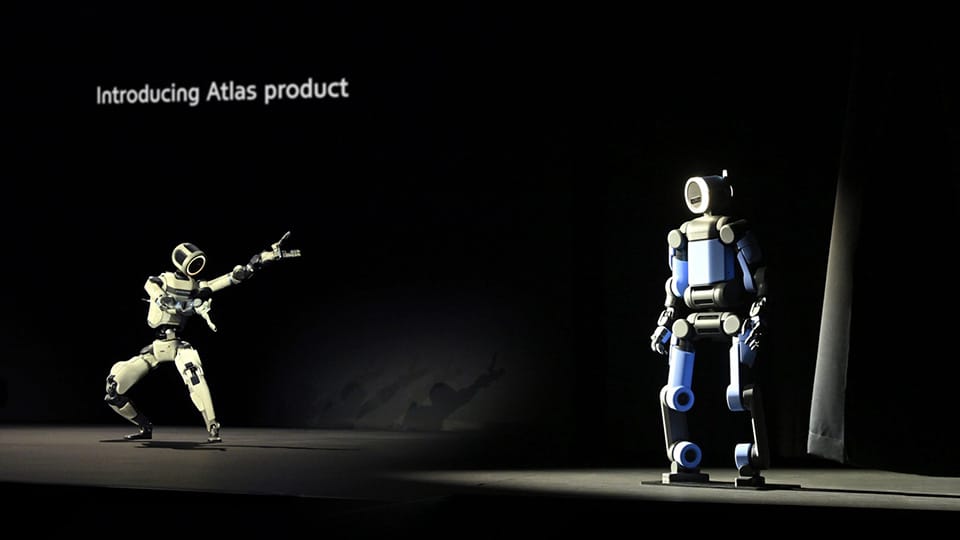
Boston Dynamics used the opening press day of CES 2026 in Las Vegas on January 5 to present the product version of Atlas, the all-electric humanoid it first showed in April 2024, and said it would begin building the robot at its Boston headquarters immediately. According to the company, every Atlas it can make in 2026 is already allocated, going to the Robot Metaplant Application Center (RMAC) run by its majority owner Hyundai Motor Group and to Google DeepMind. Other customers are scheduled to receive robots from early 2027. Chief executive Robert Playter called it the best robot the company has built.
The product page lists Atlas at 1.9 metres tall and 90 kilograms, with 56 degrees of freedom and joints that rotate continuously. It can lift 50 kg in a single effort and handle 30 kg on a sustained basis, reaches 2.3 metres, is rated IP67 and works between minus 20 and 40 degrees Celsius. Boston Dynamics quotes a four-hour battery life and says the robot walks itself to a charging station and swaps its own packs. Tactile sensing and 360-degree camera coverage are standard. It plugs into manufacturing execution and warehouse management systems through the company's Orbit software, uses human detection and fenceless guarding, and can be run autonomously, by teleoperation or from a tablet. Boston Dynamics says a task learned by one Atlas can be copied across a fleet at once. No price was disclosed.
- Height
- 1.9
- m
- Weight
- 90
- kg
- Degrees of freedom
- 56
- No data
- Reach
- 2.3
- m
- Peak lift
- 50
- kg
- Sustained lift
- 30
- kg
- Battery life
- 4
- h
- Min. operating temperature
- -20
- °C
- Max. operating temperature
- 40
- °C
Figures as listed by Boston Dynamics on its Atlas product page and in its 5 January 2026 launch release; disclosed, not estimated. Price not disclosed.
As of Oct 1, 2026
Hyundai Motor Group set out the industrial frame in its own CES strategy release. The group said it aims to have a scalable production system able to manufacture 30,000 robot units a year by 2028. RMAC, which the group said opens in the United States in 2026, will train Atlas units that are to be deployed from 2028 at Hyundai Motor Group Metaplant America (HMGMA) in Georgia on highly repetitive parts sequencing, progressing to complex component assembly by 2030. Hyundai linked the plan to US$26 billion of US investment over four years from 2025 and KRW125.2 trillion in Korea over five years from 2026.
Two partners fill the gaps a car group cannot fill alone. On January 7 Hyundai Mobis said it will supply the actuators for Atlas, components it says make up more than 60% of a humanoid's material cost, and described Boston Dynamics as its first official customer in robotics. Zack Jackowski, general manager of Atlas, said working with an automotive supplier should give Atlas a reliable component chain, and noted that the new design cuts the number of unique parts sharply. Separately, Boston Dynamics and Google DeepMind agreed to bring Gemini Robotics foundation models into Atlas, with joint research at both companies' sites expected to start within months and an initial focus on car manufacturing. Alberto Rodriguez, who directs robot behaviour for Atlas, said the company wanted a partner to build new vision-language-action models for a robot this complex, while Carolina Parada, senior director of robotics at Google DeepMind, said her team was keen to test what the new Atlas can do. Hyundai also cited its strategic partnership with NVIDIA for AI infrastructure and simulation.
The launch is the payoff of a two-year sequence. When Boston Dynamics retired the hydraulic Atlas in April 2024 it named Hyundai as the first test partner for the electric version. In April 2025 Hyundai said it would buy tens of thousands of robots over the following few years, and in August 2025 it announced a US robotics facility with annual capacity of 30,000 units. The installed base the group can point to today comes from other machines. Hyundai says Spot operates in more than 40 countries and Stretch has unloaded more than 20 million boxes since its 2023 launch.
Measured against disclosed factory plans, the Hyundai target is the largest among Western humanoid programmes. Figure said in March 2025 that the first line at its BotQ plant can build up to 12,000 humanoids a year. Agility Robotics said in September 2023 that its RoboFab in Salem, Oregon would make hundreds of Digit robots in its first year and more than 10,000 a year eventually. 1X opened a factory in Hayward, California in April 2026 with capacity for 10,000 NEO units a year. Rivals carry heavy funding too, with Figure raising US$1 billion at a US$39 billion post-money valuation in September 2025 and Apptronik closing a US$520 million Series A extension in February 2026. Hyundai's 30,000 figure covers robot units in general rather than Atlas alone, so the comparison is of stated capacity, not humanoid output.
- Hyundai Motor Group (Boston Dynamics)
- Atlas and other robots
- US robot production system
- 30,000
- 2028
- 2026-01-05
- Figure AI
- Figure humanoids
- BotQ, first line
- 12,000
- No data
- 2025-03-15
- Agility Robotics
- Digit
- RoboFab, Salem, Oregon
- 10,000
- No data
- 2023-09-18
- 1X Technologies
- NEO
- Hayward, California
- 10,000
- No data
- 2026-04-30
Company disclosures. Hyundai figure covers robot units generally, not Atlas only. Agility figure is eventual capacity (more than 10,000). 1X figure was disclosed after the CES launch. Capacity is not output.
As of Oct 1, 2026
Several numbers that would let buyers judge Atlas are missing. Boston Dynamics has not given a price, a 2026 production quantity, cycle times or uptime data, and the four-hour battery rating means swapping is central to any two-shift use. The Georgia deployment is two years away, the Gemini Robotics work had not started at launch, and Hyundai Mobis has not said what volumes or which actuator types it will supply. The early 2027 delivery window for outside customers is the first test of whether Atlas is a product for the market or mainly for its parent.
ROBOTNESS analysis
The CES launch matters less for Atlas's specification sheet than for the fact that Hyundai has tied captive demand, an in-group actuator supplier and a dated production target into one plan, which no other Western humanoid maker has shown.
Evidence is in the paperwork. Demand is internal (RMAC in 2026, HMGMA sequencing in 2028, assembly in 2030), the costliest component class is sourced from an affiliate that says actuators are over 60% of material cost, and the 30,000-unit system is dated to 2028. Figure, Agility and 1X have each disclosed factory capacity, but none has a parent that is also the first large customer and the parts supplier.
The strongest counter-argument is that captive demand can hide weak economics. A parent can absorb robots that would not pass an outside buyer's payback test, and Hyundai has not published Atlas pricing, throughput or the share of the 30,000 units that will be humanoids. The software that decides usefulness, Gemini Robotics on Atlas, was still a research plan in January.
- Bull case: RMAC opens on time in 2026, external customers take delivery in early 2027 as promised, and Mobis volumes bring actuator cost down along an automotive learning curve. Atlas then becomes the reference humanoid for car plants worldwide, with Hyundai's sites as the proof.
- Bear case: battery runtime, reliability or model performance keep Atlas in pilot roles, and the 2028 sequencing start slips. The 30,000-unit system then fills mainly with Spot, Stretch and mobile platforms, and humanoid volume stays in the hundreds.
- Signals to watch: the RMAC opening in the US during 2026 and the number of Atlas units it runs; first deliveries to customers outside the group in early 2027; and any Hyundai disclosure before the 2028 HMGMA start on Atlas unit counts or Mobis actuator volumes.
- 5 January 2026, CES Las Vegas
- 56 DoF, 50 kg peak lift, 2.3 m reach, IP67, 4 h battery
- Google DeepMind, Gemini Robotics models
- Begins immediately at Boston Dynamics HQ, Boston
- Sequencing from 2028, assembly by 2030
- Fully committed to Hyundai RMAC and Google DeepMind
- Hyundai Mobis (announced 7 January 2026)
- From early 2027
- 30,000 robot units a year by 2028
Why it matters
Atlas is the first humanoid from a Western maker launched with a dated production target from its own parent, a named first factory application and an in-group supplier for its most expensive parts. That combination turns Hyundai into a test of whether automotive industrial logic (captive volume, tiered suppliers, process data) can carry humanoids past the pilot stage.
For buyers, the important detail is that 2026 output is fully allocated to Hyundai and Google DeepMind. Outside customers cannot get an Atlas before early 2027, which gives rivals Figure, Agility and Apptronik a window of at least a year in third-party plants.
Rival analysis
Figure has the most capital (US$1 billion Series C at US$39 billion post-money in September 2025) and a BotQ line rated at 12,000 units a year, but must win external customers for volume. Agility stated RoboFab capacity of more than 10,000 a year only at full build-out. Apptronik's US$520 million extension in February 2026 funds a similar push.
Boston Dynamics differs in that its first and largest customer is its owner. That removes sales risk in the near term but also means outside validation of Atlas economics will arrive later than for rivals that sell from day one.
Valuation context
Boston Dynamics is a Hyundai Motor Group subsidiary and has disclosed no standalone valuation or funding round around the launch. The economics sit inside Hyundai's US$26 billion US investment programme for 2025 to 2028, of which the robotics facility is one part with no separately disclosed cost.
Without a price or bill of materials, Atlas unit economics cannot be compared with rivals. The only disclosed cost marker is Hyundai Mobis's statement that actuators represent more than 60% of a humanoid's material cost, which makes the Mobis supply deal the main lever on future margins.
Supply-chain implications
Hyundai Mobis enters the robot components market with Atlas as its first official customer. It brings automotive quality systems and scale, but has not disclosed actuator types, unit volumes or production sites for robot parts. Boston Dynamics says the production design cuts unique part counts sharply, which simplifies sourcing.
Compute and models come from outside the group, with Google DeepMind for foundation models and NVIDIA for AI infrastructure and simulation. Hyundai Glovis is assigned logistics. Battery cells, sensors and hands remain undisclosed, so dependency on Asian suppliers for those parts cannot yet be assessed.
Signals to watch
RMAC opening in the US during 2026, and whether Hyundai discloses how many Atlas units run there. First Gemini Robotics on Atlas results from the joint research announced on 5 January 2026.
Outside customer deliveries from early 2027, which will be the first price evidence. Hyundai statements on the 30,000-unit system location and the humanoid share of that capacity before the 2028 HMGMA start.
Analyst view
Thesis: Hyundai has the most complete industrial plan for a Western humanoid, but the plan rests on internal demand whose economics are not disclosed. Confidence medium. The production start, allocation and timelines are on record from both companies, which supports the plan's credibility.
Confidence is not high because there is no price, no throughput or uptime data, the battery is rated at four hours, and the AI partnership was only at the research start. The 2028 sequencing deployment is the first point at which the plan can be verified on a production line.
Questions you should be asking
What is the 2026 Atlas build quantity, and how many go to RMAC versus Google DeepMind? What price and service model will outside customers see in 2027?
How much of the 30,000-unit annual capacity is meant for humanoids, and where will the plant be? Which actuator types will Hyundai Mobis make, at what volumes, and will it sell them to other humanoid makers?