Yaskawa puts Google DeepMind's Gemini Robotics ER 1.6 inside MOTOMAN NEXT to build an agentic industrial robot
Yaskawa Electric said on July 15 it had developed an agentic robot system with Google DeepMind that uses Gemini Robotics ER 1.6 as the decision layer for its MOTOMAN NEXT robot. The system plans and executes tasks from high-level instructions without detailed teaching and recovers from errors on its own. Applications and delivery timing will be announced later.
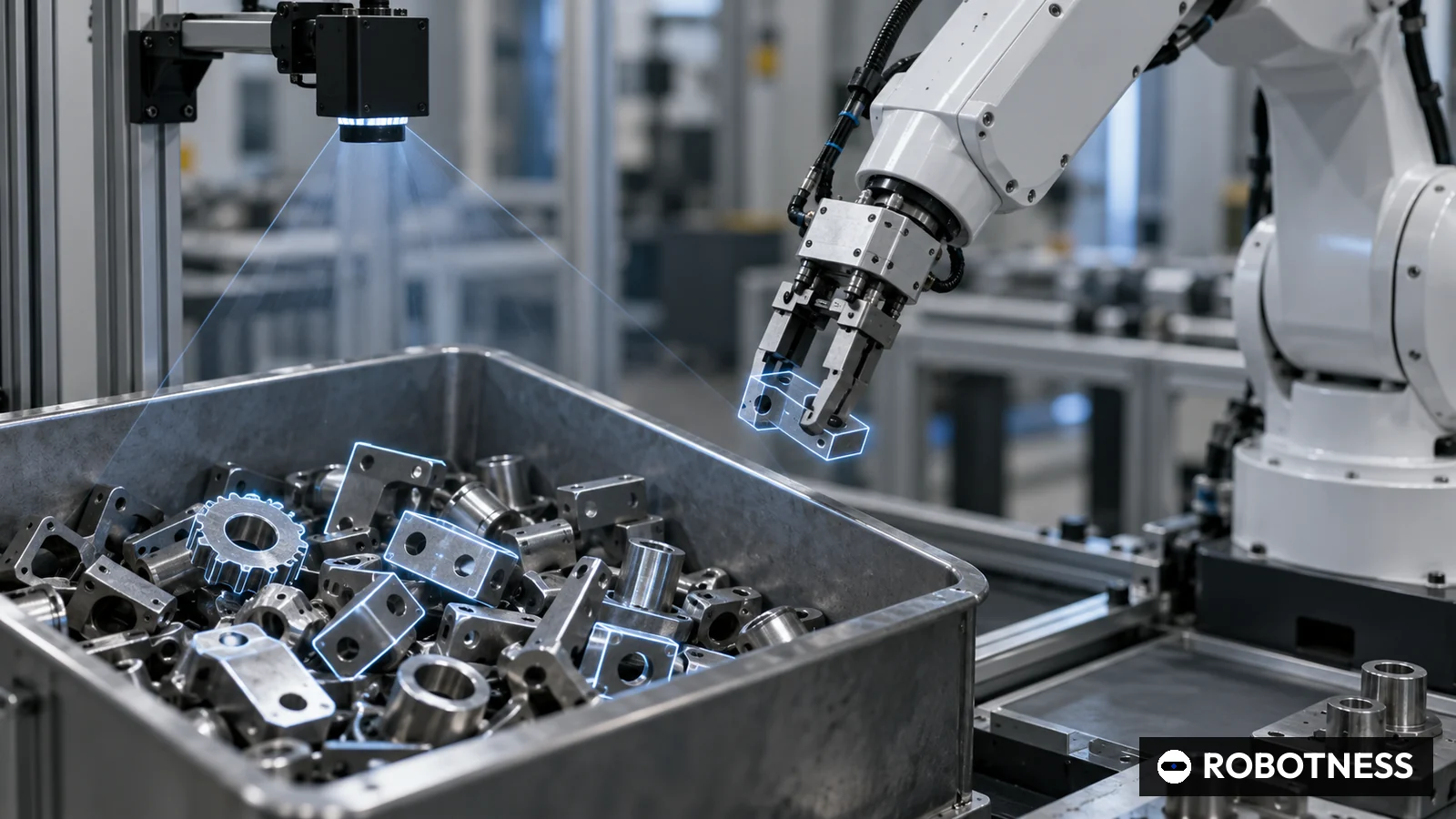
Yaskawa Electric Corp. said on July 15, 2026 it had developed an agentic robot system with Google DeepMind, pairing its MOTOMAN NEXT AI robot with Gemini Robotics ER 1.6, Google DeepMind's generative AI model for robot reasoning. In the system the Google model acts as the robot's decision-making intelligence, assessing the situation and devising the sequence of steps, while MOTOMAN NEXT executes the work, according to Yaskawa's release.
Yaskawa did not disclose financial terms, launch customers or prices. It said specific applications and delivery timing would be announced once preparations are complete. The release was issued two days after Yaskawa reported a separate physical AI demonstration with SoftBank, and one day before it joined Fujitsu's physical AI initiative with FANUC and Kawasaki Heavy Industries.
What the system does
According to Yaskawa, the system lets a robot take an instruction such as sorting a set of components, work out the order of tasks itself and carry them out without detailed programming or teaching. If an object is dropped during transport, the robot can recover automatically. The system can also be linked to production management systems so that tasks flow from factory software rather than from a technician at a teach pendant.
The execution side relies on three capabilities that Yaskawa says come standard on MOTOMAN NEXT: machine vision that recognises the environment and object positions with high precision, path planning that calculates safe routes around obstacles, and force sensing that judges grip status and contact. Gemini Robotics ER 1.6 supplies the higher-level reasoning that decides what to do with those capabilities.
The SoftBank track
On July 13, Yaskawa and SoftBank said they had demonstrated a physical AI system that handles wire harnesses, flexible parts whose shape and position are hard for conventional robots to predict. The demonstration used a vision-language-action model, which generates motion from camera images and task instructions, trained with SoftBank's AI data centre GPU cloud. Yaskawa said the physical AI runs as a module inside its existing robot control system, and that the workflow automates data collection, model training, simulation evaluation and deployment on real robots. The work builds on an earlier partnership agreement between the two companies.
Yaskawa's numbers
The AI push comes as Yaskawa's robot business is under pressure. In the quarter from March to May 2026, consolidated revenue rose 10.6% to ¥138,982 million but operating profit fell 19.2% to ¥8,486 million, according to its July 10 filing. Robotics segment revenue grew 2.0% to ¥56,728 million while segment operating profit dropped 82.3% to ¥888 million, which the company attributed to production effects from a core system migration and restructuring costs in Europe. Yaskawa kept its full-year forecast of ¥580,000 million in revenue, up 7.0%, and ¥60,000 million in operating profit, up 26.8%. On Aug. 31 it launched the MOTOMAN-HC12 collaborative robot with a 12 kg payload, 1,410 mm reach and a newly developed torque sensor.
Rivals and Google's two partners
Google now works with both of Japan's largest robot makers through different units. FANUC announced in May a collaboration covering Google Cloud's Gemini Enterprise and the Intrinsic platform, said it participates in Google DeepMind's Gemini Robotics Trusted Tester Program, and on Sept. 11 unveiled a Gemini-based AI Welding Agent. Yaskawa's deal goes directly to a Gemini Robotics model for task reasoning. Kawasaki Heavy Industries, whose precision machinery and robot segment grew fastest of the three, has focused on its own physical AI centre in San Jose and on healthcare with Fujitsu.
- Yaskawa Electric
- Mar to May 2026
- 56,728
- 2
- 580,000
- 60,000
- Gemini Robotics ER 1.6 in MOTOMAN NEXT (July 15)
- FANUC
- Apr to Jun 2026
- 96,103
- 18.7
- 948,100
- 218,000
- Gemini Enterprise, Intrinsic (May 13); AI Welding Agent (Sept. 11)
- Kawasaki Heavy Industries
- Apr to Jun 2026
- 69,594
- 22.2
- 2,560,000
- 180,000
- No data
Figures as disclosed in quarterly earnings filings and company releases. Profit forecast is operating profit for Yaskawa and FANUC, business profit for Kawasaki. Kawasaki robot revenue is external sales of the precision machinery and robot segment; its YoY change is derived as 69,594 / 56,930 minus 1. Yaskawa's fiscal year ends in February.
As of Oct 1, 2026
The architecture divides labour in a way that is becoming common in robotics. A large multimodal model handles what is often called embodied reasoning, interpreting the scene and planning steps, while the robot's own controller handles the precise, safety-critical motion. That split lets Yaskawa keep its strengths in motion control and safety while borrowing reasoning it would struggle to build, and it means the same robot can be upgraded as Google releases newer models.
For global buyers, the significance is that high-mix tasks such as kitting, sorting and line-side handling, which have required extensive teaching, could be set up by instruction. For Google, a second Japanese robot partner broadens the installed base on which Gemini Robotics models run in factories.
The risks are concrete. Yaskawa has not published success rates, cycle times or a release date. Dependence on a Google model raises questions about latency, offline operation and data handling that factory customers will ask. Yaskawa is also running several AI tracks at once, with Google DeepMind, SoftBank and Fujitsu, while its robotics segment profit has nearly vanished, which could stretch engineering resources.
The next markers are Yaskawa's results for the June to August quarter, any announcement of applications and launch timing for the Google DeepMind system, and further VLA work with SoftBank.
ROBOTNESS analysis
Yaskawa's Google DeepMind deal is a bid to leapfrog on AI while its robot margins are weak, and its value depends on turning a reasoning model into a product before FANUC's Gemini-based offerings reach customers.
The evidence is the sequence. Within three days in July, Yaskawa announced the SoftBank VLA demonstration, the Google DeepMind system and participation in Fujitsu's NVIDIA-based initiative. MOTOMAN NEXT already carries vision, path planning and force sensing as standard, so the missing piece was high-level reasoning, which Gemini Robotics ER 1.6 supplies.
The strongest counter-argument is that the release contains no product, no date and no performance data, while FANUC has already set a December ship date for a Gemini-based product. Yaskawa's robotics segment profit of ¥888 million leaves little room for a long development cycle.
Bull case: Yaskawa launches a Gemini Robotics application for kitting or sorting within fiscal 2026, robotics margins recover as the core system issues fade, and MOTOMAN NEXT becomes the reference platform for Gemini Robotics in factories.
Bear case: the system stays a demonstration, customers prefer FANUC's larger installed base and simpler delivery model, and Yaskawa spreads its engineers across too many partnerships while margins stay depressed.
Signals to watch:
- October 2026: Yaskawa's June to August quarterly results, a test of whether robotics segment profit recovers from ¥888 million.
- By Feb. 28, 2027 (end of Yaskawa's fiscal year): announcement of concrete applications and delivery timing for the Google DeepMind system.
- End of December 2026: start of FANUC's Gemini-based AI Welding Agent shipments, the benchmark Yaskawa will be measured against.
- MOTOMAN NEXT
- Gemini Robotics ER 1.6
- Yaskawa Electric and Google DeepMind
- July 15, 2026
- Task planning from high-level instructions, automatic error recovery, links to production systems
- SoftBank VLA wire harness handling (July 13, 2026)
- To be announced
- ¥56,728 million revenue (+2.0%), ¥888 million profit (−82.3%)
- Machine vision, path planning, force sensing
Why it matters
Yaskawa has announced a system that places a Google DeepMind robotics reasoning model directly in the control loop of its industrial robot. That moves the competition between Japan's robot makers from hardware and teaching tools to which AI model sits above the controller.
It also shows how Google is approaching industrial robotics: through partnerships with incumbents that own the installed base rather than by building arms. With FANUC on Gemini Enterprise and Intrinsic and Yaskawa on Gemini Robotics, Google has a presence in both of Japan's largest robot ecosystems.
Rival analysis
FANUC is ahead on commercialisation, with a December ship date for its Gemini-based welding agent and more than 1,000 robots shipped for physical AI applications by May. Its robot division grew 18.7% in April to June against Yaskawa's 2.0% in March to May.
Kawasaki's robot segment grew 22.2% on semiconductor robots and is investing through its San Jose centre. Outside Japan, ABB and KUKA compete in the same applications, and humanoid developers using Gemini Robotics or similar models target some of the same handling tasks.
Valuation context
No financial terms were disclosed. Yaskawa's full-year guidance of ¥60,000 million in operating profit implies a sharp recovery from the first quarter's ¥8,486 million, so the market will judge the AI story against whether margins rebound.
The robotics segment is 40.8% of revenue, so its profitability drives the group. An AI product that commands higher prices would help, but no pricing has been given.
Supply-chain implications
MOTOMAN NEXT's standard vision and force sensing mean the Google DeepMind system needs no new external sensors, so near-term component demand is unchanged. Compute is the variable: running a reasoning model may require cloud access or on-premises GPUs, and the SoftBank track already relies on SoftBank's GPU cloud.
On the servo and drive side, Yaskawa supplies its own motion components, so successful AI products would pull through more of its in-house hardware.
Signals to watch
Yaskawa's June to August results and any recovery in robotics profit. Announcement of the first commercial application and timing for the Google DeepMind system. Any performance data such as success rates on sorting or kitting.
Also watch for further Gemini Robotics model versions and whether Yaskawa adopts them quickly, which would show how tightly the two companies are integrated.
Analyst view
Thesis: the partnership gives Yaskawa credible AI capability but is unlikely to change its competitive position against FANUC until a product ships, which is not expected before late fiscal 2026 at the earliest. Confidence: low to medium, leaning low.
Reasons: the technical architecture is sound and the partner is strong, but there is no date, no data and no customer, and segment profitability is weak. The SoftBank and Fujitsu tracks add options but also dilute focus.
Questions you should be asking
When will Yaskawa announce applications and pricing? Does the system run on premises or require a cloud connection to Google? Who owns task data generated by MOTOMAN NEXT in customer plants?
How will Yaskawa reconcile the Google DeepMind system, the SoftBank VLA work and the Fujitsu platform for customers?