Toyota research spinout Walden Robotics launches with $300 million seed at a $1.1 billion valuation
Walden Robotics, spun out of Toyota Research Institute in January 2026, emerged from stealth on July 15, 2026 with a $300 million seed round at a $1.1 billion valuation co-led by Toyota and Deviation Capital. The Cambridge, Massachusetts company says its robots, driven by large behavior models, have been doing production work at a Toyota plant in North America since February, and on July 28 it added Samsung SDS as a manufacturing partner.
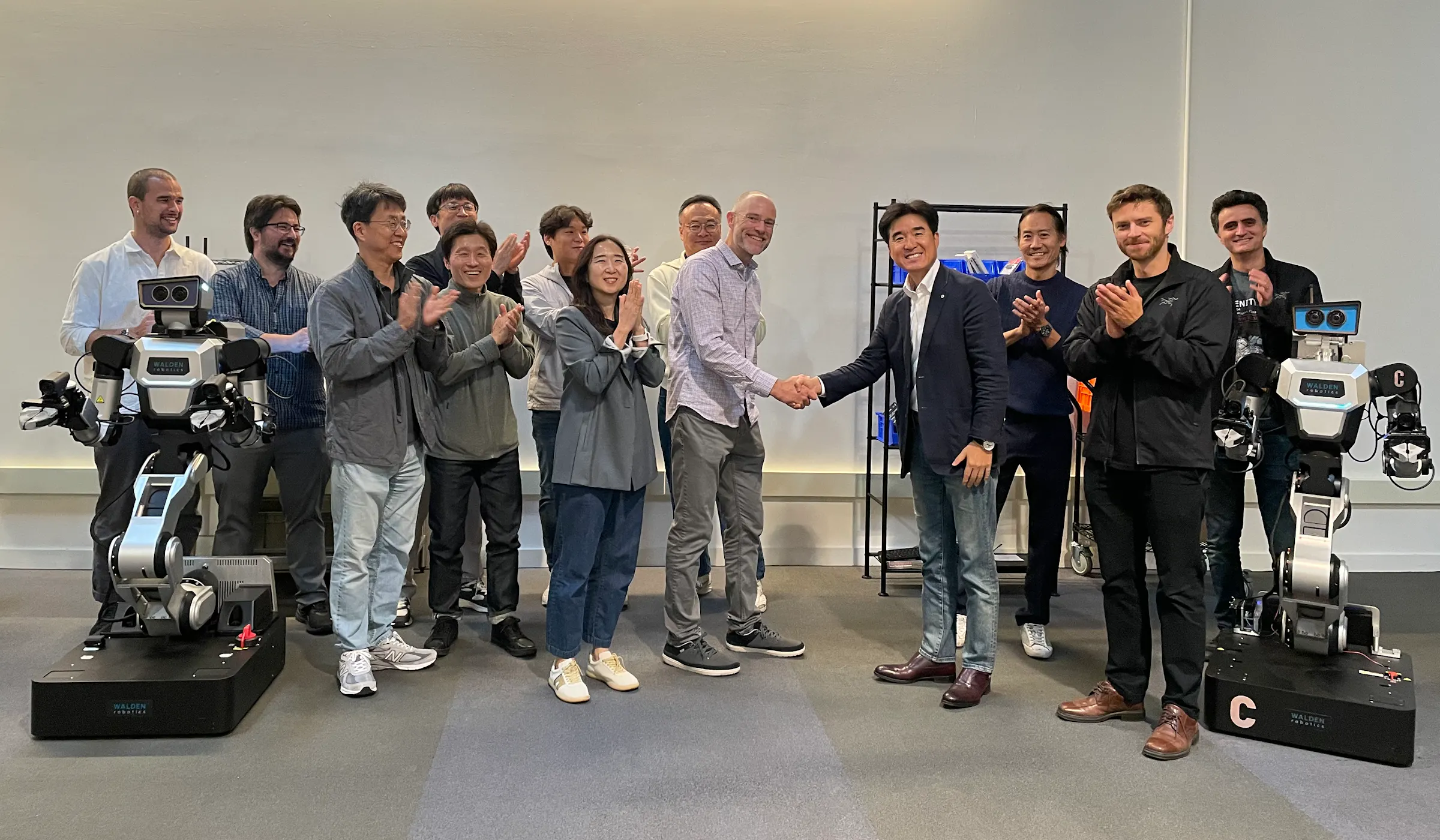
Walden Robotics, a robotics company spun out of Toyota Research Institute, has raised $300 million in a seed round that values it at $1.1 billion, the company said on July 15, 2026 as it came out of stealth. The round arrives just six months after the company's formation in January 2026, an unusually large seed financing for a U.S. robotics start-up.
Toyota Motor Corporation, Toyota Invention Partners and Toyota Ventures co-led the round with Deviation Capital, according to Walden. NVIDIA, Boeing, AE Ventures, Samsung Ventures, Prologis Ventures, CoreWeave Ventures, Calibrate Ventures, Colle Capital, Shine Capital, NextView Ventures, Squarepoint Capital, One Madison Group, KAS Venture Partners and Menlo Ventures also invested.
What Walden says it has built
Walden develops general-purpose robots driven by large behavior models, a class of model trained on demonstrations of many manipulation tasks so that a robot can learn new jobs quickly and keep improving from real-world operation. The company says its robots moved from pilot to production within two months at a Toyota plant in North America and have been doing useful work there since February 2026. It is working with customers in automotive, aerospace, semiconductors, electronics, logistics and life sciences, it said, without naming them or disclosing robot counts.
In an August 6 post, co-founder and chief technology officer Ben Burchfiel described one task as moving a camshaft autonomously. He said Walden robots run autonomously most of the time with a remote assistant available, and that the corrections those assistants make generate training data close to failure states, where learning matters most. The company has not disclosed how many robots each remote assistant supervises.
The people and the pedigree
Chief executive Russ Tedrake, an MIT professor, previously led large behavior model research at TRI as senior vice president. In a launch essay he credited TRI with contributions including Diffusion Policy, a widely used method for learning robot motions from demonstrations, the Universal Manipulation Interface for collecting gripper data, and the open-source Drake simulator. Walden says its founding team comes from TRI, MIT, Stanford and Amazon.
Hiroki Nakajima, Toyota's executive vice president and chief technology officer, said in the release that Walden's approach reflects Toyota's kaizen and jidoka principles. Colin Beirne of Deviation Capital also commented.
Samsung joins
On July 28, 2026 Walden said Samsung SDS would run proof-of-concept projects with it in semiconductors, batteries, displays, pharmaceuticals and biomanufacturing, combining Samsung's systems integration work with Walden's robots. Samsung Ventures invested in the seed round and Samsung NEXT is an existing investor, Walden said.
Competitive context
The round puts Walden in the top tier of embodied-AI financings. Skild AI raised a $300 million Series A at a $1.5 billion valuation in July 2024, Apptronik raised $350 million in its first Series A close in February 2025, and DYNA Robotics closed a $120 million Series A in September 2025. Unlike Figure AI or Agility Robotics, Walden has not marketed a legged humanoid and emphasizes deployment in existing factories with remote human backup.
- Walden Robotics
- 2026
- Seed
- 300,000,000
- 1,100,000,000
- 2026-07-15
- 27.3
- Skild AI
- 2023
- Series A
- 300,000,000
- 1,500,000,000
- 2024-07-09
- 20
- Apptronik
- 2016
- Series A
- 350,000,000
- No data
- 2025-02-13
- No data
- DYNA Robotics
- No data
- Series A
- 120,000,000
- No data
- 2025-09
- No data
- Agility Robotics
- 2015
- Series B
- 150,000,000
- No data
- 2022-04-22
- No data
- Figure AI
- No data
- Series A
- 70,000,000
- No data
- 2023-05-24
- No data
Implied new-investor stake = round amount / post-money valuation, computed only where both are disclosed. Figures as announced by each company; null means not disclosed.
As of Oct 1, 2026
Why it matters globally
Walden gives Toyota a direct equity stake in a U.S. robot-model company built by its own former research team, at a time when carmakers are choosing between building, buying or partnering for factory physical AI. Hyundai Motor Group plans to put Boston Dynamics' Atlas to work at its Metaplant America from 2028 and Mercedes-Benz is an Apptronik investor; Toyota now has its own vehicle.
Risks and open questions
Walden has disclosed no revenue, robot count, unit price or remote-assistance ratio. Its production record is at one Toyota plant, a customer that is also its lead investor. A $1.1 billion valuation at seed stage leaves little room for slippage in converting pilots at other customers.
What to watch
The next markers are named customers outside Toyota, results from the Samsung SDS proofs of concept and any disclosure of fleet size.
ROBOTNESS analysis
Walden is a bet that factory robots win on deployment discipline and remote-assisted learning rather than on humanoid form, and Toyota has paid to own a piece of that bet.
The evidence is the speed and the backers. Walden reached production at a Toyota plant within two months of formation, raised $300 million in six months, and drew strategic money from an automaker, an aircraft maker, a chip and AI platform company, a GPU cloud and a logistics landlord.
The strongest counter-argument is that a single in-family deployment proves little. Toyota is both customer and lead investor, and Walden has not shown how many robots it runs or how many remote assistants they need.
Bull case. Remote-assisted autonomy lets Walden deploy in dozens of plants before full autonomy is solved, the corrections compound into a stronger model, and the company becomes the default physical-AI vendor for Toyota's supply chain and Samsung's fabs.
Bear case. Remote-assistance costs stay high, customers outside Toyota move slowly, and better-capitalized model companies such as Figure and Skild AI absorb the market for general-purpose robot software.
Signals to watch
- First named customer outside the Toyota group, expected to be among the six sectors Walden lists
- Results or expansion of the Samsung SDS proofs of concept announced on July 28, 2026
- Any disclosure of the robots-per-remote-assistant ratio discussed in Walden's August 6, 2026 post
- Cambridge, Massachusetts
- Russ Tedrake (MIT professor, ex-TRI SVP)
- $300 million seed
- Spun out of Toyota Research Institute, January 2026
- Samsung SDS proofs of concept (announced July 28, 2026)
- Toyota Motor Corp, Toyota Invention Partners, Toyota Ventures, Deviation Capital
- July 15, 2026
- $1.1 billion
- Production at a Toyota plant in North America since February 2026
- NVIDIA, Boeing, Samsung Ventures, CoreWeave Ventures, Prologis Ventures, Menlo Ventures
Why it matters
Walden's launch shows that the most valuable asset in robot learning is now the research team, not the hardware. Toyota let a group it had funded for nearly a decade leave and then paid to own part of what they build, which is a recognition that a start-up structure can attract capital and talent faster than a corporate lab.
It also validates a commercial model that many humanoid companies avoid discussing, robots that are autonomous most of the time but backed by remote humans. Walden is open about that design and argues the human corrections are the most valuable training data it collects.
Rival analysis
Walden's closest peers are model-first companies such as Skild AI, Physical Intelligence and DYNA Robotics, which also sell intelligence that can run on different robot bodies. It differs by pairing that model work with direct factory deployments in its investors' operations.
Against full-stack humanoid makers such as Figure, Agility and Apptronik, Walden competes for the same automotive and logistics budgets. Its advantage is a captive first customer in Toyota and a strategic channel into Samsung's electronics and battery plants; its disadvantage is far less capital than Figure or Skild.
Valuation context
At $1.1 billion post-money, new investors bought about 27.3% of Walden, a higher share than the 20% implied by Skild AI's $300 million Series A at $1.5 billion in 2024. That is a large dilution for a seed round and suggests the founders prioritized capital to scale deployments.
Without disclosed revenue, the valuation rests on the team, the Toyota relationship and the investor syndicate. Comparisons with Figure at $39 billion or Skild at $14 billion indicate considerable upside if Walden reaches multi-customer scale, and considerable downside if it remains a Toyota supplier.
Supply-chain implications
The investor list maps a supply chain. NVIDIA supplies compute and simulation, CoreWeave supplies GPU cloud capacity, Prologis owns logistics real estate where robots would work, Boeing and Toyota are end users, and Samsung SDS is a systems integrator with access to semiconductor, battery and display plants.
Walden has not disclosed its hardware suppliers or robot design. The remote-assistance model also implies a labor supply chain of trained operators, whose cost per robot will determine margins until autonomy improves.
Signals to watch
Watch for the first named non-Toyota customer, any published fleet size, and the outcome of the Samsung SDS proofs of concept in semiconductors, batteries, displays and biomanufacturing.
A follow-on round in 2027 at a materially higher valuation would confirm traction; a quiet year without new customers would suggest the Toyota deployment is not yet repeatable.
Analyst view
Thesis. Walden is the most credible attempt yet to turn a corporate robot-learning lab into an independent vendor, and its remote-assisted deployment model is a pragmatic route to revenue before full autonomy.
Confidence is medium to low. The team and backers are strong, but every operating claim rests on one plant owned by the lead investor, and the company has disclosed no revenue, robot count or remote-assistance ratio.
Questions you should be asking
How many Walden robots are running at Toyota, and how many remote assistants support them? What hardware do they use, and who builds it? What does Walden charge per robot or per task?
Which of the six target sectors will produce the first non-Toyota deployment? Does Toyota hold any exclusivity or preferential rights over Walden's technology?