Tesla will retire Model S and X lines in Fremont for an Optimus line designed for 1 million robots a year, and plans a 10 million-unit line in Texas
Tesla said in its first-quarter 2026 shareholder update that its first-generation Optimus line, designed for 1 million humanoid robots a year, will replace the Model S and Model X lines at its Fremont factory. It is also preparing Gigafactory Texas for a second-generation line designed for long-term annual capacity of 10 million robots, while reporting revenue of $22.4 billion and $44.7 billion in cash and investments.
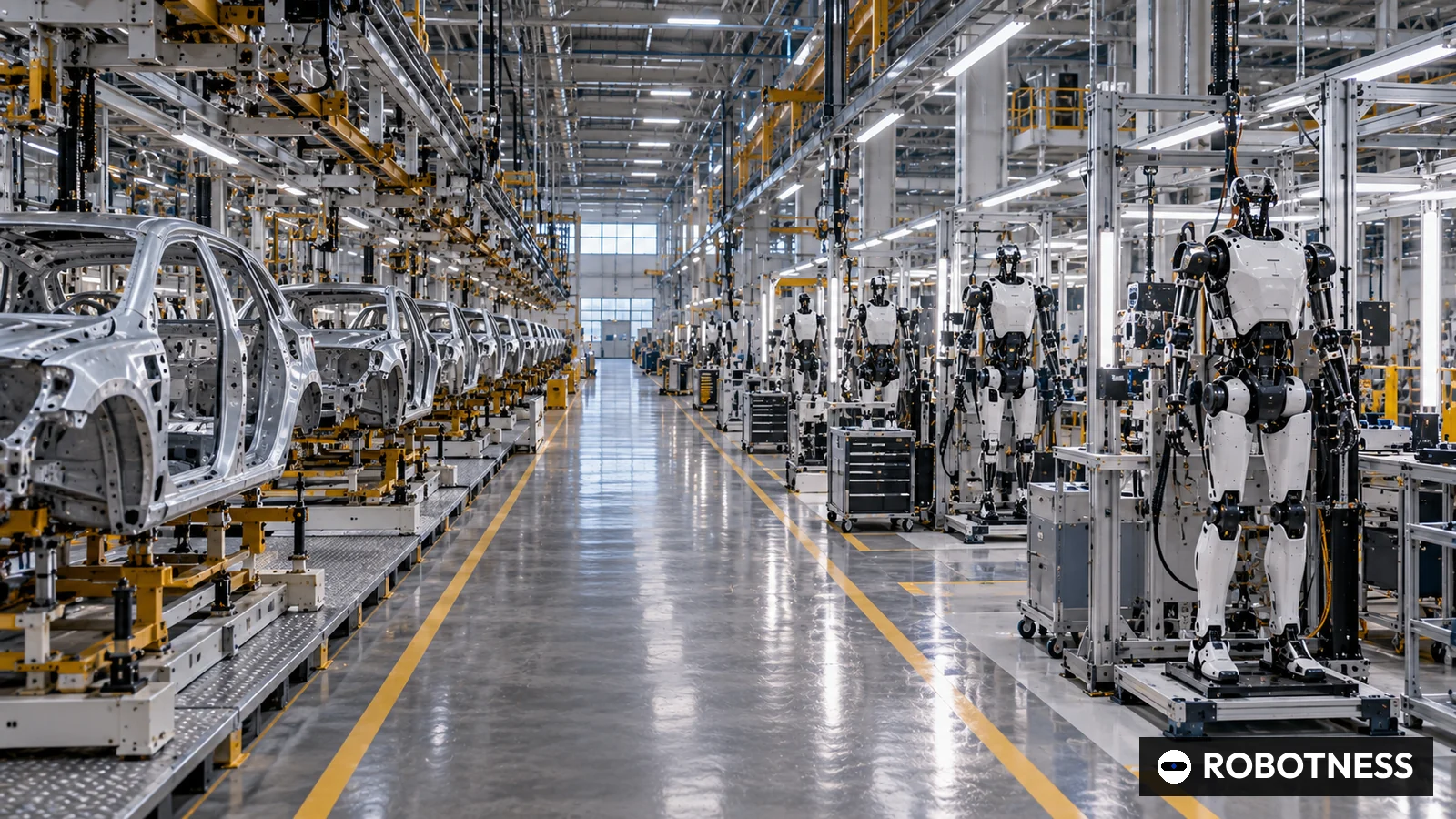
Tesla laid out the clearest manufacturing plan yet for its Optimus humanoid robot on April 22, 2026. In its shareholder update for the first quarter, the company said the first-generation Optimus production line, designed for 1 million robots a year, will replace the Model S and Model X lines at its factory in Fremont, California.
The update went further. Tesla said it is preparing Gigafactory Texas for a second-generation line that is being designed for long-term annual production capacity of 10 million robots. First-generation lines are being installed in anticipation of volume production, the company wrote, and preparations for its first large-scale Optimus factory were set to begin in the second quarter.
The robot plan sits on a balance sheet that few rivals can match. Tesla reported first-quarter revenue of $22.39 billion, up 16% from $19.34 billion a year earlier, with gross profit of $4.72 billion and operating income of $941 million. Net income attributable to common shareholders was $477 million. Capital expenditure for the quarter was $2.49 billion, free cash flow was $1.44 billion, and cash, cash equivalents and investments stood at $44.74 billion at the end of March.
The Optimus decision has a direct cost on the vehicle side. Model S and Model X were Tesla's original premium cars and the products that established the brand. Freeing their floor space in Fremont gives the robot programme an existing, permitted automotive plant rather than a greenfield site. The company also said Cybercab, the Tesla Semi and Megapack 3 remain on schedule for volume production starting in 2026, so Optimus is one of several ramps competing for engineering attention this year.
Tesla delivered 358,023 vehicles in the quarter. The update described progress on Optimus ahead of mass production but did not give a unit count for robots built, a launch date for a next-generation design, external customers or a price. It also did not name suppliers for the robot's actuators, hands or battery packs.
The stated capacities dwarf anything disclosed by competitors. 1X Technologies said on April 30 that its Hayward, California factory can build up to 10,000 NEO robots a year and that it aims for more than 100,000 a year by the end of 2027. Agility Robotics has said its RoboFab plant in Oregon is designed for up to 10,000 Digit units a year. Figure AI disclosed in April that its BotQ line had reached a rate of one Figure 03 robot per hour. Tesla's Fremont design figure is 100 times the capacity 1X and Agility have described.
Those comparisons come with a caveat. A line designed for 1 million units is a statement of intent about tooling and layout, not a production forecast. Tesla has a record of setting aggressive vehicle volume targets and reaching them late. What is new is that the company has tied Optimus to specific buildings and to the retirement of named car lines, which makes the plan measurable.
The technology bet is that a humanoid built with automotive methods, together with the AI training approach it uses for vehicles, can reach a cost that makes general-purpose labour automation viable. Tesla said it is building an intelligence layer to complement the real-world AI it uses for vehicles and humanoid robots.
ROBOTNESS analysis
By naming Fremont and Texas and retiring two car lines, Tesla has turned Optimus from a demonstration programme into a capital allocation decision that investors can now track quarter by quarter.
The evidence is in the specificity. Tesla gave design capacities for two sites, said first-generation lines are being installed and set a quarter for factory preparation to begin. It can fund the work from $44.74 billion in cash and investments and positive free cash flow, which no start-up rival can.
The strongest counter-argument is that capacity is not demand. Tesla disclosed no robot customers, no units built and no price, and a 1 million-unit line is only valuable if the robot is useful enough for buyers to absorb that output. Competitors with fewer units have named paying industrial customers.
Bull case. Fremont starts volume output on schedule, Optimus works first inside Tesla's own plants and then for outside customers, and automotive-scale cost curves give Tesla a price no humanoid start-up can match. Optimus becomes a second growth engine as vehicle growth slows.
Bear case. Engineering bandwidth is stretched across Cybercab, Semi, Megapack 3 and Optimus, the robot slips, and Fremont floor space sits underused after Model S and X end. Investors begin to treat the 10 million-unit Texas figure as an aspiration rather than a plan.
Signals to watch.
- The second-quarter 2026 update in July, for confirmation that large-scale factory preparation started in Q2 and any robot unit count.
- The end-of-production date for Model S and Model X in Fremont during 2026.
- Any disclosure of a first external Optimus customer or price before Tesla's 2026 annual shareholder meeting.
- Tesla
- Optimus (gen 1 line)
- Fremont, California
- 1,000,000
- Designed; lines being installed
- 2026-04-22
- Tesla
- Optimus (gen 2 line)
- Gigafactory Texas
- 10,000,000
- Long-term design; site being prepared
- 2026-04-22
- 1X Technologies
- NEO
- Hayward, California
- 10,000
- Current capacity; target 100,000+ by end-2027
- 2026-04-30
- Agility Robotics
- Digit
- RoboFab, Salem, Oregon
- 10,000
- Designed capacity
- 2026-06-24
- Figure AI
- Figure 03
- BotQ
- No data
- Rate of one robot per hour; capacity not disclosed
- 2026-04-29
Capacities as stated by each company; design capacity is not output. Tesla Fremont versus 1X or Agility = 1,000,000 / 10,000 = 100x. No estimates.
As of Oct 1, 2026
- $2.49 billion
- April 22, 2026 (Q1 2026 shareholder update)
- $22.39 billion, up 16% year on year
- 358,023 vehicles
- Preparations for first large-scale Optimus factory to begin in Q2 2026
- Second generation, designed for long-term capacity of 10 million robots a year
- $941 million
- $44.74 billion at March 31, 2026
- First generation, designed for 1 million robots a year, replacing Model S and Model X lines
- $477 million
Why it matters
Tesla has moved Optimus from keynote demonstrations to its factory plan. The decision to replace Model S and Model X lines with a robot line is a real opportunity cost, since those vehicles still generate revenue, and it ties the humanoid programme to a specific building, a specific capacity and a specific quarter. That makes Optimus auditable in a way it was not before.
For the wider industry the figures reset the reference point for scale. Start-ups talk about thousands of units; Tesla is designing for a million in its first line. Even if actual output is a fraction of that, suppliers of actuators, reducers, sensors and cells will plan around Tesla's numbers, which affects pricing and allocation for every other humanoid maker.
Rival analysis
Figure AI is the most aggressive start-up on manufacturing, reporting a one-robot-per-hour rate at BotQ and more than 350 Figure 03 units delivered by the end of April. 1X has a 10,000-unit factory in Hayward aimed at homes, and Agility a 10,000-unit plant aimed at logistics. Boston Dynamics builds Atlas with Hyundai as both owner and customer. None of them has a captive vehicle business to fund the ramp.
Tesla's disadvantage is disclosure. Rivals name customers and deployments; Tesla's update named none for Optimus. Until outside buyers appear, the comparison is between Tesla's planned capacity and competitors' demonstrated commercial use.
Valuation context
Tesla does not break out Optimus spending. First-quarter capex of $2.49 billion covers vehicles, energy, AI compute and robots together, so the robot investment cannot be isolated from the update. What can be said is that the company ended March with $44.74 billion in cash and investments, about 72 times Agility's expected $620 million SPAC proceeds (formula 44.74 / 0.62).
That cash cushion means Optimus does not need outside funding, but it also means its economics will stay hidden inside consolidated results unless Tesla chooses to report robot revenue or units separately.
Supply-chain implications
The update did not name Optimus suppliers. A 1 million-unit line would require tens of millions of precision actuators, reducers and motors a year, which is far beyond today's humanoid supply base. Tesla's practice in vehicles has been to bring critical components in-house, and the update's emphasis on its own lines suggests a similar approach for core actuators and battery packs.
For component makers in Asia and Europe, the Texas design figure of 10 million robots matters more than the Fremont line. Suppliers will need firm orders, not design capacities, before building plants of that scale, so the first purchase commitments Tesla places will be a better guide than the headline numbers.
Signals to watch
The second-quarter update in July should confirm whether large-scale Optimus factory preparation began in Q2 as promised, and whether Tesla gives any count of robots built or deployed in its own plants.
The end of Model S and Model X production in Fremont is another hard marker. Finally, watch for the first external Optimus customer, price or delivery date, which would move the programme from internal use to commercial product.
Analyst view
Thesis. Optimus has become a funded industrial programme with dated milestones, but its value depends on demand Tesla has not yet shown.
Confidence is medium. The capacity statements, factory locations and financial strength are confirmed in Tesla's own update, which supports the view that the company will build lines. Confidence is limited by the absence of customers, prices and unit counts, and by Tesla's history of late volume ramps. External orders would raise it to high.
Questions you should be asking
How many Optimus robots did Tesla build in the first quarter, and how many work inside its own factories?
When will Model S and Model X production end, and what happens to the vehicles' remaining order book?
Which actuators and hand components will Tesla make in-house, and which will it buy?