Tokyo's Qibitech raises about ¥600 million in Series B to sell one control layer for robots from any maker
Qibitech, the Tokyo developer of HATS vendor-agnostic robot control software, said on 30 September 2026 it raised about ¥600 million in a Series B through a third-party share allotment to funds managed by JIC Venture Growth Investments and Sumitomo Corporation Venture Partners. The money goes to HATS development, sales and hiring.
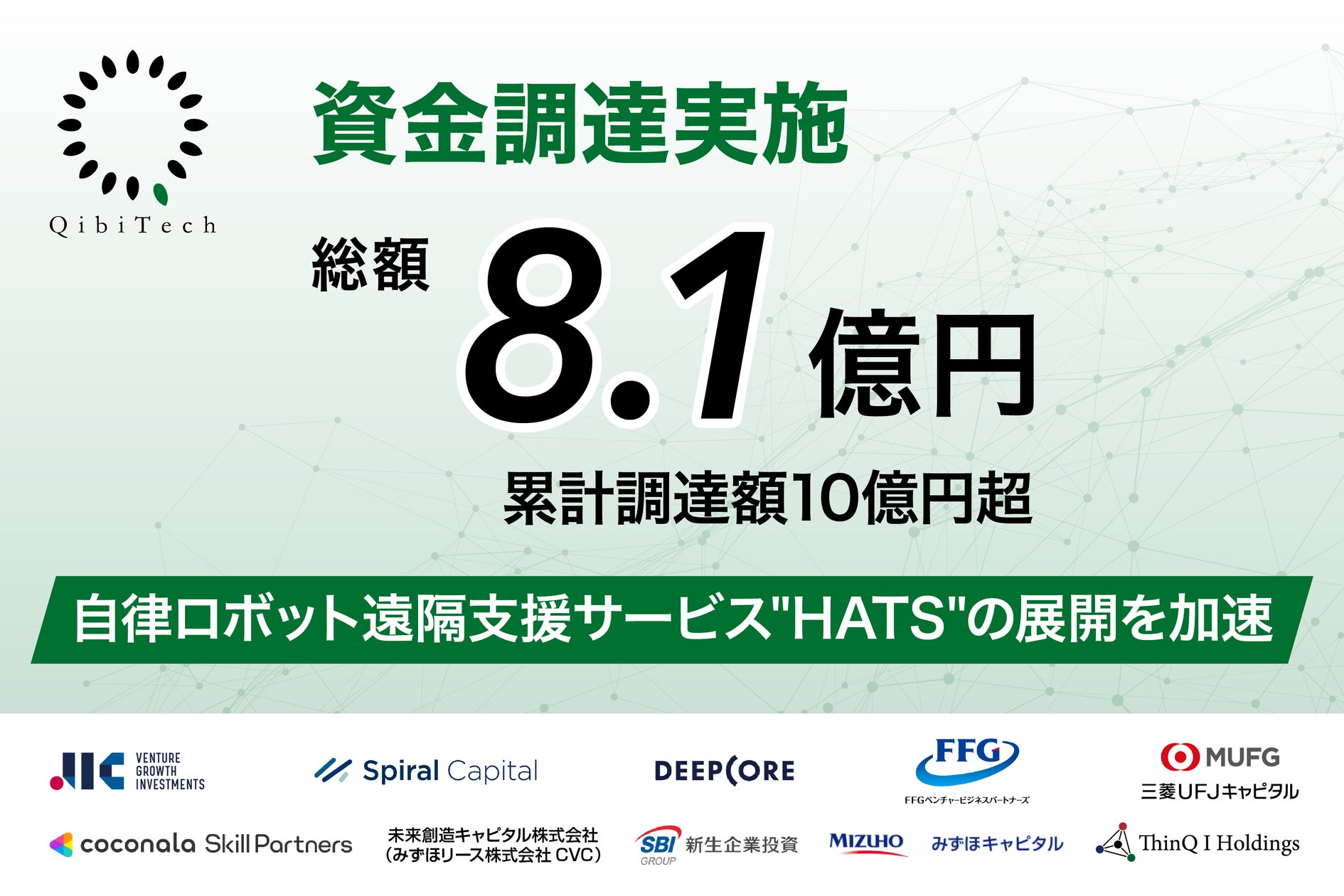
Qibitech, a Tokyo company whose HATS software lets operators control robots from different manufacturers on a single platform, said on 30 September 2026 that it had raised about ¥600 million in a Series B round. The shares were allotted to JIC Venture Growth Fund 2, managed by JIC Venture Growth Investments, and to SVP Open Innovation Fund 1, managed by Sumitomo Corporation Venture Partners, according to the company's release.
The round
The JIC fund is an existing shareholder adding to its stake, while the Sumitomo Corporation fund is a new investor. Qibitech did not name a lead or disclose a valuation. It said it will use the money to strengthen HATS product development, build out sales and hire staff. The release gives the amount in yen only, and ROBOTNESS does not convert it.
What HATS does
Qibitech describes HATS as vendor-free robot control software that integrates multiple robots from different makers on one platform. The company says it connects those robots with upper-level systems such as warehouse management and manufacturing execution systems, with building equipment such as elevators, and with AI tools. In September 2026 the company reorganised the product into HATS Standard and HATS Pro grades and released a new HATS SDK for developers and system integrators.
The target sectors are logistics, manufacturing, facility management and inspection. The release does not give deployment numbers or name customers.
Background
Qibitech was founded in November 2011 and is based in Shinagawa, Tokyo, with Kenichi Maehara as representative director and chief executive. In March 2024 it raised about ¥810 million in a round led by JIC Venture Growth Investments, with DeepCore, Mitsubishi UFJ Capital, Mizuho Capital and others joining, and said at the time that it had raised more than ¥1 billion across three rounds. Maehara said in the new release that the funding will strengthen development and sales as the company works towards a society in which robots work naturally on real sites.
Competitive context
Qibitech's Series B landed in the same week as two other bets on the layer above the robot. Paris-based Inbolt raised $12.5 million for AI vision that works across six arm brands, and Brooklyn's Destro AI raised an $8 million seed round for software that schedules warehouse work across mixed fleets. In Europe, Dresden's Wandelbots sells a multi-vendor programming platform. Qibitech's distinctive point is building integration: linking robots to elevators and facility systems matters for service and delivery robots in Japanese offices, hospitals and hotels, not only for warehouses.
ROBOTNESS analysis
Qibitech's raise shows Japanese capital backing the integration layer rather than another robot, a sensible bet in a market where labour shortages push buyers to mix robots from many makers but where the round size also shows how small that layer still is.
The evidence is the investor mix and the product change. A government-linked growth fund doubling down and a trading-house venture arm joining suggest the buyers they know, in logistics, real estate and facilities, need a neutral way to run robots from several suppliers. The SDK release also signals a shift from custom integration projects to a product that system integrators can resell.
- SiMa.ai
- US
- Edge AI chips for physical AI
- Series C
- 150
- 2026-09-28
- Inbolt
- FR
- AI 3D vision for industrial robots
- Unnamed
- 12.5
- 2026-09-30
- Destro AI
- US
- Warehouse multi-robot orchestration
- Seed
- 8
- 2026-09-29
- Tangent Robotics
- US
- Tactile robot hands
- Pre-seed
- 4.5
- 2026-09-30
- Qibitech
- JP
- Vendor-agnostic robot control software
- Series B
- No data
- 2026-09-30
Amounts as disclosed on each company's primary announcement; Qibitech disclosed about JPY 600 million and is not converted. Figures disclosed, not estimated.
As of Oct 1, 2026
The strongest counter-argument is that the round is smaller than the company's previous one, about ¥600 million against about ¥810 million in 2024, and no deployment metrics were disclosed, so the market traction behind the raise cannot be measured from outside. Robot makers and building-system vendors can also add their own integration features.
- 2024-03-27
- Third-party allotment (third round)
- 810
- JIC Venture Growth Investments
- 2026-09-30
- Series B
- 600
- No data
Amounts as stated by the company (about). Series B relative to prior round = 600 / 810 = 0.74. Days between announcements = 917. Cumulative = more than JPY 1,000m stated in 2024 plus about JPY 600m. Figures disclosed, not estimated.
As of Oct 1, 2026
In the bull case Qibitech uses the SDK to sign integrators, publishes site and robot counts within a year, and becomes the default neutral layer for robots in Japanese buildings and warehouses. In the bear case it remains a project-based integrator, and larger platforms from robot makers or elevator companies absorb the role.
Three signals would confirm or break the thesis.
- By 31 March 2027, named system integrators or customers adopting the HATS SDK.
- By 30 September 2027, disclosed numbers of sites, robots or robot makers connected through HATS.
- Over the next 12 months, any partnership with a Sumitomo Corporation group company that turns the new investor into a customer.
- Kenichi Maehara
- Series B, third-party share allotment
- About ¥600 million (yen only disclosed)
- November 2011, Shinagawa, Tokyo
- HATS vendor-agnostic robot control platform; HATS Standard, HATS Pro and HATS SDK from September 2026
- 30 September 2026
- JIC Venture Growth Fund 2 (JIC Venture Growth Investments, existing); SVP Open Innovation Fund 1 (Sumitomo Corporation Venture Partners, new)
- HATS development, sales, hiring
- About ¥810 million, March 2024, led by JIC Venture Growth Investments
Why it matters
Japan is one of the markets where robot buyers are most likely to end up with mixed fleets. Labour shortages push logistics operators, building managers and hospitals to add robots one use case at a time, and each comes from a different supplier with its own controller. Qibitech is betting that someone has to make these machines share elevators, doors and work orders, and that this someone should be neutral.
The round is small, but the investors matter. JIC Venture Growth Investments is a government-linked growth investor and Sumitomo Corporation's venture arm brings a trading house with logistics and real estate businesses that could become customers or channels.
Rival analysis
Qibitech competes with three kinds of players. Robot makers increasingly offer their own fleet managers and building integrations. Elevator and building-system companies in Japan have developed interfaces for robots to ride elevators and pass security gates, which can make them gatekeepers. Overseas multi-vendor platforms such as Wandelbots in factories and Destro AI in warehouses address similar problems but are not active in Japan's building segment.
Qibitech's advantage is local integration depth across robots, elevators and upper-level systems. Its weakness is scale: without disclosed site counts, it is hard to judge whether HATS has become a product or remains a collection of projects.
Valuation context
No valuation was disclosed and the amount was given only in yen, so the desk does not convert or rank it in USD terms. Measured on disclosed figures, the Series B of about ¥600 million is about 0.74 times the roughly ¥810 million raised in March 2024 (600 / 810), and 917 days separated the two announcements. Adding the new round to the more than ¥1 billion the company said it had raised by March 2024 puts total disclosed funding above ¥1.6 billion.
A smaller follow-on round with a returning lead investor is common for Japanese deep-tech companies moving from projects to products. It is not, by itself, a sign of weak traction, but it does mean the next disclosure on deployments carries weight.
Signals to watch
Named system integrators or customers adopting the HATS SDK by the end of March 2027. Disclosed numbers of sites, robots or robot makers connected through HATS by the end of September 2027. A commercial partnership with a Sumitomo Corporation group company within the next year.
Analyst view
Thesis: Japanese investors are backing the neutral integration layer for mixed robot fleets, and Qibitech's SDK shift is the step that could turn it from an integrator into a platform. Confidence: low to medium. The product direction and investor mix are coherent, but the company disclosed no deployment metrics and the round is smaller than its last.
We would raise confidence on disclosed site counts and SDK partners, and lower it if a major robot or elevator company launches its own open multi-vendor platform in Japan.
Questions you should be asking
How many sites and robots run on HATS today, and from how many robot makers? What share of revenue comes from licences versus integration projects? Which system integrators have signed up for the SDK? Are elevator integrations built with specific elevator makers? Will Sumitomo Corporation group companies deploy HATS?