Hugging Face ships LeRobot 0.6 with world models and NVIDIA's GR00T N1.7, deepening an open robotics alliance
Hugging Face released version 0.6.0 of its open-source LeRobot robotics library on July 7, adding three world-model policies, five vision-language-action models including NVIDIA's GR00T N1.7, two reward models and six simulation benchmarks. NVIDIA said a day earlier that it is bringing GR00T, Isaac Teleop, Isaac Lab-Arena, Jetson Thor support and, soon, Cosmos 3 into LeRobot.
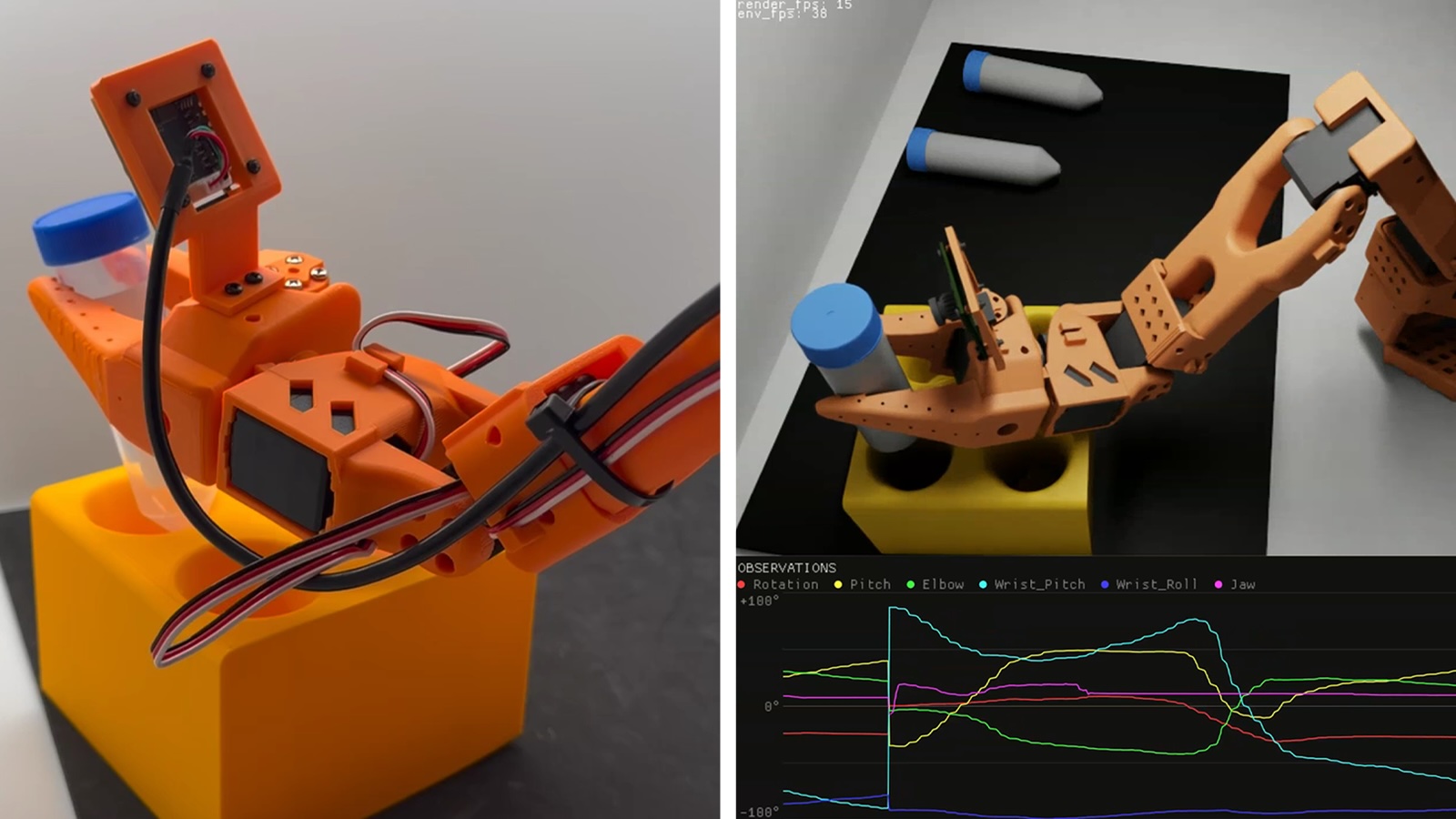
Hugging Face has turned its LeRobot library into a shelf of competing robot brains. Version 0.6.0, released on July 7, 2026, adds three world-model policies, five vision-language-action (VLA) models, two reward models and six simulation benchmarks, and it arrives with a package of NVIDIA tools that the chipmaker announced for LeRobot the day before.
The NVIDIA side of the release has five parts. Isaac GR00T N1.7, which NVIDIA calls the first open and commercially viable robot foundation model, can now be post-trained and deployed through LeRobot workflows. Isaac Teleop, an open-source data-collection framework, captures human demonstrations from external devices in standardised formats directly in LeRobot. Isaac Lab-Arena joins the LeRobot Environment Hub so developers can build simulation scenes and use them to train and evaluate policies such as GR00T, Physical Intelligence's Pi models and SmolVLA. Jetson Thor support targets deployment of VLA models on LeRobot's Reachy 2 open-source humanoid. NVIDIA said its Cosmos 3 world model is coming soon to LeRobot.
NVIDIA framed the partnership in audience terms: it connects NVIDIA's 3 million robotics developers with Hugging Face's 16 million AI builders. It also pointed to what it calls the largest open-source physical AI dataset, downloaded more than 15 million times, with more than 350,000 real and simulated trajectories and 57 million grasps. Hugging Face co-founder and chief science officer Thomas Wolf said open source is how a field turns advanced research into something people can study, adapt and build on.
The model list in LeRobot 0.6 is broad. The three world-model policies are VLA-JEPA, a compact model built on Qwen3-VL-2B that predicts the future in latent space; LingBot-VA, an autoregressive video-action model that needs a 24 to 32 GB GPU; and FastWAM, a model of about 5 billion parameters that pairs video-generation and action experts. The five VLAs are GR00T N1.7, which uses NVIDIA's Cosmos-Reason2-2B vision-language model; MolmoAct2 from the Allen Institute for AI, which needs about 12 GB for inference and can run zero-shot on SO-100 and SO-101 arms; EO-1 on a Qwen2.5-VL-3B backbone; Multitask DiT, a diffusion transformer of about 450 million parameters; and EVO1, a 0.77-billion-parameter model on InternVL3-1B.
- GR00T N1.7
- NVIDIA
- VLA
- 3
- FastWAM
- No data
- World model (video + action experts)
- 5
- EO-1
- No data
- VLA (Qwen2.5-VL-3B backbone)
- 3
- VLA-JEPA
- No data
- World model (Qwen3-VL-2B backbone)
- 2
- EVO1
- No data
- VLA (InternVL3-1B backbone)
- 0.77
- Multitask DiT
- No data
- Diffusion transformer
- 0.45
- MolmoAct2
- Allen Institute for AI
- VLA
- No data
As described in Hugging Face's v0.6.0 release notes and NVIDIA's GR00T N1.7 model card. For EO-1, VLA-JEPA and EVO1 the figure is the stated backbone or model size; developer null where the release notes do not name one.
As of Oct 1, 2026
The two reward models address a bottleneck in robot learning, judging whether an attempt worked. Robometer is a general-purpose reward model built on Qwen3-VL-4B and trained on more than 1 million robot trajectories. TOPReward scores attempts zero-shot by reading the probability that a vision-language model answers "True".
The six new benchmarks, all run through the lerobot-eval command, bring the library to nine benchmark families including LIBERO, Meta-World and NVIDIA's IsaacLab-Arena. They include LIBERO-plus with 10,000 perturbed task variants, RoboTwin 2.0 with 50 bimanual tasks and more than 100,000 training trajectories, RoboCasa365 with 365 kitchen tasks across 2,500 procedurally generated kitchens, RoboCerebra with a 6,660-episode long-horizon dataset, RoboMME with 16 memory tasks, and VLABench for knowledge and reasoning.
- LIBERO-plus
- Perturbed LIBERO variants
- 10,000
- RoboCasa365
- Kitchen tasks (2,500 generated kitchens)
- 365
- RoboTwin 2.0
- Bimanual tasks
- 50
- RoboMME
- Memory-based tasks
- 16
- RoboCerebra
- Long-horizon episodes in dataset
- 6,660
Counts as disclosed in the LeRobot v0.6.0 release notes.
As of Oct 1, 2026
Under the hood, the release adds fully sharded data-parallel training across GPUs, one-flag cloud training on Hugging Face Jobs, data loading up to twice as fast, a lerobot-rollout command with human-in-the-loop corrections, depth-camera support for Intel RealSense and an automatic language-annotation pipeline. Loading a dataset subset dropped from 275 seconds to 0.06 seconds, and base dependencies shrank by 40%. Supported hardware includes the SO-100 and SO-101 arms, Koch, OpenArm, reBot and Unitree's G1 humanoid. The release lists 10 core authors and more than 79 community contributors.
GR00T N1.7 itself dates from April 17, when NVIDIA opened early access and added a licence it says supports production use. Its Hugging Face model card lists 3 billion parameters, training on 21.6 million data points from 13 datasets mixing human, robot and simulated data, and release under the NVIDIA Open Model License. The model card reports up to 35.9 Hz inference on an H100 GPU with TensorRT.
The competitive context explains why NVIDIA is investing in someone else's library. Google DeepMind's Gemini Robotics 2, released on July 30, keeps its action models with trusted testers. Skild AI, which introduced its S1 model on August 18, sells a proprietary brain. Physical Intelligence open-sourced its π0 policy in February 2025, and its models are among those LeRobot's environment hub supports. By making LeRobot the place where open policies are trained and compared, NVIDIA puts GR00T, Isaac and Jetson next to every rival model a developer tries.
The risks are fragmentation and quality. Eight new policies in one release give developers choice but little guidance on which works for a given robot, and the benchmarks are simulations rather than factory tests. Hugging Face does not publish usage figures for individual policies, and NVIDIA has not given a date for the Cosmos 3 integration.
ROBOTNESS analysis
LeRobot is becoming the neutral marketplace for open robot models, and NVIDIA is making sure its own stack is the default aisle in that marketplace.
The evidence is in the release structure. Hugging Face provides the neutral ground: policies from NVIDIA, the Allen Institute and several independent research groups sit side by side, with common benchmarks and data tools. NVIDIA supplies the most complete vertical inside it, from Isaac Teleop for data to Isaac Lab-Arena for simulation, GR00T N1.7 for policy and Jetson Thor for deployment.
The strongest counter-argument is that open libraries rarely decide which hardware wins. Developers who use LeRobot on cheap SO-101 arms and consumer GPUs may never buy a Jetson Thor, and models such as MolmoAct2 or VLA-JEPA could outperform GR00T on community benchmarks and pull attention away from NVIDIA.
Bull case: LeRobot becomes the standard training and evaluation layer for robot learning, as Hugging Face's Transformers library did for language models, and NVIDIA tools become the path of least resistance from prototype to product. GR00T gains community fine-tunes that make it the most-used open VLA.
Bear case: the policy list keeps growing faster than evidence about which models work in the field, enterprise robot makers keep proprietary stacks, and LeRobot remains a research and education tool with limited influence on commercial deployments.
Signals to watch:
- The date Cosmos 3 integration actually ships in a LeRobot release.
- Community fine-tunes and benchmark results for GR00T N1.7 versus MolmoAct2 and VLA-JEPA on the new RoboCasa365 and RoboTwin 2.0 suites.
- Any commercial robot maker that announces a LeRobot-based training pipeline for a shipping product.
- July 7, 2026 (LeRobot v0.6.0); NVIDIA announcement July 6, 2026
- Cosmos 3 world model integration
- 3 world models, 5 VLAs, 2 reward models
- 6, for 9 benchmark families in total
- 3 billion parameters, NVIDIA Open Model License
- GR00T N1.7, Isaac Teleop, Isaac Lab-Arena, Jetson Thor support for Reachy 2
- More than 350,000 trajectories, 57 million grasps, 15 million+ downloads
- NVIDIA 3 million robotics developers; Hugging Face 16 million AI builders
- SO-100/101, Koch, OpenArm, reBot, Unitree G1
Why it matters
Robot learning lacks a common toolchain of the kind language AI built around shared model hubs and training libraries. LeRobot 0.6 is a serious attempt to provide one: the same commands now train, evaluate and deploy world models, VLAs and reward models across nine benchmark families and a range of low-cost and humanoid hardware.
NVIDIA's decision to put GR00T N1.7, Isaac Teleop, Isaac Lab-Arena and Jetson Thor support into that library, rather than only into its own Isaac stack, signals that it sees open community tooling as the main channel for reaching robotics developers. The 3 million and 16 million developer figures cited by NVIDIA set the scale of that channel.
Rival analysis
Google DeepMind and Skild AI both keep their most capable action models closed or gated. That leaves the open field to NVIDIA, the Allen Institute for AI, Physical Intelligence's open π0 line and a long tail of academic models, all of which now meet in LeRobot.
Inside LeRobot, GR00T N1.7 competes with smaller models such as the 0.77-billion-parameter EVO1 and the roughly 450-million-parameter Multitask DiT, which suit cheap arms and consumer GPUs. NVIDIA's advantage is the surrounding tooling; its exposure is that community benchmarks make it easy to show where a smaller or rival model beats GR00T.
Valuation context
Neither company attached financial terms to the collaboration. For NVIDIA, the economic logic is hardware pull-through: every developer who moves from simulation in Isaac Lab-Arena to deployment on Jetson Thor becomes a potential module customer.
For Hugging Face, robotics extends a platform business built on hosting models and datasets into a field where datasets are large and compute-heavy. Features such as one-flag training on Hugging Face Jobs point to a paid path for robotics users, though Hugging Face has not disclosed robotics revenue.
Supply-chain implications
LeRobot's supported hardware list, SO-100 and SO-101 arms, Koch, OpenArm, reBot and Unitree's G1, shows where open robot learning is happening: low-cost arms and an affordable humanoid. Isaac Teleop's standardised formats for external capture devices and new support for Intel RealSense depth cameras and hardware video encoders widen the range of sensors that feed shared datasets.
On compute, the release supports CUDA 12.8 and PyTorch 2.7 to 2.11, adds multi-GPU sharded training and documents measured VRAM needs, such as 24 to 32 GB for LingBot-VA and about 12 GB for MolmoAct2 inference. Those figures put many of the new policies within reach of single workstation GPUs.
Signals to watch
First, a LeRobot release that ships the promised Cosmos 3 integration. Second, published comparisons on RoboCasa365, RoboTwin 2.0 and LIBERO-plus that rank GR00T N1.7 against MolmoAct2, VLA-JEPA and EVO1.
Third, adoption of Isaac Teleop formats by dataset contributors, which would show whether NVIDIA's data standard takes hold. Fourth, deployments of VLA models on Reachy 2 with Jetson Thor, the concrete test of the edge-deployment promise.
Analyst view
Thesis: LeRobot is becoming the neutral marketplace for open robot models, and NVIDIA is positioning its stack as the default path through it. Confidence: medium. The breadth of the v0.6 release and the depth of NVIDIA's contribution are documented on both companies' pages.
Confidence is not higher because open libraries have limited sway over commercial hardware choices, and because no usage data per policy has been published. A measurable shift of community fine-tunes toward GR00T, or commercial products trained in LeRobot, would raise it.
Questions you should be asking
When will Cosmos 3 be available in LeRobot, and in which sizes? How many community fine-tunes of GR00T N1.7 exist on Hugging Face, and how do they compare with fine-tunes of rival policies?
Will Hugging Face publish usage metrics for robotics models and datasets? Which commercial robot makers, if any, train production policies with LeRobot?