FANUC to ship AI Welding Agent that reads drawings and writes robot weld programs, built on Google's Gemini Enterprise
FANUC said on Sept. 11 it will begin shipping an AI Welding Agent at the end of December 2026. The system photographs a part drawing with the CRX tablet teach pendant and generates welding conditions and robot motion without manual teaching, using Google Cloud's Gemini Enterprise. Price was not disclosed.
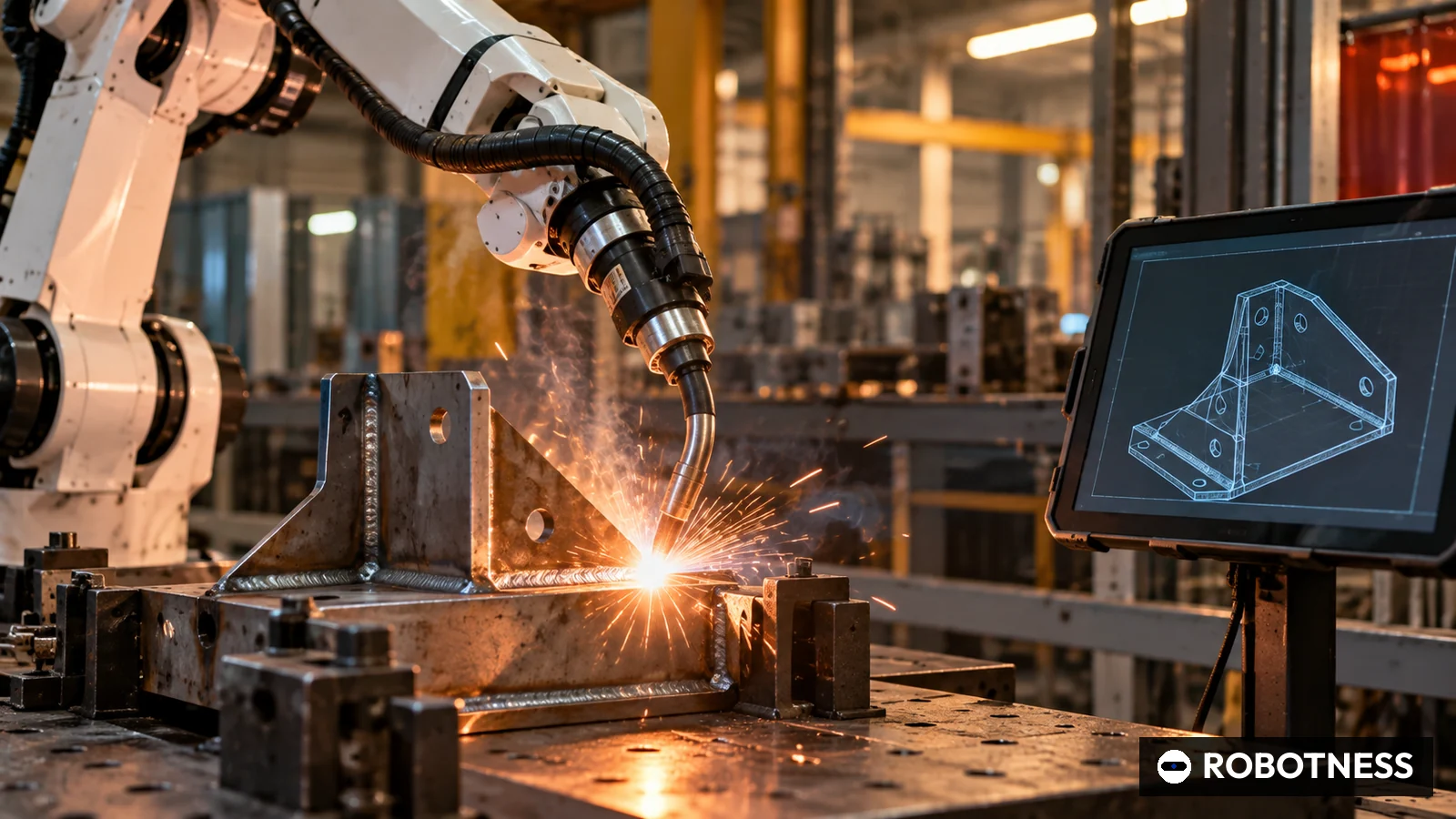
FANUC Corp. said on Sept. 11, 2026 it will start shipping an AI Welding Agent at the end of December, a system that reads the engineering drawing of a part and generates the program a robot needs to arc weld it. The agent runs on Gemini Enterprise, Google Cloud's enterprise generative AI platform, and is FANUC's first physical AI product built with Google to carry a shipping date.
FANUC describes the product as “zero setup, zero teaching.” The agent derives welding conditions, namely current and voltage, together with the robot's motion program, from the drawing alone. FANUC did not disclose pricing, performance figures or launch customers. The company demonstrated the system at the International Welding Show at Tokyo Big Sight, which opened on Sept. 16.
How it works
According to the release, the operator captures the drawing with the camera built into the tablet teach pendant of FANUC's CRX collaborative robot, so no dedicated camera or extra device is needed. The AI interprets the part, generates welding parameters and the robot path, and the operator can run them as generated or adjust them before welding. FANUC said the agent works with any welding power source connected to its robots, which means users do not have to switch power-source brands to adopt it.
FANUC addressed data concerns directly. Customer drawings and production data are protected by Gemini Enterprise's enterprise security and are not used to train AI models for other users, the company said. Customers do not need a separate contract with Google Cloud because the service is provided under their FANUC agreement.
The target is a labour bottleneck. FANUC said skilled arc welders who can both set welding conditions and teach robots are scarce worldwide and that the shortage is delaying supply of materials and components. It named automotive and truck parts, construction materials and shipbuilding as the main target industries.
The FANUC and Google track
The launch builds on a collaboration FANUC announced with Google on May 13, which covered Gemini Enterprise and Intrinsic, Google's software platform for building and deploying AI robot applications, including its Flowstate development environment. In that release FANUC said its lineup spans collaborative robots with a 3 kg payload up to industrial robots carrying 2.3 tonnes, that its robots support ROS through open-source drivers, that it takes part in Google DeepMind's Gemini Robotics Trusted Tester Program, and that it had shipped more than 1,000 robots for physical AI applications since showing its physical AI system at the International Robot Exhibition in December 2025.
The business behind it is growing. FANUC reported consolidated net sales of ¥231,035 million for the April to June 2026 quarter, up 17.7% year on year, with robot division sales up 18.7% to ¥96,103 million, according to its July 31 filing. It raised its full-year forecast to net sales of ¥948,100 million and operating income of ¥218,000 million. On the same day as the welding agent, FANUC also announced an ultra-light portable collaborative robot aimed at automating construction sites and a high-speed, low-distortion pipe welding system, and on Sept. 30 it signed a physical AI partnership with Hitachi.
Competition
Yaskawa Electric, FANUC's closest domestic rival in arc welding robots, also exhibited at the 2026 International Welding Show, according to its event notice. On Aug. 31 it launched the MOTOMAN-HC12 collaborative robot with a 12 kg payload, a 1,410 mm reach and a newly developed torque sensor, listing arc welding among its applications, and in July it announced an agentic robot system with Google DeepMind. Kawasaki Heavy Industries' precision machinery and robot segment grew faster than both in the latest quarter, driven by semiconductor robots rather than welding. The table compares the three robot businesses.
- FANUC
- Robot division
- Apr to Jun 2026
- 96,103
- 18.7
- No data
- No data
- Yaskawa Electric
- Robotics
- Mar to May 2026
- 56,728
- 2
- 888
- -82.3
- Kawasaki Heavy Industries
- Precision machinery and robots
- Apr to Jun 2026
- 69,594
- 22.2
- 5271
- 124.5
Figures as disclosed in quarterly earnings filings. FANUC does not disclose robot division profit. Kawasaki revenue is external sales; its YoY changes are derived: 69,594 / 56,930 minus 1 and 5,271 / 2,348 minus 1. Yaskawa's fiscal year ends in February.
As of Oct 1, 2026
The technical idea is simple to state. Welding drawings encode joints, weld lengths and sizes in standard symbols that a trained person reads before choosing parameters and teaching the torch path point by point. A multimodal model that can interpret those symbols lets software do the reading, and FANUC's robot software turns the result into parameters and motion. FANUC has not published accuracy data, so how often operators must correct the output remains unknown.
For the global market the significance is that the teaching step, rather than the robot, has long been the cost that keeps small-batch welding manual. A collaborative robot that a shop can set up from a drawing changes the economics for job shops and suppliers that weld many part numbers in small lots, which is where welder shortages bite hardest.
The open questions are commercial and technical. FANUC has not said what the agent costs, whether it is a one-off licence or a subscription, or whether it will run on robots other than the CRX. A cloud-based model adds a dependency on network access in plants that often restrict it. Responsibility for weld quality when an AI sets the parameters is another issue customers in safety-critical sectors such as shipbuilding will raise.
The dates to watch are the end of December 2026, when shipments are due to start, FANUC's results for the July to September quarter, and the first customer references from automotive parts makers and shipyards.
ROBOTNESS analysis
The AI Welding Agent matters less as a welding product than as proof that FANUC can turn its Google alliance into a priced, shipping item within eight months.
The evidence is the timeline. FANUC announced the Google collaboration on May 13, showed the agent at the welding show on Sept. 16 and set shipments for the end of December. The product uses hardware customers already own, the CRX tablet teach pendant, and requires no separate Google contract, which removes two common adoption hurdles.
The strongest counter-argument is that welding quality depends on details a drawing does not capture, such as fit-up gaps, distortion and material batches. If operators routinely have to retune AI-generated parameters, the zero-teaching promise shrinks to a faster first draft.
Bull case: the agent cuts setup time enough that high-mix job shops adopt collaborative welding cells, FANUC extends it to industrial ARC robots and other processes, and the subscription-style delivery under FANUC contracts creates recurring software revenue on top of hardware.
Bear case: accuracy is uneven across drawing styles, plants balk at sending drawings to a cloud model, and rivals with their own AI partnerships match the feature quickly, leaving FANUC with little pricing power.
Signals to watch:
- End of December 2026: whether shipments start on schedule and whether FANUC discloses pricing.
- FANUC's July to September 2026 quarterly results: any comment on welding agent orders.
- Fiscal 2027 (from April 2027): extension of the agent beyond the CRX or to other processes, and named shipbuilding or automotive customers.
- Part drawing captured by the CRX tablet teach pendant camera
- Not disclosed
- Welding current, voltage and robot motion program
- AI Welding Agent
- Sept. 11, 2026
- End of December 2026
- Google Cloud Gemini Enterprise
- International Welding Show, Tokyo Big Sight, from Sept. 16, 2026
- Automotive and truck parts, construction materials, shipbuilding
Why it matters
Arc welding is one of the largest robot applications, yet small-batch work has stayed manual because teaching paths and tuning parameters for each part number costs more than the robot saves. By moving that step to a model that reads drawings, FANUC is attacking the integration cost rather than the hardware price, which is where adoption actually stalls in job shops.
The product is also the first concrete output of FANUC's Google collaboration with a ship date. It shows that FANUC's alliances can produce sellable items quickly, which matters for judging the Hitachi and Fujitsu tie-ups announced around it.
Rival analysis
Yaskawa Electric competes head on in arc welding and exhibited at the same show, while its MOTOMAN-HC12 collaborative robot launched on Aug. 31 lists arc welding among its uses. Yaskawa's robotics segment grew 2.0% in the March to May quarter and its segment profit fell 82.3% to ¥888 million, which leaves it less room to subsidise software. Kawasaki's robot growth is coming from semiconductor robots.
Other welding specialists, including Panasonic Connect and Daihen in Japan and power-source makers in Europe and the United States, will need comparable automation. FANUC's choice to support any power source connected to its robots is aimed squarely at customers who already use those brands.
Valuation context
FANUC gave no price, so the agent will not move estimates until order data appear. The robot division contributed 41.6% of first-quarter net sales and grew 18.7%, and full-year guidance was raised to ¥948,100 million in net sales.
If the agent is sold as a subscription under FANUC contracts, as the no-separate-Google-contract model suggests is possible, it would be one of FANUC's first recurring AI software lines, which investors typically value differently from hardware.
Supply-chain implications
The agent needs no additional hardware beyond the CRX tablet teach pendant, so it creates no new component demand. Its effect on the supply chain is indirect: if it makes collaborative welding cells viable in more plants, demand rises for CRX arms, torches, wire feeders and power sources, and FANUC's power-source neutrality spreads that demand across welding brands.
On the compute side, inference runs on Google Cloud. That makes Google a recurring supplier inside FANUC's product and ties the agent's cost structure to cloud pricing.
Signals to watch
Shipment start at the end of December 2026 and any disclosed price. Accuracy or setup-time data from early users. Whether FANUC extends the agent to its industrial arc welding robots or to other processes such as sealing or deburring.
Watch also for competitive launches from Yaskawa and specialist welding robot makers, and for any policy at shipyards or automakers on AI-generated weld procedures.
Analyst view
Thesis: the welding agent is a credible, low-friction product that strengthens FANUC's lead in collaborative welding, but its revenue effect in fiscal 2026 will be small. Confidence: medium.
Reasons: the product uses existing hardware, has a firm ship date and solves a documented shortage. Against that, there is no price, no accuracy data and no named customer, and the quality-assurance question for welded structures is unresolved.
Questions you should be asking
What is the pricing model and does it require a recurring fee? How often must operators correct AI-generated parameters in practice? Will the agent work offline or on-premises for plants that restrict cloud access?
Who is accountable for weld quality when parameters come from the model, and how will classification societies and automotive customers treat AI-generated procedures?