BMW brings a humanoid into German car production for the first time, putting Hexagon's AEON on battery work in Leipzig
BMW Group said on 27 February 2026 that Plant Leipzig will pilot Hexagon Robotics' wheeled AEON humanoid in high-voltage battery assembly and component production, after a first test in December 2025 and with the pilot phase set for summer 2026. It also set up a Munich-based Center of Competence for Physical AI in Production and published the results of its 2025 Figure 02 pilot in Spartanburg, where the robot moved more than 90,000 parts in about 1,250 hours.
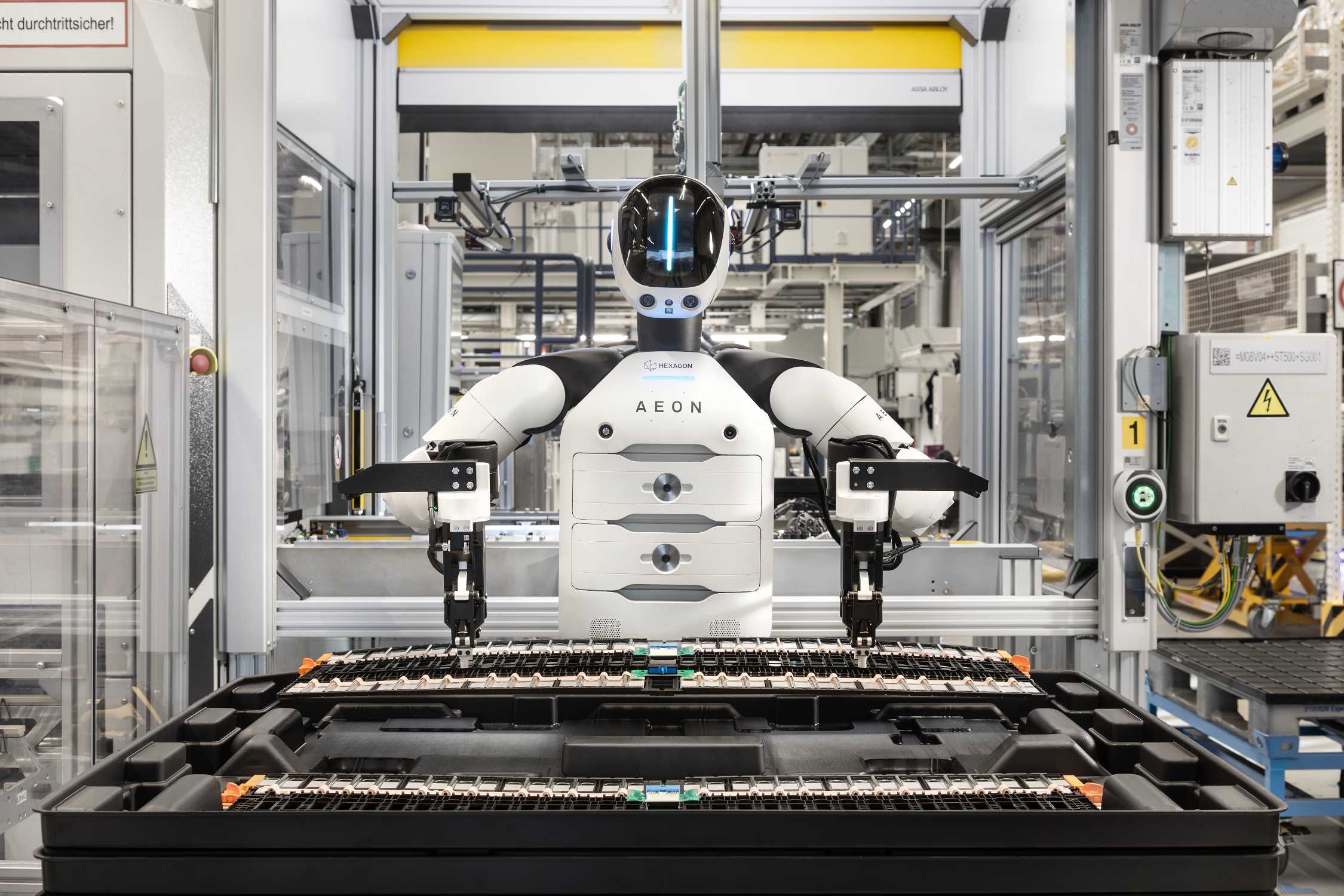
The humanoid that BMW ran in South Carolina last year moved more than 90,000 sheet-metal parts in about 1,250 operating hours. By ROBOTNESS arithmetic that is 72 parts an hour, or three for every BMW X3 it helped build. BMW Group has decided the result justifies a second attempt, this time in Germany and with a different robot from a different supplier.
The carmaker said on 27 February 2026 that Plant Leipzig will run its first European pilot of humanoid robots in production, using AEON, a wheeled humanoid made by Hexagon Robotics of Zurich. It also announced a Center of Competence for Physical AI in Production to carry AI and robotics across its plant network. The more interesting question is why a manufacturer with a working Figure pilot brings in a second vendor, and what that says about how European industry intends to buy these machines.
Leipzig is giving the robot battery work, not a showcase job
According to BMW, AEON had its first test deployment at Leipzig in December 2025. Further tests were planned for April 2026 and the actual pilot phase for summer 2026. The intended jobs are high-voltage battery assembly and component manufacturing. BMW said the robot can take different hand or gripper elements and scanning tools, and that it moves on wheels, which lets it switch between production areas. Hexagon lists AEON at 165 cm and 60 kg, with a top speed of 2.4 metres per second, 34 degrees of freedom, a payload of 15 kg for short lifts and 8 kg carried continuously, up to four hours per charge and an automatic battery swap.
The plant is a demanding place for a newcomer. Leipzig employs about 6,800 people and built 259,430 vehicles in 2025, roughly 1,300 a day, according to BMW's plant site. One line carries the BMW 1 Series, the 2 Series Gran Coupé, the 2 Series Active Tourer and the MINI Countryman, with four models, three drive types and two brands mixed together, and the site also makes high-voltage battery components. Battery assembly is where the pilot is pointed. The choice of supplier says more than the choice of station.
BMW picked a measurement company it already buys from
Hexagon AB is a Stockholm-listed maker of measurement, sensor and industrial software systems. When it unveiled AEON on 17 June 2025 it gave its size as about 24,800 employees and net sales of roughly EUR 5.4 billion. AEON was its first humanoid. Hexagon said then that the robot runs on NVIDIA Jetson processors and Omniverse simulation software, uses Microsoft Azure for training, is driven by maxon actuators, and would start pilots with Schaeffler and Pilatus Aircraft. BMW called Hexagon a long-standing partner in sensor technology and software. Arnaud Robert, president of Hexagon Robotics, said the company was pleased to help bring humanoids into real working environments with BMW.
The gap between AEON's public debut and its first test inside a BMW plant was about six months. That is fast for a first product, and it was possible because Hexagon was already an approved supplier. Spartanburg shows what BMW will measure it against.
Spartanburg set a baseline of 72 parts an hour
BMW said Figure 02 worked ten-hour shifts from Monday to Friday over ten months in 2025, removing sheet-metal parts and placing them for welding with millimetre precision. It logged about 1,250 operating hours, supported production of more than 30,000 X3 and walked about 1.2 million steps. BMW added that it is evaluating Figure 03 for further uses.
- Figure 02 operating hours, Spartanburg 2025
- 1,250
- BMW, about
- BMW X3 built with its support
- 30,000
- BMW, more than
- Components moved
- 90,000
- BMW, more than
- Steps walked
- 1,200,000
- BMW, about
- Components per operating hour
- 72
- ROBOTNESS: 90,000 / 1,250
- Components per X3 supported
- 3
- ROBOTNESS: 90,000 / 30,000
- Steps per operating hour
- 960
- ROBOTNESS: 1,200,000 / 1,250
- Equivalent ten-hour shifts
- 125
- ROBOTNESS: 1,250 / 10
- Plant Leipzig vehicle output, 2025
- 259,430
- BMW plant page
- Plant Leipzig employees
- 6,800
- BMW plant page, about
Inputs as published by BMW Group on 27 February 2026 and on the Plant Leipzig site; BMW rounds them ('about', 'more than'), so derived ratios are approximate. Formula: rate = total / operating hours. BMW did not disclose cycle times, uptime or a human baseline.
As of Oct 1, 2026
These are pilot numbers at a single station. BMW did not publish cycle times, uptime, the human rate for the same task or the cost per hour, which are the four figures a plant manager would want before ordering a fleet. The company's own framing points somewhere else.
The investment is in a selection process, not a robot order
The new competence centre sits in Munich under team lead Felix Haeckel. BMW said it evaluates technology partners against defined maturity and industrialisation criteria, first in theory, then in the lab, then in plant pilots, and that it now runs a unified IT and data model in place of isolated data silos, so that robots plug into production through standard interfaces. Production board member Milan Nedeljković said digitalisation improves the competitiveness of BMW's production in Europe and worldwide. Michael Nikolaides, who runs the production network, said BMW wants to bring new technology into its plants early. The company said the aim is to relieve employees of strenuous work.
BMW is not alone among European carmakers. Mercedes-Benz invested in Apptronik's Series A close in March 2025 and again in its USD 520 million Series A-X in February 2026, according to Apptronik's releases. Boston Dynamics, owned by Hyundai Motor Group, said in January that it had started building the production version of Atlas. Schaeffler, one of AEON's launch pilots, later joined the funding rounds of NEURA Robotics and London's Humanoid.
- Hexagon Robotics (AEON)
- Zurich (division of Hexagon AB, Stockholm)
- BMW Plant Leipzig pilot; Schaeffler and Pilatus pilots named at launch
- No data
- None (funded by listed parent)
- No data
- Figure AI
- United States
- BMW Plant Spartanburg (Figure 02 in 2025)
- 1745
- Series C, 2025-09-16
- 39,000
- Apptronik
- United States
- Mercedes-Benz invested in its Series A close and Series A-X
- 923
- Series A-X, 2026-02-11
- No data
- Humanoid
- United Kingdom
- Schaeffler and Bosch joined its Series A
- 152
- Series A, 2026-07-21
- 1,350
- NEURA Robotics
- Germany
- Schaeffler and Bosch joined its Series C
- No data
- Series C, 2026-06-10
- No data
Sum of disclosed rounds stored in ROBOTNESS from company and investor releases, not estimates: Figure AI 70 + 675 + 1,000 = 1,745; Apptronik 350 + 53 + 520 = 923. NEURA's Series C was announced as 'up to' an amount, so ROBOTNESS stores no figure. Humanoid's and NEURA's rounds came after BMW's 27 February 2026 announcement. Hexagon does not report AEON funding separately.
As of Oct 1, 2026
ROBOTNESS analysis
BMW is building a qualified-vendor system for humanoids before any vendor has proven a business case, and the second supplier matters more than the second robot.
The evidence is in the structure. BMW runs a US startup on one continent and a European industrial supplier on the other, both under one data model and one evaluation gate in Munich. Carmakers buy welding robots and presses the same way, with several approved suppliers and common interfaces, which gives them leverage on price once volume arrives. The Spartanburg figures give BMW a reference rate of about 72 parts an hour against which AEON can be judged.
The strongest counter-argument is that the pilot proves very little yet. AEON is a first-generation product from a company whose core business is metrology, its wheeled base suits flat plant floors only, and BMW has disclosed no economics. A sceptic would read the Leipzig choice as support for a long-standing supplier rather than a vendor competition.
Bull case: AEON matches or beats the Spartanburg rate on battery work, BMW names a third supplier through the Munich centre, and humanoids become a standard tender item at European plants by 2027 with prices set by competition. Bear case: battery assembly proves too variable for a 34-joint robot carrying 8 kg continuously, the summer pilot stays in a test area, and the competence centre ends up a research unit.
Since the announcement, Hexagon said on 12 June 2026 that AEON had started performing production tasks at Leipzig, that battery assembly work would move from the plant's Innovation Garage onto the factory floor in later phases, and that AEON would be in production use by the end of 2026. Figure said on 30 June 2026 that Figure 03 was working in Hall 52 at Spartanburg.
Three signals will settle the thesis. First, whether AEON is in regular production at Leipzig by 31 December 2026, the date Hexagon set. Second, how BMW treats the EU Machinery Regulation, which becomes mandatory on 20 January 2027 and, according to the European Commission, adds provisions for machinery whose safety functions are AI-powered. Third, whether BMW's 2026 annual reporting in spring 2027 names a third humanoid partner or a second European plant. A third supplier would confirm the vendor-system reading. A quiet year would favour the sceptics.
- BMW Group Plant Leipzig, first humanoid pilot in BMW production in Germany
- AEON by Hexagon Robotics (Zurich), wheeled humanoid
- Center of Competence for Physical AI in Production, Munich
- First test December 2025; further test April 2026; pilot phase summer 2026
- 27 February 2026, BMW Group, Munich
- About 72 parts per operating hour (ROBOTNESS arithmetic)
- High-voltage battery assembly and component manufacturing
- About 6,800 employees; 259,430 vehicles in 2025
- 165 cm, 60 kg, 2.4 m/s, 34 DoF, 15 kg short-term payload, up to 4 h per charge, battery auto-swap
- About 1,250 hours, more than 30,000 X3, more than 90,000 parts, about 1.2 million steps
Why it matters
BMW's announcement moves humanoid robots from a single US experiment to a multi-plant, multi-vendor programme inside one of Europe's largest carmakers. The detail that matters for the industry is the gate it built in Munich, where partners are scored on maturity and industrialisation criteria and pass through theory, lab and plant stages. That is a procurement process, and procurement processes outlast any one pilot.
It also changes what a European humanoid vendor needs to win business. A vendor now has to fit BMW's common data model and standard interfaces and beat a published reference of roughly 72 parts an hour from Spartanburg. Startups that sell a robot plus a closed software stack will find that harder than suppliers already wired into a carmaker's IT, which is exactly Hexagon's position.
Rival analysis
Figure AI is the incumbent at BMW and the best-funded rival on our table, with USD 1,745 million in disclosed rounds and a USD 39 billion post-money in September 2025. Its advantage is a full-stack model and walking robots that cope with mixed floors. Hexagon's counter is the installed relationship, metrology heritage and a wheeled base that is cheaper to make safe on flat plant floors.
Apptronik, backed by Mercedes-Benz, and Hyundai's Boston Dynamics are the other carmaker-linked programmes. In Europe, NEURA Robotics and Humanoid each drew Schaeffler and Bosch into their 2026 rounds, so the German supplier base is spreading bets across several makers rather than picking one. AEON is the only one of these built by a listed industrial group, which gives buyers balance-sheet comfort and gives Hexagon less pressure to show quick volume.
Valuation context
Hexagon does not report AEON funding or revenue separately, so there is no direct valuation marker. The comparable private marks in ROBOTNESS are Figure AI at USD 39 billion post-money (September 2025) and Humanoid at USD 1.35 billion post-money (July 2026). Apptronik's Series A-X was priced at three times its Series A valuation, per the company, but no absolute figure was disclosed.
The useful lens for Hexagon investors is option value. A BMW production reference for a humanoid built inside a measurement group is worth more as a sales reference to other European plants than as revenue in 2026. Until Hexagon discloses robot unit sales or a robotics segment, any valuation of AEON is guesswork, and we do not offer one.
Supply-chain implications
AEON's disclosed bill of key parts is international. Actuators come from maxon of Switzerland, compute from NVIDIA Jetson processors, simulation from NVIDIA Omniverse and training infrastructure from Microsoft Azure, according to Hexagon. Sensors and spatial software are Hexagon's own. That leaves the robot exposed to US compute export rules and a single Swiss actuator source.
For BMW, the robot is one more node in a supply chain it already controls through standard interfaces. The battery-assembly use matters here: Leipzig builds high-voltage battery components, so a humanoid there touches a process with high safety and quality demands. Any failure would surface quickly in an area where BMW has little tolerance for it.
Signals to watch
31 December 2026: Hexagon's stated date for AEON to be in production use at Leipzig. A slip into 2027 would weaken the thesis that BMW can run two vendors at pace.
20 January 2027: the EU Machinery Regulation becomes mandatory. Watch whether BMW or Hexagon describe a conformity route for AEON's AI-supported safety functions. Spring 2027: BMW's 2026 annual reporting, which may name further humanoid partners, plants or volumes.
Analyst view
Thesis: BMW is building a qualified-vendor system for humanoids, and the second supplier is the real news. Confidence: medium. The structure (two vendors, one data model, a central gate) is verified on BMW's own pages, while the economics and the results of the Leipzig pilot are not yet public.
What would raise confidence: a third named humanoid partner, disclosed throughput at Leipzig comparable with Spartanburg, or a production order. What would lower it: AEON remaining in the Innovation Garage after 2026, or BMW consolidating on one vendor.
Questions you should be asking
For BMW: what throughput, uptime and cost per hour must a humanoid reach at the Munich gate to move from pilot to production, and how does Spartanburg's 72 parts an hour compare with the human rate for the same task?
For Hexagon: how many AEON units are in customer pilots today, and how will the robot's AI-supported safety functions be certified once the EU Machinery Regulation applies in January 2027? Is there a second automotive customer in Europe?