AgiBot rolls out its 10,000th humanoid robot, doubling its fleet in 112 days
Shanghai-based AgiBot said on 30 March 2026 that its 10,000th humanoid robot had come off the production line, 112 days after it announced its 5,000th. The company said the step from 5,000 to 10,000 units ran four times faster than earlier phases, but its own December breakdown shows that only about a third of its fleet is full-size.
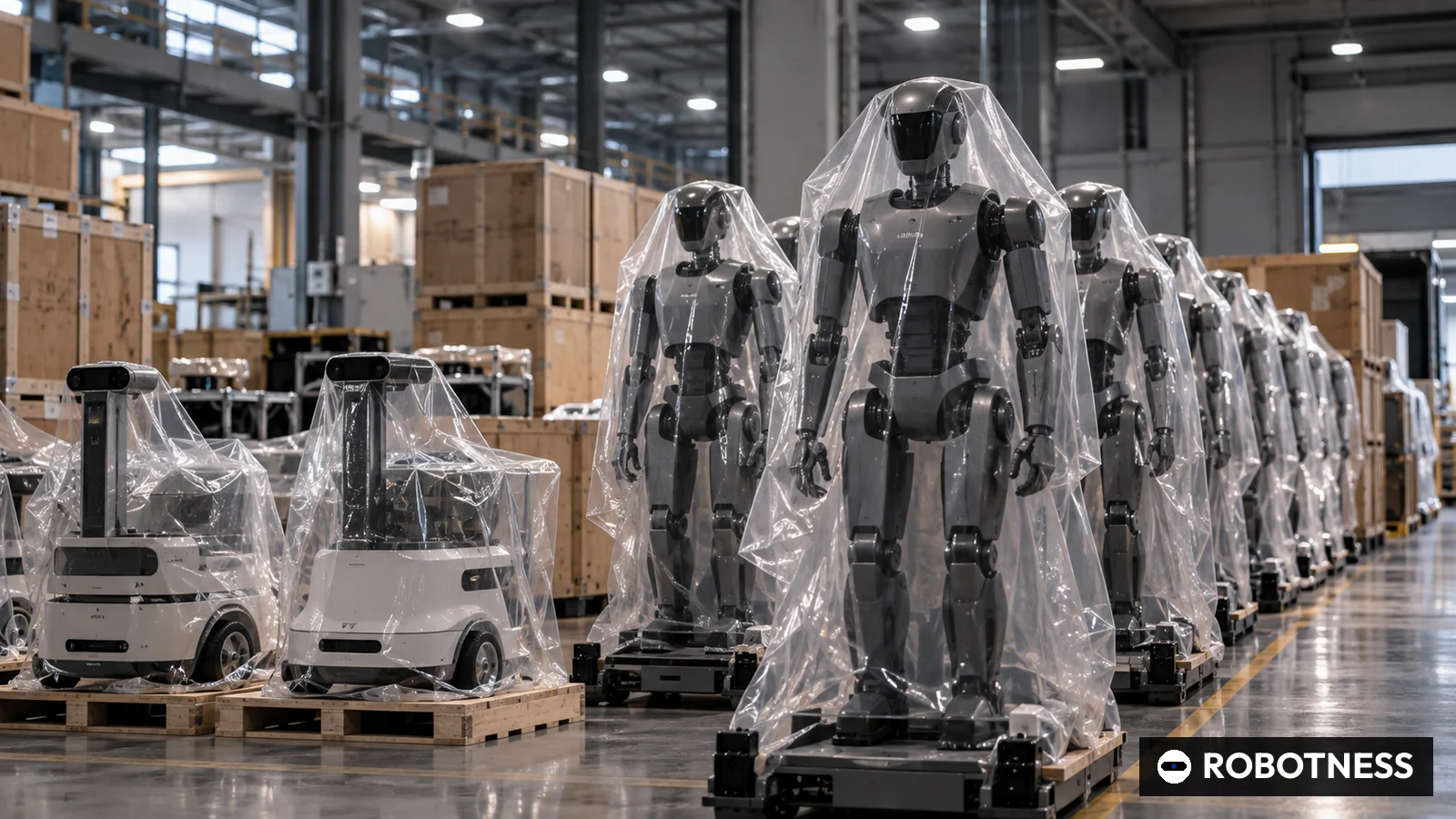
AgiBot needed about two years to build its first 1,000 robots. It built the most recent 5,000 in less than four months. The Shanghai company said on 30 March 2026 that its 10,000th humanoid robot had rolled off the line, 112 days after it announced its 5,000th on 8 December 2025, which puts it among the first humanoid makers anywhere to reach five figures.
Volume is the one claim in humanoid robotics that is hard to fake and easy to compare, and it is also easy to misread. What AgiBot counts as a humanoid, where the machines go and what they earn decide whether 10,000 marks the opening of an industrial market or a well-funded build-out ahead of one. The company's own disclosures, set against the few verified figures its rivals have published, give a clearer answer than the headline number.
The company's clock says four times faster, the calendar agrees
AgiBot said in the release that reaching 1,000 units took roughly two years, getting from 1,000 to 5,000 took about one year, and the last 5,000 took three months, an acceleration it put at four times. Counting between the two announcement dates, ROBOTNESS finds 112 days for 5,000 units, or 44.6 robots a day. Run for a full year, that pace would equal about 16,300 units. The release named neither the model of the 10,000th robot nor the factory that built it, and it named no customers.
- 5,000
- 2025-12-08
- No data
- No data
- No data
- 10,000
- 2026-03-30
- 112
- 5000
- 44.6
- 15,000
- 2026-06-28
- 90
- 5000
- 55.6
Source: AgiBot press releases of 8 December 2025, 30 March 2026 and 28 June 2026. Days are counted between announcement dates, which ROBOTNESS uses as a proxy for rollout dates. Average units per day = units added / days. Milestones disclosed, derived columns computed by ROBOTNESS, nothing estimated.
As of Oct 1, 2026
Peng Zhihui, AgiBot's co-founder, president and chief technology officer, said in the release that the figure reflected a change in the company's ability to scale and a shift from technical validation to large commercial demand. AgiBot said a significant share of the 10,000 units was already deployed in logistics, retail, hospitality, education and manufacturing, and that it now sells in Europe, North America, Japan, South Korea, Southeast Asia and the Middle East. It added that industry analysts ranked it first in global humanoid shipments in 2025. A later AgiBot release attributed that ranking to Omdia, which put AgiBot's 2025 shipments at 5,168 units and its global share at 39%.
The pace held. On 28 June 2026 AgiBot announced its 15,000th robot, a Genie G2 working in quality inspection for tablet production, 90 days after the 10,000 mark, or 55.6 units a day by the same method. The more revealing number, though, sits in the breakdown the company published at 5,000.
Two thirds of the fleet is not full-size
When AgiBot passed 5,000 units in December it split them by family. The full-size A series accounted for 1,742 units, the half-size X series for 1,846 and the task-optimised Genie G series, built for factories, logistics and services, for 1,412. Full-size machines were therefore 34.8% of the total. The March release listed a wider catalogue, with the A3, A2 Ultra, A2 Lite and A2-W, the X1 and X2, the G2 and G1, D1 quadrupeds, a C5 cleaning robot, OmniHand dexterous hands and a VR teleoperation kit. It did not say whether quadrupeds or cleaners are in the 10,000, although the December count reached 5,000 using the A, X and G families alone.
- A series (full-size)
- 1742
- 34.8
- X series (half-size)
- 1846
- 36.9
- Genie G series (task-optimised)
- 1412
- 28.2
- Total
- 5000
- 100
Source: AgiBot press release, 8 December 2025. Share = series units / 5,000. Figures disclosed, not estimated. No later breakdown has been published.
As of Oct 1, 2026
AgiBot was founded in 2023 and is led by founder, chairman and chief executive Deng Taihua. It made its United States debut at CES in Las Vegas on 5 January 2026, showing the A2, X2, G2 and D1 lines, and sells a "Powered by AgiBot" programme that lets partners customise hardware, software and algorithms. At its partner conference on 17 April the company said 2025 revenue had passed RMB1 billion, up from more than RMB60 million in 2024, ROBOTNESS reported at the time. It has not published margins or profit.
Against rivals, the gap narrows once size is counted
- AgiBot
- CN
- Cumulative humanoids rolled out
- 10,000
- 2026-03-30
- Company release
- AgiBot
- CN
- Shipments in 2025
- 5,168
- 2025-12-31
- Omdia, as cited by AgiBot
- UBTech Robotics
- CN
- Full-size humanoids sold in 2025
- 1,079
- 2025-12-31
- HKEX filing
- UBTech Robotics
- CN
- Full-size humanoids sold in H1 2026
- 921
- 2026-06-30
- HKEX filing
- UBTech Robotics
- CN
- Annualised full-size capacity at year-end (more than)
- 6,000
- 2025-12-31
- HKEX filing
- Figure AI
- US
- Figure 03 robots delivered (more than)
- 350
- 2026-04-29
- Company release
- 1X Technologies
- US
- Hayward annual NEO capacity (up to)
- 10,000
- 2026-04-30
- Company release
- Tesla
- US
- Fremont Optimus line annual design capacity
- 1,000,000
- 2026-04-22
- Shareholder update
ROBOTNESS records verified on primary pages, as of 1 October 2026. Units built, units sold and capacity are different measures and are labelled as such. Derived: AgiBot 2025 shipments / UBTech 2025 full-size sales = 5,168 / 1,079 = 4.8; AgiBot A-series cumulative at 5,000 mark / UBTech 2025 full-size sales = 1,742 / 1,079 = 1.6; implied 2025 global market = 5,168 / 0.39 = about 13,250.
As of Oct 1, 2026
The closest verified comparison is UBTech Robotics, which reported in its Hong Kong filing that it sold 1,079 full-size humanoids in 2025 and 921 in the first half of 2026, with year-end capacity above 6,000 units. AgiBot's Omdia-cited 2025 shipments of 5,168 were 4.8 times UBTech's full-size sales. Counting only full-size machines, AgiBot's cumulative A-series total at the 5,000 mark, 1,742 units built since 2023, was 1.6 times what UBTech sold in 2025 alone. In the United States, Figure AI said on 29 April that it had delivered more than 350 Figure 03 robots, 1X said its Hayward plant can build up to 10,000 NEO robots a year, and Tesla said its Fremont Optimus line is designed for one million a year without giving unit output. Dividing 5,168 units by a 39% share implies a global 2025 market of about 13,250 humanoids.
Why the mix decides the economics
A half-size robot carries smaller motors and lighter joints than a full-size biped, and it costs far less to build. A full-size machine needs high-torque actuators in hips and knees, where reducers, motor heat and battery weight set the limits on cost and reliability. Ten thousand units across all three families proves that a Chinese supply chain for motors, reducers, batteries and compute can run at volume. It does not prove that a walking robot can work a full shift on a production line. AgiBot's own list of eight application areas includes data-collection training, meaning some robots are bought to gather demonstrations for AI models rather than to replace labour.
What the release leaves out
"Rolled out" means a robot left the production line, not that a customer paid for it, so built units, shipped units and installed units may differ. AgiBot gave no prices, no revenue for the quarter, no split by country and no utilisation data for the fleet in service. Those gaps matter more than the round number, because they decide whether the next 10,000 will come from repeat industrial orders or from exhibition, education and state-backed training sites.
ROBOTNESS analysis
AgiBot's 10,000 is proof that China can manufacture humanoid-class robots at scale, but with roughly two thirds of the fleet half-size or task-optimised, it is not yet proof of a mass market for full-size factory humanoids.
The evidence is in the company's own numbers. Output per day rose from 44.6 to 55.6 between March and June, so the factory side is real. Yet the only published mix shows full-size units at 34.8%, and the one listed rival that reports sales by size, UBTech, sold 1,079 full-size machines in 2025. On a like-for-like basis the lead is 1.6 times, not 4.8 times.
The strongest counter-argument is that the mix is a strategy, not a weakness. Smaller and wheeled-base robots sell today, generate the RMB1 billion of revenue AgiBot reported for 2025, and feed real-world data into its models, which should make the full-size A3 more capable when factory demand arrives.
Bull case. Industrial customers such as the consumer-electronics line AgiBot disclosed in April move from pilots to repeat orders, the full-size share rises above half, and AgiBot reaches profitable scale before a listing that discloses audited margins.
Bear case. Volume keeps rising but lands in showrooms, classrooms and subsidised training halls. Prices fall as Unitree and others compete in the same tiers, and unit counts outrun revenue.
Three signals to watch:
- Any listing application by AgiBot, which would give audited unit sales, average prices and margins for the first time.
- 31 December 2026, the deadline for deployment sites under the MIIT and SASAC humanoid training action, which will show how much demand is state-created.
- UBTech's 2026 annual results, due by 31 March 2027, the cleanest public benchmark for full-size humanoid sales.
- 10,000th humanoid robot rolled out, 30 March 2026, Shanghai
- China, Europe, North America, Japan, South Korea, Southeast Asia, Middle East
- 5,168 units, 39% global share (Omdia, as cited by AgiBot)
- 44.6 units a day, about 16,300 a year annualised
- 15,000th unit, 28 June 2026, 90 days later
- A series 1,742, X series 1,846, Genie G series 1,412
- 5,000th unit, 8 December 2025
- 112 (ROBOTNESS count between announcement dates)
Why it matters
Unit counts are the first hard evidence that humanoid robots have left the prototype stage, and AgiBot is one of the first private companies to publish a five-figure total with a dated trail of milestones behind it. Investors pricing humanoid makers have had funding rounds and demonstrations to go on; a run rate of 44.6 units a day, rising to 55.6 a day by June, is a manufacturing fact that can be checked against each new announcement.
The second reason is the mix. AgiBot's December breakdown is one of the few published splits of a humanoid fleet by size class, and it shows that a market leader's volume is built largely on half-size and task-optimised machines. That should change how readers interpret every other volume claim in the sector, including the 100,000-unit expectation the Chinese industry ministry later set for embodied AI products in 2026.
Third, the milestone shifts the competitive question from whether Chinese makers can build humanoids at scale to who pays for them. The answer will decide whether the industry's next phase is a margin story or a subsidy story.
Rival analysis
UBTech is the most comparable listed rival and the only one that reports full-size humanoid sales in a filing, with 1,079 units in 2025 and 921 in the first half of 2026, with capacity of more than 6,000 a year. UBTech concentrates on the Walker S series for car plants and factories, so its count is smaller but almost entirely full-size. AgiBot's like-for-like full-size lead, 1,742 cumulative A-series units against UBTech's 1,079 sold in 2025, is real but modest.
Unitree, which listed on Shanghai's STAR Market in August 2026, sells large volumes of quadrupeds and humanoids to research, education and entertainment buyers and reported 2025 revenue of RMB1,699.27 million, but its listing announcement gave no humanoid unit numbers. AgiBot competes with it directly in the half-size and research tiers, which is where price pressure will hit first.
In the United States the reference points are capacity plans rather than volumes. Figure AI had delivered more than 350 Figure 03 robots by 29 April 2026, 1X has capacity for up to 10,000 NEO units a year in Hayward, and Tesla is converting Fremont floor space to an Optimus line designed for one million a year. On units built and delivered, AgiBot is well ahead of every Western rival that has published a delivery figure.
Valuation context
AgiBot has not disclosed a valuation, and the two funding rows ROBOTNESS holds for it, a Series A extension announced on 3 September 2024 and a strategic round on 1 August 2025, carry no disclosed amounts. Any figure circulating in the press is therefore unverified for our purposes.
The listed comparables give a sense of what public investors pay for Chinese robot volume. Unitree's STAR Market issue price of RMB150.80 valued the company at about RMB60.99 billion, which its listing document put at 35.89 times 2025 revenue, against 19.37 times for UBTech and 20.12 times for Dobot. AgiBot's reported 2025 revenue of more than RMB1 billion sits in the same bracket as Unitree's RMB1.70 billion and UBTech's RMB2.0 billion.
The unit data matters for valuation because it lets investors separate volume from value. A company whose fleet is two thirds smaller robots should earn less revenue per unit than one selling only full-size machines; UBTech's 2025 full-size revenue averaged about RMB760,000 a robot. Until AgiBot publishes revenue by product family, its revenue per unit cannot be computed, and that is the number a listing would have to supply.
Supply-chain implications
A run rate of roughly 16,000 to 20,000 robots a year draws heavily on four component groups, namely frameless torque motors, precision reducers such as strain-wave and planetary gear sets, battery packs and edge AI compute. Full-size machines need the highest-torque joints in hips and knees; half-size and task-optimised units use smaller parts that Chinese suppliers already make in volume for automation and consumer devices.
AgiBot has not named its suppliers. Its scale nonetheless matters to the Chinese reducer and actuator makers that have been building humanoid lines, and to Japanese precision-gear makers whose products have been the reference in industrial robots. If AgiBot's volume rests mainly on domestic parts, it is evidence that the cost curve for humanoid joints is now being set in China.
The OmniHand dexterous hand and the VR teleoperation kit point to a second chain, in tactile sensing and data collection. Data-collection training is one of AgiBot's eight listed application areas, so part of its demand is internal to the AI stack, with robots producing training data for the company's own models.
Signals to watch
A listing application would be the single most informative event. Hong Kong or mainland prospectuses require audited unit sales, average selling prices, customer concentration and gross margin, which would answer whether the 10,000 and 15,000 milestones translate into proportionate revenue.
The 31 December 2026 deadline in the MIIT and SASAC special action on real-world training of humanoids will show how much of 2026 demand comes from state-designated scenario sites. A large share of AgiBot's second-half volume going to such sites would support the bear case on demand quality.
UBTech's 2026 annual results, due by 31 March 2027, and full-year 2026 rankings from research firms such as Omdia will show whether AgiBot's lead holds and whether the full-size share of the market is rising. A further AgiBot milestone release with a size breakdown would be the cheapest test of our thesis.
Analyst view
Thesis: AgiBot has proved it can manufacture at a pace no other humanoid maker has published, but its volume is weighted towards smaller and task-specific machines, so the milestone validates China's supply chain more than it validates factory demand for full-size humanoids. Confidence: medium.
The confidence is medium rather than high because the only size breakdown is from December 2025, and the mix may have shifted towards the A3 and Genie G2 since. The 15,000th unit, a G2 doing inspection work on a tablet line, hints that industrial use is growing. Against that, AgiBot has given no prices, no revenue per unit and no utilisation data, so the volume could also be flattered by demonstration and data-collection fleets.
Two things would change our view. A disclosed full-size share above 50%, or audited revenue per unit close to UBTech's roughly RMB760,000, would move us to a high-confidence bull reading. A listing document showing heavy reliance on government-linked buyers or rental fleets would move us to the bear case.
Questions you should be asking
What share of the 10,000 and 15,000 units were full-size A-series robots, and how has that share moved since the December 2025 breakdown?
How many of the units rolled out have been sold and invoiced, how many are in rental or demonstration fleets, and how many are used internally for data collection?
What is the average selling price by family, and what gross margin does each family earn?
Which factories produce the robots, what is current annual capacity, and which joint components are sourced outside China?
How many robots are deployed outside China, and in which of the named regions are there paying industrial customers?