NEURA Robotics raises up to $1.4 billion in Series C as Tether, Amazon, Qualcomm, Bosch and the EIB back Germany's physical AI bet
Metzingen-based NEURA Robotics said on June 10, 2026 that it had secured a Series C of up to $1.4 billion, which it called the largest round ever raised by a full-stack robotics company. Backers include Tether, Qualcomm Technologies, Amazon, NVIDIA, Bosch, Schaeffler and the European Investment Bank, and the company put its order book and deployment pipeline above $1 billion. No valuation was disclosed.
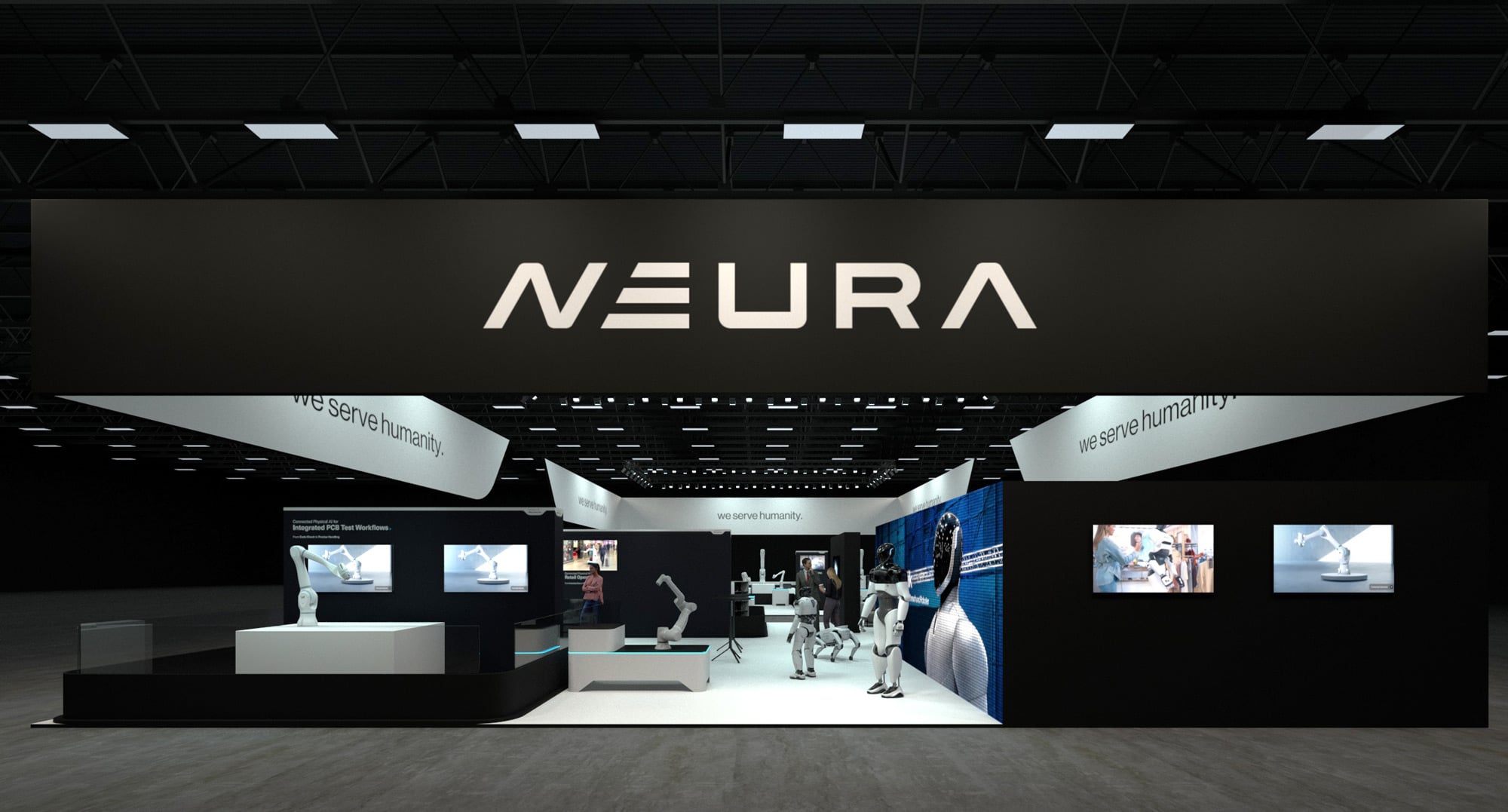
NEURA Robotics, the cognitive robot maker based in Metzingen near Stuttgart, said on June 10, 2026 that it had raised a Series C financing of up to $1.4 billion. The company described the round as the largest ever for a full-stack robotics company, a claim that puts a German firm level with the biggest US robot-intelligence rounds of the past year.
The investor list mixes crypto money, US technology groups, German industrials and European public capital. NEURA named Tether, Qualcomm Technologies, Amazon, NVIDIA, imec.xpand, Bosch, Schaeffler, the European Investment Bank, Lingotto Horizon and InterAlpen Partners, plus unnamed others. The announcement did not designate a lead investor, did not break down individual commitments and did not give a valuation. The phrase up to $1.4 billion indicates that not all of the capital was necessarily paid in at signing.
What NEURA said it will build
NEURA said the money will fund global deployment of its cognitive robots and humanoids, expansion of Neuraverse, its open software and skills ecosystem, a rollout of NEURA Gyms, which it describes as real-world training environments for robots, the scaling of manufacturing and deployment infrastructure, and development of next-generation physical AI systems. The company said its existing order book and strategic deployment pipeline exceed $1 billion. Its product family includes the MAiRA cognitive robot, the LARA arm, the MAV mobile platform, MiPA and the 4NE1 humanoid, along with sensing and teaching add-ons.
From a €120 million Series B
The round lands 17 months after NEURA's Series B. On January 15, 2025 the company announced €120 million led by Lingotto Investment Management, with BlueCrest Capital Management, Volvo Cars Tech Fund, InterAlpen Partners, Vsquared Ventures, HV Capital, Delta Electronics, C4 Ventures, L-Bank and founder David Reger participating. At that time NEURA cited an order book of €1 billion, more than 300 employees and tenfold revenue growth over the previous year. Founded in 2019 by Reger, the company has positioned itself as a European alternative to US humanoid start-ups, building its own arms, sensors and software rather than relying on third-party hardware.
The investors and what they said
The strategic names matter more than the headline. Amazon's Nafea Bshara, vice president and distinguished engineer, called the investment a natural extension of Amazon's strategic partnership with NEURA. Qualcomm's Nakul Duggal, executive vice president and group general manager, said physical AI is the next major evolution of computing. Bosch chief executive Stefan Hartung said the group sees significant growth opportunities in humanoid robotics, and Schaeffler chief executive Klaus Rosenfeld framed robotics as a growth area beyond the bearing maker's traditional business. Tether chief executive Paolo Ardoino said the infrastructure behind robotics must evolve as machines move from scripted automation to autonomy. Nicola Beer, vice president of the European Investment Bank, said the bank was putting serious European firepower behind the next wave of the technology.
Competitive context
The size compares directly with US peers. Skild AI announced a $1.4 billion Series C at a $14 billion valuation on January 14, 2026; Figure AI raised $1 billion in a Series C at a $39 billion post-money valuation on September 16, 2025; Apptronik closed a $520 million Series A extension on February 11, 2026. Those three disclosed valuations or clean round sizes. NEURA disclosed neither a valuation nor a closing structure, which makes a like-for-like comparison of price impossible.
- NEURA Robotics
- DE
- 2019
- Series C (up to)
- 1,400,000,000
- No data
- 2026-06-10
- Skild AI
- US
- 2023
- Series C
- 1,400,000,000
- 14,000,000,000
- 2026-01-14
- Figure AI
- US
- No data
- Series C
- 1,000,000,000
- 39,000,000,000
- 2025-09-16
- Apptronik
- US
- 2016
- Series A extension
- 520,000,000
- No data
- 2026-02-11
- 1X Technologies
- US
- 2014
- Series B
- 100,000,000
- No data
- 2024-01-13
Figures as disclosed by each company; NEURA amount is a ceiling (up to). Null means not disclosed. No estimates.
As of Oct 1, 2026
The technology in plain terms
NEURA's pitch is that a robot should perceive, learn and adapt rather than replay a fixed program. Its cognitive arms carry built-in sensing so they can work beside people, and the Neuraverse layer is meant to let developers publish skills that run across NEURA hardware. The NEURA Gyms concept reflects a view, stated by the company, that physical AI must be trained and validated in the real world and not only in simulation. That is a counterpoint to the simulation-first strategy promoted by NVIDIA, which is itself an investor.
What it means
For Europe the round answers a recurring complaint that deep-tech companies must move to the US to raise growth capital at this scale. Reger said in the announcement that many believed globally relevant AI infrastructure companies could only emerge from Silicon Valley. The presence of Bosch, Schaeffler and the EIB also ties the company into German supply chains and EU industrial policy at the same time.
Risks and open questions
The undisclosed valuation, the conditional up to wording and the lack of investor-by-investor amounts leave real uncertainty about how much cash NEURA can deploy and when. The $1 billion order book and pipeline figure combines firm orders with pipeline, so it is not a measure of contracted revenue. Humanoid commercialisation timelines for 4NE1 were not given.
What to watch
NEURA is due to show 4NE1, 4NE1 Mini, MAiRA, LARA and MAV+ at Automate 2026 in Chicago from June 22 to 25, 2026, where Reger is scheduled to speak at the Humanoid Robot Forum on June 23. Investors will look for disclosure of first-close amounts, NEURA Gyms sites and any acquisitions funded by the round.
ROBOTNESS analysis
NEURA has bought itself a seat at the top table of physical AI, but the round is better read as an industrial alliance than as a price signal.
The evidence is in the cap table. Amazon, Qualcomm and NVIDIA bring compute and deployment channels, Bosch and Schaeffler bring components and factories, and the EIB brings policy cover. That is a coalition aimed at making NEURA the default European platform, and strategic investors often accept terms that pure financial investors would not.
The strongest counter-argument is that a round described as up to $1.4 billion with no valuation and no lead could prove smaller in practice, and that NEURA's spread across arms, mobile robots, humanoids, a software ecosystem and training gyms is wide for a company that had about 300 staff in early 2025.
Bull case. If NEURA converts even part of its pipeline through Bosch, Schaeffler and Amazon sites, it gains the deployment data that US rivals buy with simulation and teleoperation, and Europe gains a scale player in cognitive robots. The money also gives NEURA room to buy assets.
Bear case. Capital without disclosed terms invites tranche conditions that tighten if milestones slip, and the humanoid race is being priced by US firms with far larger valuations. If 4NE1 lags Figure, Apptronik and Chinese makers, NEURA risks becoming a well-funded cobot company.
Signals to watch.
- June 22 to 25, 2026: NEURA's product line-up and partner demos at Automate 2026 in Chicago.
- Second half of 2026: any disclosure of first-close cash, valuation or NEURA Gyms locations.
- First half of 2027: named 4NE1 customer deployments at investor sites such as Bosch or Schaeffler.
- Series C, up to $1.4 billion
- 2019
- June 10, 2026
- Not disclosed
- €120 million Series B, January 15, 2025, led by Lingotto
- Metzingen, Germany
- Tether, Qualcomm Technologies, Amazon, NVIDIA, imec.xpand, Bosch, Schaeffler, European Investment Bank, Lingotto Horizon, InterAlpen Partners
- Above $1 billion (company figure)
Why it matters
This is the largest private robotics financing disclosed by a European company and it was assembled from strategic rather than purely financial money. That structure matters because Amazon, Bosch and Schaeffler are also prospective deployment sites, so the round doubles as a distribution agreement in all but name.
It also shifts the European policy debate. The EIB's participation shows public capital is now willing to back a single national champion in physical AI, which will shape how Brussels designs future robotics funding instruments.
Rival analysis
Skild AI and Figure AI raised at disclosed valuations of $14 billion and $39 billion, which gives them currency for acquisitions and talent. NEURA's undisclosed terms limit that signalling advantage. Apptronik's $520 million extension shows that Western humanoid makers still raise in the half-billion range, which makes NEURA's headline figure stand out.
In Europe, NEURA's closest rivals in cobots are Universal Robots in Denmark and the robotics arms of ABB and KUKA. None of them is a venture-funded challenger, so NEURA's competitive problem is less about funding and more about reliability and service networks that incumbents have built over decades.
Valuation context
No valuation was disclosed, so no step-up can be calculated. The only verified comparison is round size: up to $1.4 billion versus €120 million in January 2025, a roughly tenfold increase in round size if the full amount is drawn, using unconverted currency figures as disclosed.
Because the wording is up to, analysts should treat the figure as a ceiling. Tranche-based rounds are often tied to product or revenue milestones, which would put the 4NE1 timeline under more scrutiny.
Supply-chain implications
Bosch and Schaeffler are among Europe's largest suppliers of motion components, from drives to bearings and actuators. Schaeffler has publicly targeted humanoid actuators as a growth area, and its presence on NEURA's cap table links a key component maker to a robot OEM.
Qualcomm and NVIDIA cover on-robot compute, while Amazon covers cloud and logistics deployment. The stack is unusually complete for a single round, though none of the parties disclosed exclusive supply terms.
Signals to watch
Automate 2026 in Chicago from June 22 to 25 will show whether 4NE1 has moved beyond demonstrations. Disclosure of how much of the round has closed will indicate the strength of the commitments.
Acquisitions are the other signal. A company holding fresh capital in a fragmented European market has obvious targets among sub-scale mobile robot and service robot makers.
Analyst view
Thesis: NEURA has secured the capital and the partners to become Europe's reference physical AI platform, but execution across too many product lines is the main risk. Confidence: medium. The investor list and order pipeline figure are verified on the company's own release, but the absence of valuation, tranche terms and humanoid timelines prevents a higher rating.
We would upgrade confidence on disclosure of closed amounts and on named 4NE1 deployments at investor sites.
Questions you should be asking
How much of the up to $1.4 billion was committed unconditionally at announcement, and which investor led pricing?
What share of the over $1 billion order book and pipeline is firm orders, and which customers are behind it? When will 4NE1 ship in volume, and where will NEURA Gyms be located?