Generalist's GEN-1 robot model reaches 99% success on trained tasks with about an hour of robot data, pretrained without any robot data
Generalist AI released GEN-1 on April 2, 2026, an embodied foundation model pretrained on more than 500,000 hours of human physical interaction data captured with wearable devices and no robot data. The company reports 99% average success on tasks where its previous model reached 64%, about one hour of robot data per task and task times roughly three times faster than the prior state of the art; the results are the company's own and have not been independently replicated.
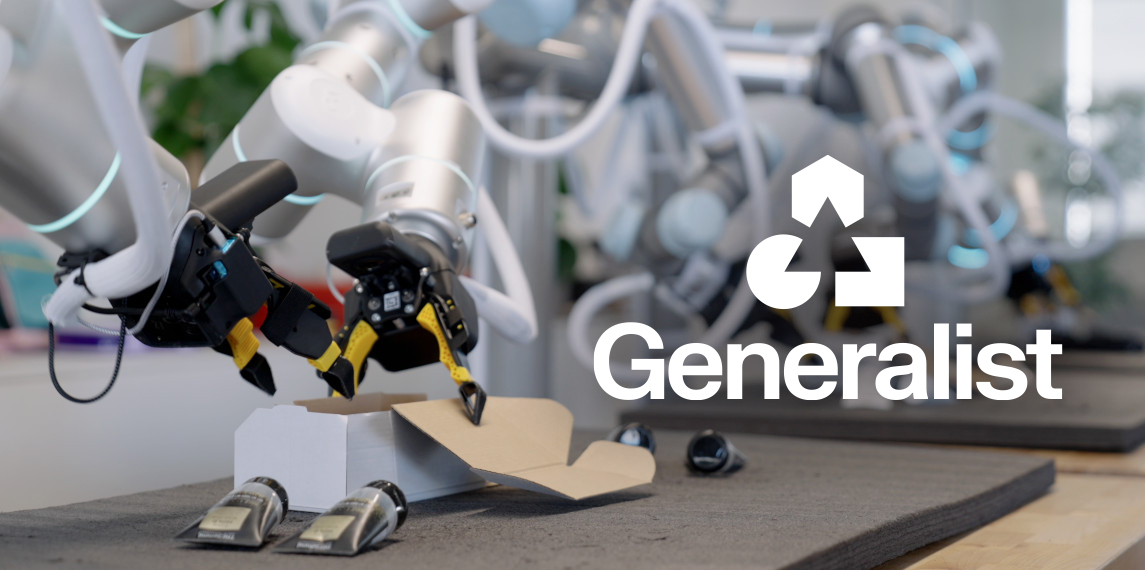
Generalist AI has released GEN-1, a robot foundation model that the company says reaches 99% average success on a set of manipulation tasks after about an hour of robot data per task. The model was announced in a research post on April 2, 2026, and its pretraining dataset contains no robot data at all, according to the company.
The headline numbers come in pairs. On tasks where its previous model, GEN-0, averaged 64% success, GEN-1 averages 99%, while models trained from scratch average 19%, Generalist says. Servicing a robot vacuum rose from 50% with GEN-0 to 99%, folding boxes from 81% to 99%, and packing phones from 62% to 99%. Generalist also says GEN-1 reaches GEN-0's level of performance with ten times less task-specific data.
Speed is the second claim. The company says GEN-1 completes tasks roughly three times faster than the prior state of the art, folding a box in 12.1 seconds against about 34 seconds for GEN-0 and Physical Intelligence's π0, and packing a phone in 15.5 seconds. Early access partners could use the model from the day of the announcement, the post says.
The data strategy is what distinguishes Generalist. Rather than collecting teleoperated robot demonstrations, the company equips people with low-cost wearable devices and records how they handle objects. Its pretraining set now holds more than half a million hours of what it calls high-fidelity physical interaction data. Robot data enters only at the fine-tuning stage, in quantities of roughly one hour per task.
Generalist describes GEN-1 as a large multimodal model that emits actions in real time and presents it as a system rather than only model weights, with the inference stack and harnessing around the model treated as part of the product. The company did not disclose the model's size or architecture in the post, and the results come from its own evaluations rather than a peer-reviewed paper.
The release sits in a sequence. Generalist published GEN-0 on November 4, 2025, followed GEN-1 five days later with a post titled Going Beyond World Models & VLAs on April 7, 2026, and on June 4 announced $400 million in new funding led by Radical Ventures, taking its total raised above $500 million. New investors include 8VC, Union Square Ventures, Hanabi Capital and Norwest, joining existing backers NVIDIA, Boldstart Ventures, Spark Capital, Bezos Expeditions and NFDG, the company said. It did not disclose a valuation.
The competitive field is crowded and well funded. Physical Intelligence, whose π0 model Generalist used as a speed reference, raised a Series B in November 2025. Skild AI raised $1.4 billion at a $14 billion valuation in January 2026, and Figure AI raised $1 billion at $39 billion in September 2025, according to their own announcements. Google DeepMind and NVIDIA publish their own robot models. Most of these rely heavily on robot data from teleoperation or simulation, which makes Generalist's human-data approach a distinct bet.
The technical idea is that human hands already perform the manipulations robots need, and that recording them at scale is cheaper than running robot fleets. If the representation learned from people transfers to robot bodies with an hour of robot data, the cost of adding a new task falls sharply. The 99% figures matter because reliability, not capability, is what blocks deployment in factories and warehouses.
The caveats are significant. The numbers are self-reported on tasks Generalist chose, the post acknowledges that not every attempted task reached 99% and that some uses would need still higher success or speed, and there is no independent replication. The tasks shown are tabletop manipulation, so the results say little about mobile or humanoid robots.
- Servicing a robot vacuum
- 99
- 50
- 2
- 49
- Folding boxes
- 99
- 81
- 13
- 18
- Packing phones
- 99
- 62
- 42
- 37
- Average of the three
- 99
- 64
- 19
- 35
Success rates as published by Generalist AI on April 2, 2026. Difference column = GEN-1 minus GEN-0. Averages as stated by the company and consistent with the three task figures. Trial counts not disclosed.
As of Oct 1, 2026
- Generalist AI
- Growth (unnamed)
- 400,000,000
- No data
- 2026-06-04
- Skild AI
- Series C
- 1,400,000,000
- 14,000,000,000
- 2026-01-14
- Figure AI
- Series C
- 1,000,000,000
- 39,000,000,000
- 2025-09-16
- Walden Robotics
- Seed
- 300,000,000
- 1,100,000,000
- 2026-07-15
- Humanoid
- Series A
- 152,000,000
- 1,350,000,000
- 2026-07-21
- Physical Intelligence
- Series B
- No data
- No data
- 2025-11-20
Figures as disclosed by the companies or their investors; null where not disclosed. Generalist did not name the round or disclose a valuation.
As of Oct 1, 2026
ROBOTNESS analysis
GEN-1 is the strongest public case so far that human-worn capture can replace robot teleoperation as the main pretraining source for manipulation models, but the claim rests on company-run tests that the field has not yet checked.
The evidence is the gap between pretraining and fine-tuning. A model that saw no robot data in pretraining and then needed about an hour per task to reach 99% on vacuum servicing, box folding and phone packing would show that the expensive part of robot learning can move off the robot. The tenfold data reduction against GEN-0 points the same way.
The strongest counter-argument is selection. Generalist chose the tasks, ran the evaluations and published the results without a protocol of the kind TRI used in Science Robotics, with blind trials and statistical tests. A 99% success rate over an unknown number of trials on a few tasks is not the same as 99% reliability in a customer's plant.
Bull case. Wearable capture scales faster and cheaper than teleoperation, Generalist's 500,000-hour lead compounds, and the June funding lets it convert early access partners into paying deployments. Rivals then have to buy or build similar human data pipelines.
Bear case. Transfer from human hands breaks down for tasks that depend on robot-specific dynamics, independent tests show lower reliability, and better-funded rivals with robot fleets close the gap. The undisclosed valuation and lack of named customers leave the commercial story unproven.
Signals to watch:
- Whether Generalist names paying customers or deployment sites for GEN-1 before the end of 2026.
- Any third-party or peer-reviewed evaluation of GEN-series models, including at CoRL 2026.
- How Physical Intelligence, Skild AI and NVIDIA respond on human-data pretraining in their next model releases, and whether Generalist's subsequent GEN-1.5, announced on August 19, 2026, is independently tested.
- About 3x faster than prior state of the art; box folding 12.1 s vs about 34 s
- April 2, 2026
- Generalist AI (offices in Boston and San Francisco)
- Early access partners from April 2, 2026
- 99% vs 64% for GEN-0 and 19% from scratch (company figures)
- GEN-0-level performance with 10x less task-specific data
- More than 500,000 hours of human physical interaction data from wearable devices; no robot data
- About 1 hour
- $400 million led by Radical Ventures, announced June 4, 2026; more than $500 million total
Why it matters
The economics of robot learning have been set by the cost of robot data. Teleoperation needs robots, operators and time, and that has made data the main barrier to teaching robots new tasks. GEN-1 claims that pretraining on human data captured with wearables can take over most of that work, leaving about an hour of robot data per task. If that holds, the cost structure of the whole sector shifts toward cheaper human capture.
The reliability figures are the second reason. Customers reject robots that fail a few times in a hundred. A reported jump from 64% to 99% average success on the same tasks addresses the metric that decides deployment, even if it still needs independent confirmation.
Rival analysis
Physical Intelligence is the most direct rival in general manipulation models, and Generalist used its π0 as a speed reference. Skild AI, valued at $14 billion in January 2026, and Figure AI, valued at $39 billion in September 2025, pursue general robot intelligence with large funding. Google DeepMind and NVIDIA publish robot models that partners can build on.
Generalist's distinct position is its data source. Most rivals emphasise teleoperation, simulation or video. A dedicated wearable capture programme at the 500,000-hour scale is a different supply line, and it is the part of the strategy rivals would find hardest to copy quickly.
Valuation context
Generalist announced $400 million in new funding on June 4, 2026, led by Radical Ventures, with total funding above $500 million, and did not disclose a valuation. Comparable disclosed figures are Skild AI's $1.4 billion round at $14 billion in January 2026, Figure AI's $1 billion at $39 billion in September 2025 and Walden Robotics' $300 million seed at $1.1 billion in July 2026.
The GEN-1 results, published two months before the round, were the main technical evidence available to investors. The presence of NVIDIA among existing backers and the addition of growth investors such as Norwest suggest the round priced the company on model performance and data scale rather than revenue, which has not been disclosed.
Supply-chain implications
Generalist's pretraining depends on low-cost wearable devices and on people performing physical tasks while wearing them. That makes its key inputs labour, capture hardware and data processing rather than robot fleets. The company has not disclosed who manufactures the devices or where data is collected.
On the robot side, fine-tuning still needs robot data, about an hour per task. The model is presented as a system with its own inference stack, which suggests Generalist intends to control the software layer while working with third-party robot hardware.
Signals to watch
Named customers and deployment sites would turn the early access programme into evidence of demand. Third-party benchmarks or peer-reviewed results would test the 99% claims. And the company's August 19, 2026 GEN-1.5 post, which claims one-shot learning, will show whether the trajectory continues.
Rival responses are the third signal. If Physical Intelligence, Skild AI or NVIDIA begin emphasising human wearable data in their own releases, that will confirm Generalist's data thesis.
Analyst view
Thesis: Human-worn capture is a credible path to scaling manipulation pretraining, and GEN-1 gives Generalist a head start, but the reliability claims need outside verification before they can be priced as commercial fact. Confidence: medium.
Supporting the thesis are the specific per-task figures, the internal consistency between the averages and task results, and the investor response two months later. Holding confidence back are the self-selected tasks, the lack of disclosed trial counts, the absence of peer review and the absence of named customers.
Questions you should be asking
How many trials stand behind each 99% figure, and how were failures defined? Which robot hardware was used for fine-tuning and evaluation, and does the one-hour data requirement hold on other arms or hands?
How much does the human capture programme cost per hour, and how does that compare with teleoperation? And which early access partners, if any, have moved to paid deployment?