Google DeepMind's Gemini Robotics-ER 1.6 teaches robots to read gauges, lifting accuracy to 93% with Boston Dynamics' Spot as first showcase
Google DeepMind released Gemini Robotics-ER 1.6 on April 14, 2026, an embodied reasoning model built on Gemini 3.0 Flash and offered as a preview through the Gemini API and Google AI Studio. DeepMind said the model reads industrial instruments correctly 86% of the time, or 93% with an agentic zoom and code execution step, against 23% for ER 1.5. Boston Dynamics is using the capability for Spot facility inspections.
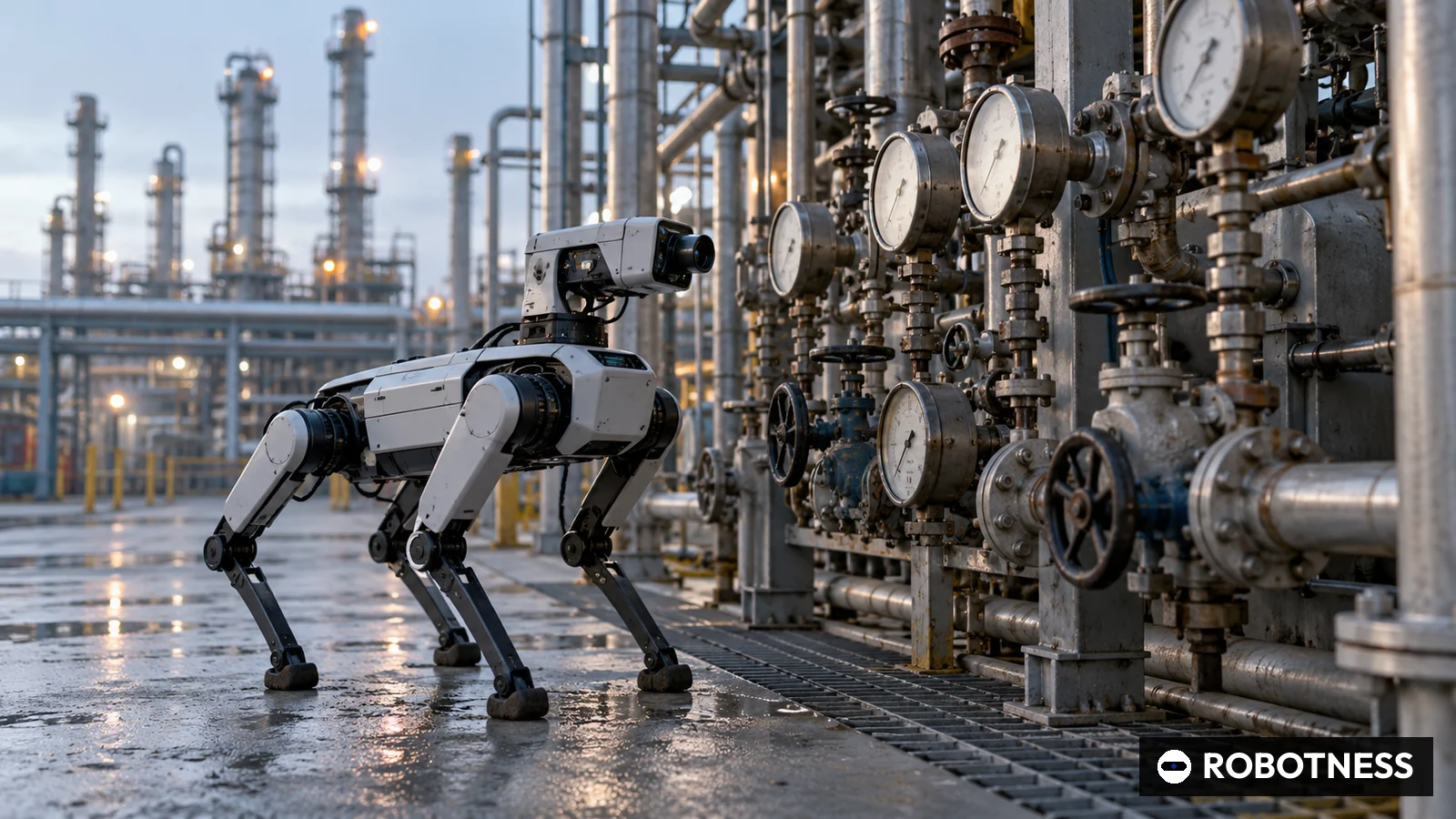
Google DeepMind has given its robot reasoning model a skill that matters on factory and plant floors. On April 14, 2026 the Alphabet unit released Gemini Robotics-ER 1.6, a vision language model specialised in embodied reasoning, and made it available to developers the same day through the Gemini API and Google AI Studio under the model name gemini-robotics-er-1.6-preview. The headline addition is instrument reading, the ability to look at a pressure gauge, sight glass or thermometer and report the value.
DeepMind's own benchmark shows the size of the step. On its instrument reading evaluation, the previous Gemini Robotics-ER 1.5 succeeded 23% of the time and the general purpose Gemini 3.0 Flash 67%. ER 1.6 reached 86%, and 93% when allowed to use what DeepMind calls agentic vision. The company also reported better pointing, counting and success detection than ER 1.5, including from multiple camera views.
- Gemini Robotics-ER 1.5
- 23
- 0
- Gemini 3.0 Flash
- 67
- 44
- Gemini Robotics-ER 1.6
- 86
- 63
- Gemini Robotics-ER 1.6 with agentic vision
- 93
- 70
Success rates from Google DeepMind's April 14, 2026 release post. Gain = model rate minus ER 1.5 rate. Benchmark defined by DeepMind, not independently replicated. Figures disclosed, not estimated.
As of Oct 1, 2026
Agentic vision means the model takes intermediate steps instead of answering in one pass. According to the DeepMind blog post by Laura Graesser and Peng Xu, the model first zooms into the image to resolve small details on a dial, then uses pointing and code execution to estimate proportions and intervals before giving a reading. The instruments named include circular pressure gauges, chemical sight glasses, vertical level indicators, thermometers and digital readouts.
The model card, published on April 20, states that ER 1.6 is built on Gemini 3.0 Flash and accepts text, images, audio and video with a context window of 128,000 tokens, returning up to 64,000 tokens of text. It was trained on Google's Tensor Processing Units using Gemini 3.0 data plus additional embodied reasoning datasets. DeepMind says the model is not approved for safety critical uses such as healthcare or transportation, or settings where a malfunction could cause injury or property damage.
Boston Dynamics, a Hyundai Motor Group company, worked closely with DeepMind on the feature. Its Spot quadruped already walks routes through industrial sites capturing images of equipment, and ER 1.6 gives it a way to interpret what it photographs. Marco da Silva, a vice president at Boston Dynamics, said in DeepMind's post that instrument reading and more reliable task reasoning will let Spot see, understand and react to real world challenges completely autonomously.
The ER line plays a specific role in DeepMind's robotics stack. Gemini Robotics models output motor actions; the ER models do the thinking around them, deciding where objects are, what order to do things in and whether a task succeeded. Developers can call ER 1.6 from their own robot software and pair it with any controller, which makes it the most broadly available part of DeepMind's robotics offering.
Safety evaluation was a large part of the release. DeepMind tested ER 1.6 on version 2 of its ASIMOV benchmark of human centric safety scenarios and said it adheres to physical safety constraints substantially better than ER 1.5 in pointing and bounding box tasks. Against Gemini 3.0 Flash it reported improvements of 6% on text based safety scenarios and 10% on video scenarios.
The competitive field for robot reasoning models is crowded. NVIDIA offers its Cosmos Reason models and GR00T policies to robot makers. Physical Intelligence and Skild AI train end to end models that combine reasoning and action. What DeepMind brings is distribution through a commercial API that any developer can already use, and a model family tied to Gemini, Google's frontier model line.
For industrial operators the significance lies in a dull but costly job. Gauge rounds in refineries, chemical plants, power stations and data centres still rely heavily on technicians walking routes. A robot that can read analogue dials without retrofitting sensors removes one of the main barriers to automating inspections in older plants.
The open questions are reliability and accountability. A 93% success rate is high for a benchmark but low for a safety reading in a hazardous plant, and DeepMind's own model card warns against safety critical deployment. DeepMind has not published pricing for the preview, or said when it will be generally available.
ROBOTNESS analysis
Instrument reading turns Gemini Robotics-ER from a research demo into a sellable industrial inspection component, and Spot gives Google a credible first customer channel.
The evidence is the jump from 23% to 86% and 93% on a task with direct commercial value, plus availability through the same API developers already pay for. Boston Dynamics' quoted endorsement ties the release to an existing product with an installed base in industrial inspection, so the feature has a route to paying users without Google building robots.
The strongest counter argument is that inspection buyers need audited accuracy, not benchmark scores. Specialised computer vision models trained on a plant's own gauges, or cheap retrofitted digital sensors, may beat a general model on reliability and cost, and the model card itself rules out safety critical use.
Bull case. ER 1.6 becomes the default reasoning layer for inspection robots from several makers, Google turns the preview into a priced API product, and gauge reading leads to broader maintenance tasks such as leak detection and valve checks.
Bear case. Operators treat robot readings as advisory only, liability concerns keep deployments in pilots, and specialist inspection software vendors win on certified accuracy.
Signals to watch.
- General availability and pricing for gemini-robotics-er-1.6-preview, which DeepMind had not announced as of the April 14, 2026 release.
- Boston Dynamics disclosures on Spot inspection customers using the feature during 2026.
- DeepMind's next Gemini Robotics model release, which would show whether ER capabilities are folded into action models.
- Skild AI
- 2023
- Series C
- 1400
- 14
- 2026-01-14
- Figure AI
- No data
- Series C
- 1000
- 39
- 2025-09-16
- Physical Intelligence
- No data
- Series B
- No data
- No data
- 2025-11-20
- 1X Technologies
- 2014
- Series B
- 100
- No data
- 2024-01-13
Company or lead investor announcements. Google DeepMind is an Alphabet unit and does not raise outside capital. Null means not disclosed. Figures disclosed, not estimated.
As of Oct 1, 2026
- Gemini Robotics-ER 1.6 (gemini-robotics-er-1.6-preview)
- Gemini API and Google AI Studio, preview
- April 14, 2026
- Gemini 3.0 Flash
- 128,000 tokens in, 64,000 tokens out
- Boston Dynamics (Spot inspections)
- ASIMOV v2
- 23%
- 86%; 93% with agentic vision
Why it matters
Most robot foundation model news concerns manipulation in labs or homes. ER 1.6 targets a narrow, paid industrial task, reading instruments during inspection rounds, and pairs it with a partner that already sells inspection robots. That makes it one of the clearest paths so far from a general robot model to recurring industrial revenue.
The release also shows Google's preferred commercial model in robotics. Rather than building robots, it sells reasoning through the Gemini API and lets hardware companies such as Boston Dynamics integrate it, the same distribution logic Google uses for its general Gemini models.
Rival analysis
NVIDIA supplies Cosmos Reason models and GR00T policies with its Jetson hardware and simulation tools, aiming to own the full developer stack. Physical Intelligence and Skild AI train end to end models and work with chosen hardware partners.
In inspection specifically, ER 1.6 competes less with foundation model labs than with established industrial computer vision vendors and with robot makers' own software. ANYbotics, for example, sells its ANYmal quadruped for industrial inspection with its own analytics.
Valuation context
Google DeepMind does not raise outside capital, so there is no direct valuation read. The relevant comparison is with independent model developers whose latest disclosed rounds include $1.4 billion at a $14 billion valuation for Skild AI and $1 billion at $39 billion for Figure AI.
Those valuations assume that robot intelligence becomes a large standalone market. Google's ability to bundle robot reasoning into an API that developers already use puts pressure on independents to show that their models outperform on tasks customers pay for.
Supply-chain implications
ER 1.6 was trained on Google's own Tensor Processing Units, so its development does not depend on NVIDIA GPUs. At deployment the model runs in Google's cloud through the API, which means robots need network connectivity to use it; the release did not describe an on device version.
For inspection robots in plants with poor connectivity or strict data rules, that cloud dependency is a practical constraint and may push operators toward edge models from other suppliers.
Signals to watch
Pricing and general availability of the preview model will show how Google intends to monetise robot reasoning. Boston Dynamics' customer announcements for Spot inspections will show whether the feature moves beyond pilots.
Also watch whether other robot makers announce ER 1.6 integrations, and whether DeepMind publishes independent or third party validation of the instrument reading benchmark.
Analyst view
Thesis: ER 1.6 is Google's most commercially focused robotics release so far, and inspection is a realistic first market. Confidence: medium. The benchmark gains are large and the partner is credible, but all performance figures are self reported and the model card itself excludes safety critical uses, which covers part of the inspection market.
Confidence would rise with named industrial customers and published error rates in production. It would fall if the preview stays unpriced and partners do not report deployments.
Questions you should be asking
What are the failure modes in the remaining 7% of instrument readings, and does the model signal low confidence when it is unsure? How will Google price robot reasoning calls compared with standard Gemini API usage?
Will Boston Dynamics run ER 1.6 in the cloud for all customers, or negotiate a private deployment for regulated sites? Will DeepMind offer an on device ER model for robots without reliable connectivity?