MIT's NeuralActuator lets low-cost robot arms feel force without sensors, winning RSS 2026's systems award
NeuralActuator, a model from MIT's Computational Design and Fabrication Group with Amazon, won the Outstanding Systems Paper Award at RSS 2026. It learns how cheap servo motors really behave from motor current, voltage and temperature, and estimates external force with a reported mean error of 0.12 N, against 0.66 N to 1.41 N for classical baselines.
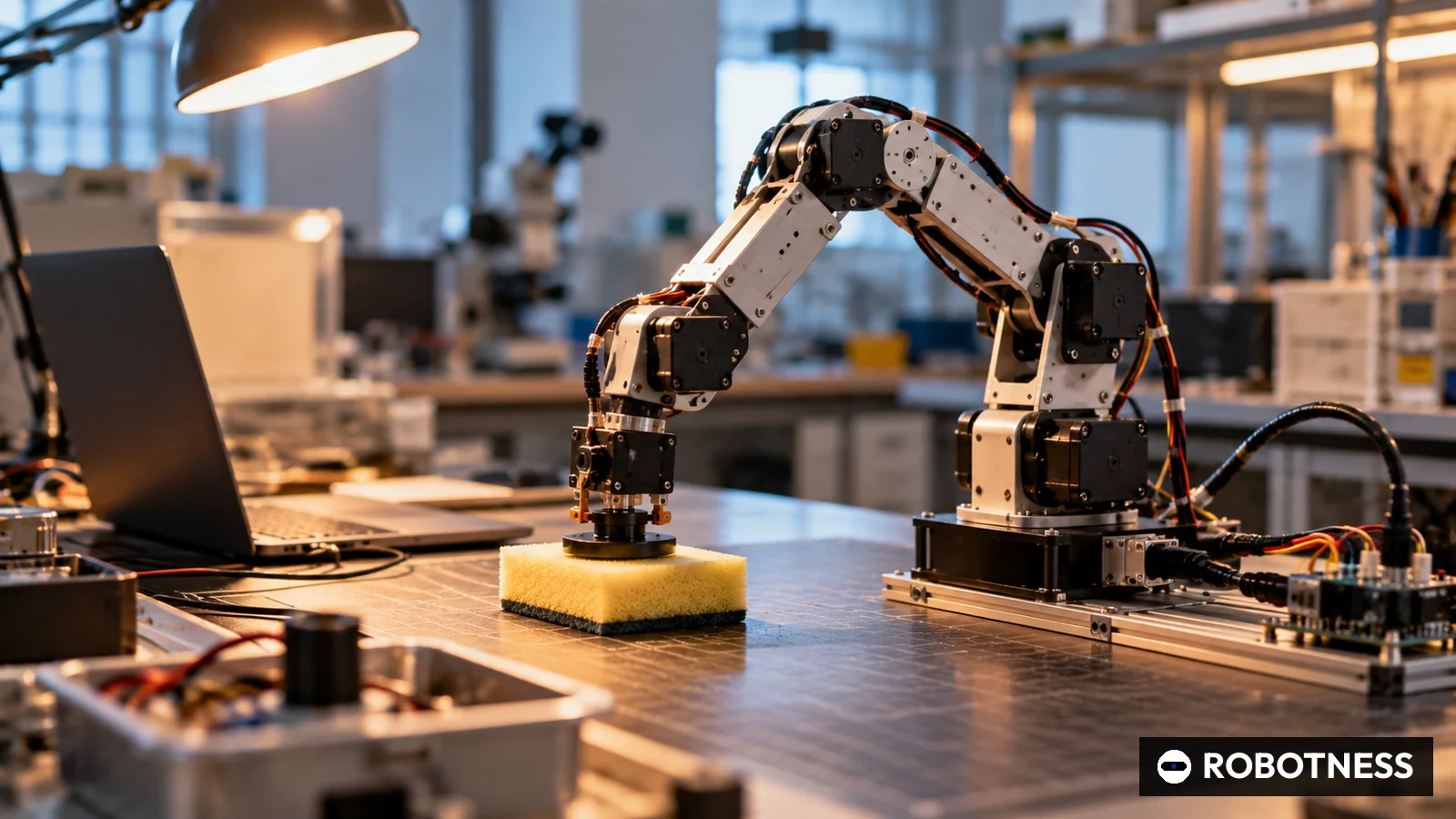
A neural model that lets inexpensive robot arms sense how hard they are pushing, without torque or tactile sensors, won the Outstanding Systems Paper Award in Memory of Seth Teller at Robotics: Science and Systems (RSS) 2026, held in Sydney from July 13 to 17. The paper, NeuralActuator, comes from researchers at MIT's Computational Design and Fabrication Group led by Wojciech Matusik, with Yuri Ivanov of Amazon, and was posted to arXiv in July 2026 (2607.11734).
The problem it solves
Most low-cost robots estimate joint torque with a simple rule: torque equals a constant times motor current. The authors say this linear model breaks down on affordable hardware because of friction, hysteresis, backlash in the gears and heat. That error is one reason policies trained in simulation behave differently on real cheap robots, and why such robots cannot tell how much force they are applying.
What NeuralActuator does
The system learns three things at once from signals the motors already report. It predicts the effective torque each joint produces, so a simulator can reproduce the real robot's motion. It estimates external force at the end of the arm, so the robot can feel contact. And it scores each motor's condition, separating normal operation from a joint that is mechanically restricted. A gate decides whether the arm is in contact before force estimates are used.
The model is a Transformer that reads a short history of nine time steps, covering commanded positions, joint states, motor currents, voltages and temperatures. The torque part is trained without any torque labels: the team feeds predicted torques into the MuJoCo physics engine, compares the simulated motion with the recorded motion and back-propagates the difference through the differentiable simulator. Force and motor-condition outputs are trained on labelled data.
The data and hardware
The authors collected a Neural Actuation Dataset of 94.52 minutes on a ROBOTIS OpenManipulator-X, a five-degree-of-freedom arm driven by DYNAMIXEL XM430-W350 servos, using a leader-follower teleoperation rig. It contains 34.15 minutes of free motion, 46.24 minutes of force-labelled interaction with payloads of 100 g to 500 g and 14.13 minutes with a deliberately restricted joint. The method was also tested on a LeRobot SO-101 arm and, offline, on a Franka Emika Panda.
The results
On the project page, the team reports a force estimation error of 0.12 N, compared with 1.41 N for a linear current-to-torque model, 1.23 N for a model with friction terms and 0.66 N for a generalized momentum observer. When the force estimate was fed to imitation-learning policies, pick-and-place success rose from 80% to 92.5% and a go-up-and-stay task from 85% to 95%. Motor condition detection reached 91.0% accuracy, 84.5% precision and 96.2% recall. Predicted joint angles stayed within 1.78 to 3.31 degrees over 500-step rollouts, and inference ran in under a millisecond on a GPU at a 60 Hz control rate. Code, data and hardware configurations have been released.
Competitive context
Industrial collaborative arms from makers such as Franka build in joint torque sensors, which add cost. Tactile skins and wrist force sensors are another route. NeuralActuator competes with these on price: it uses only signals that standard smart servos already provide. Among RSS 2026 winners, it sits alongside FlashSAC, which took the main Outstanding Paper Award for faster reinforcement learning, both aimed at making learning-based control practical on affordable hardware.
What it means for companies
For makers of low-cost arms, hobby and education robots and humanoid hands built from smart servos, the work suggests force sensing could become a software feature. Motor condition scoring points toward predictive maintenance without extra sensors. For data-collection fleets used to train robot foundation models, force estimates add a modality that cheap teleoperation rigs currently lack.
Limits
The authors note that the torque output is a lumped quantity that may absorb unmodelled contacts and payloads, rather than a pure physical motor torque. Force training relied on quasi-static payloads, motor condition was evaluated on one joint of one platform, and the study focused on low-cost servos rather than the permanent-magnet synchronous motors or hydraulics used in larger robots.
ROBOTNESS analysis
NeuralActuator shows that force sensing on cheap robots can be learned from motor telemetry, which could turn a hardware cost into a software feature for the low end of the market.
The evidence is a force error of 0.12 N, about one fifth of the best classical baseline in the paper, gains of 10 to 12.5 percentage points in imitation-learning success, and release of code and data that lets others check the claims.
The strongest counter-argument is scope. One actuator family, quasi-static loads and a single primary platform are a narrow base, and industrial buyers need certified force limits that a learned estimator cannot yet guarantee.
Bull case: servo makers ship NeuralActuator-style models in firmware, giving every low-cost arm a force sense, and data-collection fleets record force at scale for robot foundation models.
Bear case: the model must be retrained for every motor batch and wear state, accuracy drops in dynamic tasks, and companies keep paying for physical sensors where safety is involved.
Signals to watch:
- Results on other actuator types, such as quasi-direct-drive humanoid joints, in follow-up work during 2026 and 2027.
- Adoption in the LeRobot ecosystem, where the SO-101 arm used in the study is common.
- Any servo maker announcing learned force estimation in firmware.
- NeuralActuator
- 0.12
- 1
- GMO (generalized momentum observer)
- 0.66
- 5.5
- ID-Friction (inverse dynamics with friction)
- 1.23
- 10.25
- ID-Linear (linear current to torque)
- 1.41
- 11.75
Mean absolute error across payload tasks as reported on the authors' project page. Ratio = baseline MAE / NeuralActuator MAE.
As of Oct 1, 2026
- RSS 2026 Outstanding Systems Paper (Seth Teller Award)
- MIT CDFG (Wojciech Matusik) with Amazon
- 94.52 min on ROBOTIS OpenManipulator-X
- Code, data and hardware configs
- arXiv 2607.11734 (July 2026)
- 0.12 N MAE
- 91.0% accuracy, 96.2% recall
- GMO, 0.66 N
- Pick-and-place 80% to 92.5%
Why it matters
Force is the sense cheap robots lack. A joint torque sensor or wrist force sensor can cost more than an entire low-cost arm, so most hobby, education and data-collection robots run blind to contact. NeuralActuator shows that the information is already present in motor current, voltage and temperature, once a model learns the non-linear behaviour of the actuator.
The second contribution is method: training the torque model through a differentiable simulator from pose data alone removes the need for torque labels, which are exactly what cheap robots cannot measure. That approach can be applied to any robot with a reasonable simulator model.
Rival analysis
The incumbent alternatives are physical: joint torque sensors in collaborative arms such as the Franka Panda, wrist force-torque sensors and tactile skins. On the software side, classical methods include linear current models, friction models and generalized momentum observers, all of which NeuralActuator outperformed in the paper's force benchmark.
Research groups working on learned actuator networks for legged robots tackled a related problem for locomotion. NeuralActuator's difference is the combination of force estimation, condition monitoring and simulator-ready torque in one model trained without torque labels.
Valuation context
The research has no direct valuation. Its economic effect is on bill of materials: if software can replace a force sensor for some tasks, the cost of a force-aware arm falls toward the cost of the servos alone.
For investors in robot data-collection and low-cost manipulation companies, the work suggests force data can be added to cheap fleets without new hardware, which strengthens the case for scale over sensor sophistication.
Supply-chain implications
The study centres on smart servos, specifically ROBOTIS DYNAMIXEL XM430-W350 units in the OpenManipulator-X, which report current, voltage and temperature. Servos with richer telemetry become more valuable under this approach, giving servo makers a reason to expose more internal data.
Compute needs are modest: the authors report sub-millisecond GPU inference at 60 Hz. Moving the model onto embedded processors or into servo firmware would be the next supply-chain step.
Signals to watch
Watch for follow-up results on brushless and quasi-direct-drive actuators used in humanoids, and on dynamic rather than quasi-static loads. Watch the LeRobot community for adoption, since the SO-101 arm is a common low-cost platform for collecting robot learning data.
Also watch whether servo makers or arm vendors announce learned force estimation as a product feature, and whether safety standards bodies address learned force estimators.
Analyst view
Thesis: learned, sensorless force estimation will become a standard feature of low-cost manipulators within a few years, but will not replace certified sensors in safety-critical industrial work. Confidence: medium.
Confidence is medium because results are strong but narrow, with one main platform and quasi-static loads. Open release of code and data, a fivefold improvement over the best classical baseline and an RSS systems award support the direction.
Questions you should be asking
How much data does a new motor model or a worn actuator need before accuracy recovers? How does the estimator perform under fast, dynamic contact rather than static payloads?
Can the model run on a servo's own microcontroller? And how would a learned force estimate be validated against safety requirements for collaborative robots?